
To promote civic information, we need to measure it
The new Civic Information Needs Census exists thanks to the understanding that measuring information needs is critical for those creating civic information.

Editor’s note, Nov. 3, 2025: This piece was initially published on Dec. 19, 2024, and the below copy has been updated and fact-checked for the 2025 Civic Media Magazine, a project of The Objective and News Futures. You can read the updated letter to the editor and find more pieces from the series here.
Healthy media ecosystems help parents navigate the complexity of finding resources for their child with dyslexia, and they inform school administrators about systemic approaches to support all students’ reading needs. They help a resident report a broken traffic light, and they hold the local transportation agency accountable when reports are not addressed quickly.
In short, healthy media ecosystems provide people with information to meet their needs. But how do we know how much of that vision is being achieved?
At the Civic News Company (the parent organization behind local education, voting administration and public health coverage in 12 states via Chalkbeat, Votebeat and Healthbeat), we have been piloting one approach to answering this question: a Civic Information Needs Census.
As more attention is put on understanding local information needs — including guidance from Press Forward and the recent Civic Information Index — I am hopeful that some investment in newsroom infrastructure will be directed toward establishing representative survey-based measures that are consistent (allowing for comparison across populations), persistent (allowing for comparison over time) and actionable (directly informing action to meet needs).
Other fields have meaningful investments in these types of measures, and I’ve seen the impact firsthand. From 2020 to 2022, I worked on a large-scale daily survey of COVID-19 related health behaviors and needs, which helped inform policymakers’ and health organization’s decisions worldwide. The Centers for Disease Control and Prevention has run phone surveys for 40 years, and many states have their own similar surveys. Measures related to tobacco usage inform efforts to offer cessation resources; measures related to insurance and costs inform efforts to improve access and affordability.
But in the civic information field, we currently lack a consistent, persistent and actionable survey measure. Some excellent research exists. However, as Democracy Fund and Impact Architects note, current surveys are often “disparate instruments that do not speak directly to each other, are not repeated at regular intervals (and thus cannot track change over time) and tend to be done at the national level without sufficient responses at the local level to measure specifics within ecosystems.”
A shared measure will help people who are invested in promoting civic information (including journalists, philanthropists and government) achieve common goals by helping to answer key questions:
- Which topics and communities have the most needs? Where are needs being met well?
- What can we learn from what’s working and not?
- Are our efforts to meet needs making a difference over time?
This past fall, the Civic News Company worked on a national survey to get a baseline of U.S. information needs, in partnership with Embold Research, Impact Architects and Commoner Co. We also conducted a local survey for Chicago and New York City.
We hope to better understand importance and satisfaction with the local “critical information need” topics defined in a 2012 report to the Federal Communications Commission (including transportation, economic opportunities and health and well-being), and to see how insights can inform action at Civic News Company and other places that promote civic information.
Some initial learnings include:
- Majorities say information on the topics defined in the FCC report is important to their lives, but many are somewhat or very unsatisfied with the information they are able to get.
- People who say they work directly on improving local community institutions, services or policies report larger information needs across every topic and larger gaps between importance and satisfaction. These people – who can include policymakers, administrators and advocates – can have a disproportionate impact on the broader population.
- While meeting critical information needs is a national problem, solutions need to be local. In the Chicago survey, 44% of respondents reported being somewhat or very unsatisfied with information about how to resolve local infrastructure issues like potholes, sidewalk damage or broken traffic lights. Understanding why is a fundamentally local problem, as are the solutions (e.g. Is it a lack of awareness of 311? A lack of follow-through on reports from the local transportation agency? Something else?).
- Since solutions need to be local, engaging with local organizations invested in civic information — including those outside of local news — is critical to ensure survey actionability and impact. We convened a group in Chicago that met before and after the survey was fielded. Participants included news organizations like the Chicago Sun-Times, WBEZ, Block Club Chicago and City Bureau, and others invested in civic information including the Chicago Public Library, Illinois Humanities, Better Government Association, the city’s Department of Technology and Innovation and Northwestern University. Their input helped shape questions, including the addition of situational questions like the one about local infrastructure issues.
Investment in representative surveys like these could pay for itself if local media funding becomes even fractionally more effective through better-informed actions. Better data would allow organizations to prioritize communities with the greatest needs and to more quickly scale and replicate efforts that are working.
Media Impact Funders’ Foundation Maps estimates an average of roughly $500 million per year in foundation funding across the United States to journalism grantees from 2018 to 2022; costs vary based on methods used to ensure representativeness, but based on our experience, meaningful surveys for many communities could be done for $50,000 to $100,000 each, suggesting hundreds could be conducted for around 2% to 3% of foundation funding.
Measurement of information needs is itself a critical information need of those who promote civic information. We want to collaborate and build on existing measurement efforts, since shared learnings and infrastructure (such as via the Local News Impact Consortium) can increase collective impact.Consistent with this approach, we are publicly sharing our survey data and methods. We hope they are helpful for others and look forward to continuing to learn as we work together on improving people’s access to the information they need to thrive.
Kang-Xing (“KX”) Jin is a board member of Civic News Company and a media funder. He had various roles at Meta from 2006-2023, and in his last role as VP and Head of Health, he helped support the COVID Trends and Impact Survey (CTIS), a large-scale survey run with Carnegie Mellon University and University of Maryland to understand health behaviors and needs. CTIS received the 2022 AAPOR Policy Impact and Warren J. Mitofsky Innovator’s Awards.
This story was edited by James Salanga. Copy edits by Gabe Schneider and Bettina Chang. Fact-checking by Bashirah Mack.
We depend on your donation. Yes, you...
With your small-dollar donation, we pay our writers, our fact checkers, our insurance broker, our web host, and a ton of other services we need to keep the lights on.
But we need your help. We can’t pay our writers what we believe their stories should be worth and we can’t afford to pay ourselves a full-time salary. Not because we don’t want to, but because we still need a lot more support to turn The Objective into a sustainable newsroom.
We don’t want to rely on advertising to make our stories happen — we want our work to be driven by readers like you validating the stories we publish are worth the effort we spend on them.
Consider supporting our work with a tax-deductable donation.

James Salanga,
Editorial Director
Related Articles

How disaster reporting hit home for two Appalachian journalists after Helene
Disaster journalism is vital, but can be traumatizing for both journalists and sources. We can make it better by treating disaster survivors — and ourselves — with more humanity.
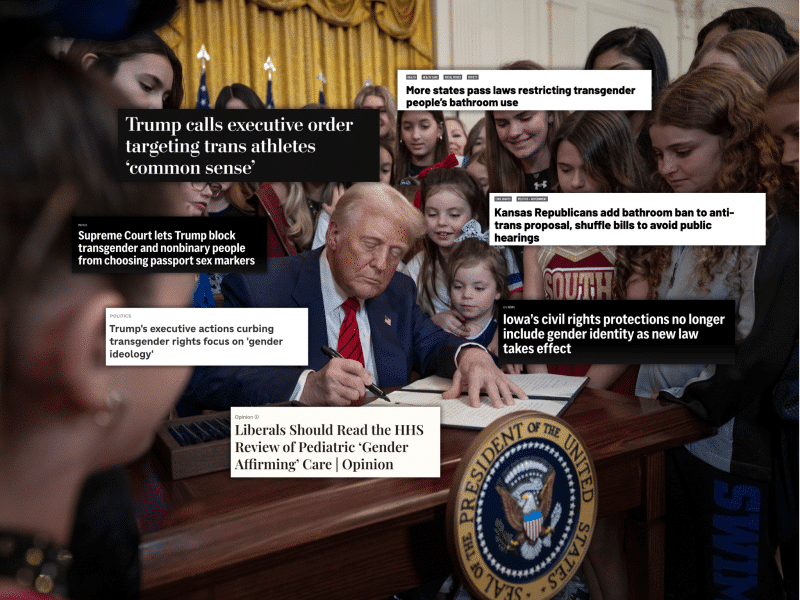
‘Almost media silence’: National, local news ignores trans Americans amid 2025’s anti-trans attacks
The failures of newsrooms to substantively cover anti-trans legislation in 2023 and 2024 have compounded over the first year of Trump’s second term in office.

The Objective’s favorite media reporting and criticism of 2025
A non-comprehensive list of The Objective’s co-directors and readers’ picks for media coverage and commentary this year.