
Teen Vogue’s loss is an irreplaceable void in teen media
Between fandoms and youth activists, people don’t take teenage girls seriously — but Teen Vogue did.
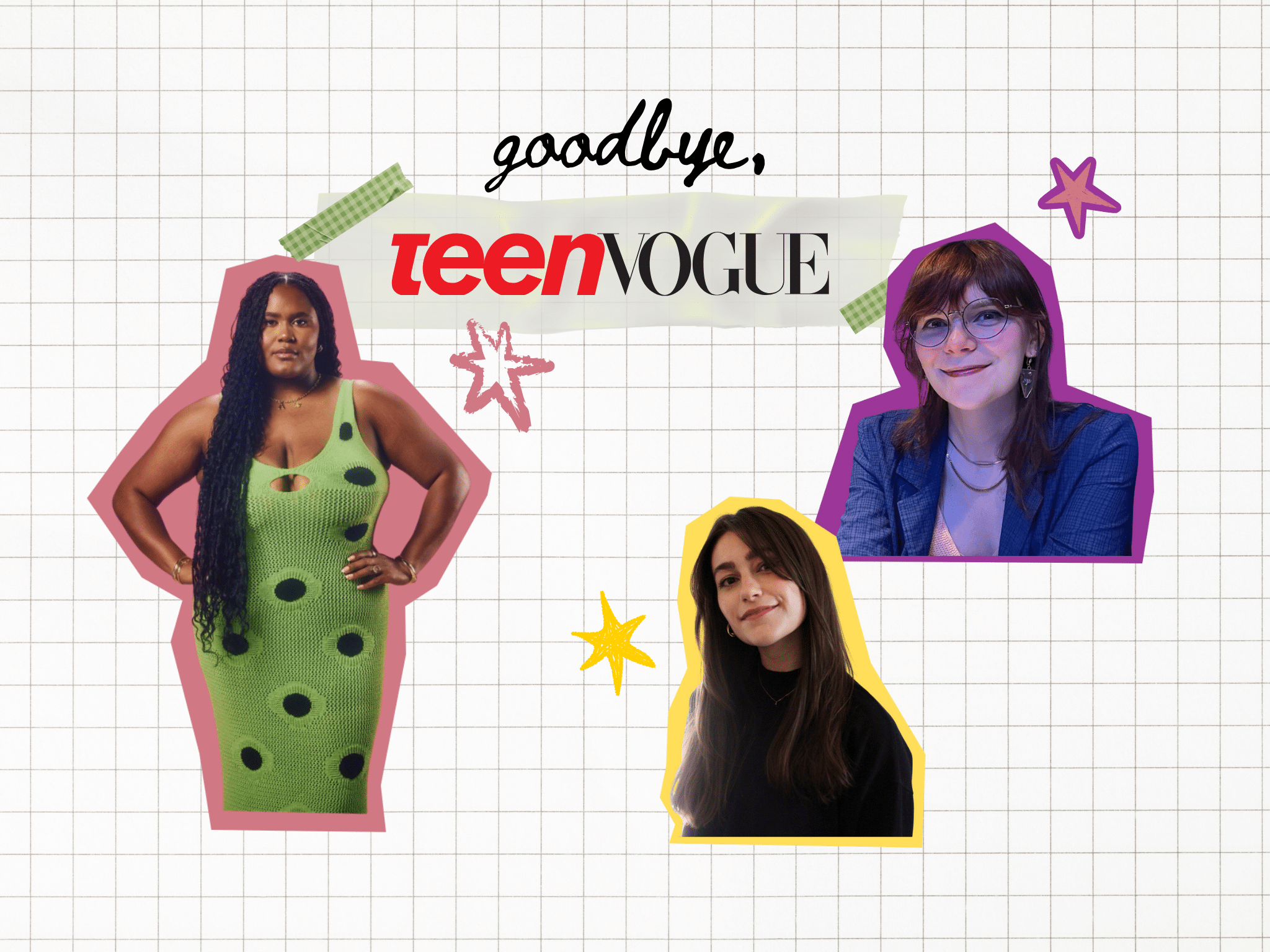
In 2020, I pitched an interview with young Black leftists on TikTok to Teen Vogue’s then-politics director Allegra Kirkland. To my utter shock, the pitch was accepted and turned into my first freelance article. At the time, the byline wasn’t the only thing that moved me. It was that Teen Vogue paid for a young, unknown writer to talk about young, unknown content creators, because that’s just what the magazine was about.
Gen Z writers have the short end of the stick with opportunities in journalism. While our millennial predecessors had Vice, Rookie Mag, and Buzzfeed for their wacky stories and long-winded explainers, we had Teen Vogue. As many eulogized Teen Vogue on X (formerly Twitter) after news of the magazine’s merger with Vogue.com, the publication carved a space for us to feel recognized and validated, and its loss under rising conservatism creates an irreplaceable void in teen media.
Thanks to Work In Progress — Rainesford Stauffer’s column for Teen Vogue — I had an outlet to both write and learn. Stauffer shared tips for identifying workplace retaliation and negotiating your first salary, crafting a brilliant, grown-up version of Ned’s Declassified School Survival Guide for students and entry-level workers. She described the column as a learning experience and “loved getting to center questions young people had about work.”
Stauffer called the Teen Vogue merger a “profound loss for journalism and for readers.” Her description of Teen Vogue’s team as “rigorous, fearless, and caring” was proven true in their final moments spent editing her story about the impact of the federal pause on food aid.
“My editor, Lex McMenamin, had been texting me earlier about the story, ensuring we’d been as thorough as possible in the framing and sourcing,” she said. “Even as devastating layoffs and changes to the publication as we know it happened — and as news around delays to SNAP continued to break — the rest of the TV team was still working to finish fact-checking and get the story out. To me, that was yet another example of the care and commitment that Teen Vogue’s team always showed with stories and sources.”
Between fandoms and youth activists, people don’t take teenage girls seriously. But Teen Vogue was different, Aiyana Ishmael, Teen Vogue’s former style editor, said: The outlet acknowledged teen girls as “thoughtful and smart because it validated everything they cared about.”
“From sustainability, social justice, politics, fashion, and everything else, Teen Vogue was a place for young women to feel seen and heard,” she said. “It also gave them the chance to speak for themselves, which doesn’t happen often for their specific age group.”
Teen Vogue was also a beacon of hope for stories with an intersectional feminist lens, carrying on the legacy of fallen media angels like Bitch Media, Gal-Dem, and the Washington Post’s former column The Lily. If you didn’t have an opportunity to write for one of these outlets, you might’ve been redirected to pitch Teen Vogue. Tiger Beat ended in 2019, J-14’s website is nowhere to be found, and the excessive amount of online influencers regurgitating the work of journalists won’t share the same impact as original reporting.
As Taylor Crumpton words it in Missing Perspectives, “The closure of Teen Vogue’s News and Politics vertical is the death of a childhood dream.”
Within the last month, the grim reaper has knocked on the doors of VIBE, People, the race and culture verticals at CBS News and NBC News, and as of Monday morning, Teen Vogue. An article from Vogue’s business vertical announced a merger with its sister publication, stating the endeavor as “a transition that’s part of a broader push to expand the Vogue ecosystem.” Their statement mentioned that Teen Vogue would “focus its content on career development, cultural leadership and other issues that matter most to young people.”
Thanks to an official statement by Condé United and the NewsGuild of New York, it was clear that this language was meticulously phrased to bury the lede: corporate greed and a rising trend in conservative politics won.
Related: Vogue guts Teen Vogue politics team
Describing this as “a move that is clearly designed to blunt the award-winning magazine’s insightful journalism at a time when it is needed the most,” Condé United, which represented Teen Vogue staffers, correctly pointed out that this announcement arrived just before Election Day and moments after the Trump administration suspended SNAP benefits, two things consistently covered at Teen Vogue.
When Teen Vogue saw Elaine Welteroth — Condé Nast’s second-ever Black editor-in-chief in its 107-year-history — take the helm in 2016, the magazine offered more than insight on celebrities and style. Its in-depth reporting on youth activism and culture was unmatched, and under more recent leadership — former politics editor Lex McMenamin and former politics director Allegra Kirkland — the magazine’s politics section surveyed the “red wave” affecting young, marginalized Floridians, interviewed Palestinian journalist Plestia Alaqad, a disability column by Alice Wong, and published a step-by-step guide for starting an ICE Watch neighborhood program.
The Roosevelt Institute, which awarded the 2025 Freedom of Speech Medal to Teen Vogue, shared in an online statement that the publication has led with “bravery and honesty” as “one of the only media outlets centering the perspectives of young people.”
“In a moment where our country is experiencing generational shifts in thinking, we are all worse off without their reporting,” they wrote.
In addition to condemning the consolidation, the union pledged a responsibility to demanding answers from Condé Nast’s leadership, which resulted in four illegal terminations of more employees from Bon Appetit, WIRED, The New Yorker, and Condé Nast Entertainment on Wednesday evening.
“Through these illegal terminations, Condé Nast management is attempting to intimidate and silence our members’ advocacy for the courageous cultural and political journalism of Teen Vogue, as well as diverting attention away from the obvious lack of corporate leadership at the company,” Susan Decarava, president of The NewsGuild of New York wrote.
Alma Avalle, Bon Appétit’s former editorial operations associate and web producer, was one of the Fired Four and says this occurrence wasn’t Conde United’s first attempt to receive answers about job security from upper management. In a video shared by TheWrap, the so-called “extreme” confrontation with Condé Nast’s chief people officer Stan Duncan just shows journalists doing their jobs and asking hard-hitting questions.
“People had serious concerns about our job security — if the company will announce two rounds of layoffs in one week, what stops them from doing another the week after?” Avalle said. “Will doing hard-hitting journalism be a threat to our job security?”
She said the union has tried an array of methods to learn those answers, from emailing Duncan to inviting him to meetings and town halls, yet the Condé Nast leader has continued to dodge them. The Objective reached out to Condé Nast for comment but has not received a response.
“The only way we have successfully gotten answers out of him in the past is to show up on the executive floor, just like we did last Wednesday,” Avalle said. “We have done that with even larger groups without any discipline being given out.”
The layoffs, she added, followed a conversation from the diversity committee in which the company said it was “actively trying to avoid the attention of the Trump administration.”
“The difference now is that the company seems emboldened by the Trump administration to violate the contract and labor law because they think there won’t be consequences,” Avalle said.
The administration’s attacks on diversity, equity, and inclusion have only narrowed the job prospects for young journalists of color who are disproportionately affected by layoffs, and who don’t receive the same volume of support major figures like Jimmy Kimmel have received after losing their jobs. I would know, as I’ve endured two layoffs from full-time media roles in less than two years. Ishmael and Kaitlyn McNab, two of Teen Vogue’s last Black editors, were affected by this decision, and it’s a chilling sign of the retraction of 2020 promises as they join the 300,000 other Black women facing unemployment. Ishmael founded Ctrl+C, a column dedicated to recreating celebrities’ outfits on a plus-size body. McNab, who supervised the culture section, was vital to the outlet’s inexplicably cool pop culture yearbook, MOMENT.
Myself and many others have inquired when people will begin to care about the loss of Black women journalists, especially as I’ve pointed out the connection between layoffs and an uptick of mandated artificial intelligence usage in the workplace.
Condé Nast, who signed a partnership with OpenAI in 2024, joined the ranks of other newsrooms like Hearst and the Washington Post to integrate generative AI services like ChatGPT to the opposition of their employees. Between America’s literacy crisis and an increased amount of frequent AI usage, if your loved ones can’t grasp the grief attached to our evolving industry, who can you turn to?
Fortunately, socialist feminist magazine Lux, women-led Dame Magazine, and worker-owned digital media company The Flytrap are pioneering an effort to maintain discerning editorial content during this oppressive presidential administration.
Still, Teen Vogue’s unparalleled pipeline for young writers, especially young women, supported radical activism and critical thinking. As many of us flock to self-publishing on newsletter platforms like Substack, pursue fiction and nonfiction book ventures, build our own media companies, and console each other, the void of Teen Vogue will be felt indefinitely.
Noella Williams is a Brooklyn-based writer covering Black culture, queer identity, fandoms, music, veganism, and more.
This piece was edited by James Salanga. Copy edits by Jen Ramos Eisen.
We depend on your donation. Yes, you...
With your small-dollar donation, we pay our writers, our fact checkers, our insurance broker, our web host, and a ton of other services we need to keep the lights on.
But we need your help. We can’t pay our writers what we believe their stories should be worth and we can’t afford to pay ourselves a full-time salary. Not because we don’t want to, but because we still need a lot more support to turn The Objective into a sustainable newsroom.
We don’t want to rely on advertising to make our stories happen — we want our work to be driven by readers like you validating the stories we publish are worth the effort we spend on them.
Consider supporting our work with a tax-deductable donation.

James Salanga,
Editorial Director
Related Articles
It’s healthy for student journalists to raise concerns about AI
Generative AI isn’t a real solution to the issues facing newsrooms. Students are right to point that out.

How disaster reporting hit home for two Appalachian journalists after Helene
Disaster journalism is vital, but can be traumatizing for both journalists and sources. We can make it better by treating disaster survivors — and ourselves — with more humanity.
‘Almost media silence’: National, local news ignores trans Americans amid 2025’s anti-trans attacks
The failures of newsrooms to substantively cover anti-trans legislation in 2023 and 2024 have compounded over the first year of Trump’s second term in office.