
‘Almost media silence’: National, local news ignores trans Americans amid 2025’s anti-trans attacks
The failures of newsrooms to substantively cover anti-trans legislation in 2023 and 2024 have compounded over the first year of Trump’s second term in office.
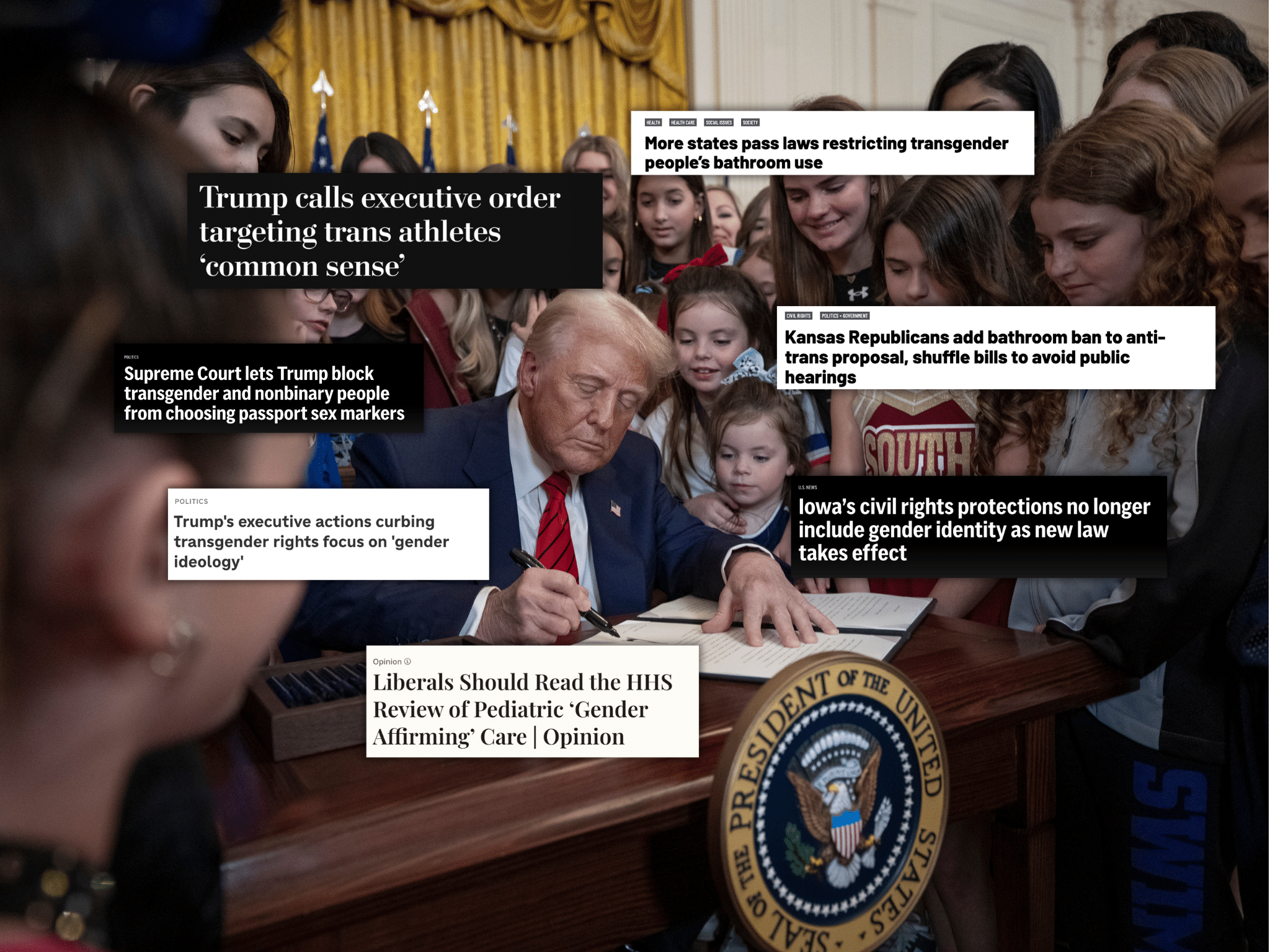
In 2016, when North Carolina Republicans passed the first bathroom bill in the United States, HB 2, the backlash was immediate: Corporations boycotted, people protested, and the bill’s champion, Governor Pat McCrory, paid for it at the ballot box that November. The next year, the bill was repealed by bipartisan legislation.
This was in large part thanks to national news media. Outlets including Politico, CNN, the New York Times, and The Guardian ran story after story about HB 2 and its consequences, turning North Carolina’s law into a national conversation. Even Fox News’ coverage was fairly neutral, with Megyn Kelly — now a vocal opponent of transgender rights — pressing McCrory on the bill’s broad scope during a televised interview. And because of the reaction to HB 2, similar bills in other states failed to materialize.
Until five years later, this time in neighboring Tennessee. There, Republicans passed HB1233, a narrower bathroom bill that only applies to K-12 schools. But nationwide blowback never came. Most major news outlets remained silent upon its passage. When it was covered, such as in this CNN article, reporting lacked the emotional charge that dominated discourse over HB 2. In the Tennessee law’s wake, Alabama, Arkansas, Idaho, Iowa, Kentucky, and Oklahoma passed similar laws restricting trans students and received minimal media coverage for doing so.
Then, in 2023, Florida passed HB 1521, which is broader than HB 2 and constitutes the first bathroom law to criminalize trans people for violating it. Not only was news coverage minimal, it drew little attention to the fact that breaking the law could lead to a year-long jail sentence. When Mississippi passed a nearly identical law the following year, articles made no mention of the criminalization provision.
Erin Reed, an independent trans journalist who writes the newsletter Erin in the Morning, said, “One of the biggest failings that legacy media had in 2023 and 2024 is that they just didn’t cover it [anti-trans legislation].”
“It was happening left and right,” she said. “Bills targeting transgender people in bathrooms and schools were one of the most common kinds of bills to be passed in a state legislature in those years. And yet, it was almost media silence on the topic, especially whenever it comes to individual stories and the way that they’re impacted.”
Related: Legacy media helped create this anti-trans moment. Now they’re reporting on it.
Now, nearly 10 years after the first attempt to police trans people’s bathroom use failed, 20 states — plus the federal government — have implemented at least some trans bathroom restrictions. And most people have no clue. This isn’t just an issue with bathrooms either: Laws and policies limiting Medicaid coverage of gender-affirming care, restricting trans peoples’ IDs and birth certificates, and effectively stripping the rights of transgender inmates have received little to no attention from those whose job it is to report them.
In the past 12 months, this issue has only gotten worse. Just hours after his inauguration, Trump signed Executive Order 14168, which stipulates that the definition of “sex” as being “an individual’s immutable biological classification as either male or female” “shall govern all Executive interpretation of and application of Federal law and administration policy.”
As a result of the order, gender marker changes were banned on passports and Consular Report of Birth Abroad documentation, federal employees lost health insurance coverage of gender-affirming care, the Equal Employment Opportunity Commission stopped investigating gender identity discrimination complaints, trans people’s bathroom use in federal buildings was restricted, and in December, the Department of Justice announced it was removing sexual violence protections for trans people in correctional facilities. Trump also signed specific orders banning trans people from the military, restricting gender-affirming care for those under 19, and blocking trans participation in sports.
So far, only a few of these actions have garnered significant media attention. When Trump’s anti-trans policies are covered, it’s usually because of developments in ongoing lawsuits. Rarely are these articles sparked by the harm Trump’s policies have brought upon trans Americans. Almost never do they adequately capture the new reality that has been thrust upon the trans community.
Reed says there’s been a trend: the biggest U.S. media outlets — the New York Times, Washington Post, The Atlantic, the Wall Street Journal, and CBS — are taking “even harder turns into not giving us a platform.”
“[They’re] not just ignoring the issue, but reporting on the issue in a very negative way towards trans people,” she said.
When it comes to gender-affirming care for minors, this coverage has been excessively damaging. For years, news outlets have platformed criticism of trans kids’ healthcare, lending credibility to the idea that there is a legitimate debate among medical organizations over the efficacy of such care. Following RFK Jr.’s announcement of federal regulations that sidestepped Congress and weaponize Medicaid and Medicare to effectively ban care for trans kids in December, Newsweek, the Washington Post, and The Hill all published supportive opinion pieces. Only USA Today released an opinion article opposing RFK Jr.’s proposal.
Of those three supportive op-eds, two were written by people with a clear conflict of interest: The article published by Newsweek was written by two of the contributors to the gender-critical HHS report — philosopher Moti Gorin and psychiatrist Kathleen McDeavitt — and the Washington Post article was written by Dr. Oz, who is in charge of overseeing Medicaid and Medicare. In doing so, these outlets are providing a medium for these people to retroactively justify their own actions without presenting any voices to the contrary or contextualizing the legal issues that plague the proposed regulations.
Related: New York Times podcast on youth trans care leaves out the patients
“Both-sides coverage, unfortunately, would be an improvement for us right now,” Reed added.
Coverage at the state level has also continued to decline even as anti-trans laws get more and more severe. The most extreme anti-trans law of the past year, SF 418, was passed in Iowa, making it the first state in U.S. history to remove discrimination protections for a protected class. It also made Iowa the fourth state to ban trans people from changing their IDs and the seventh to ban trans people from amending their birth certificates.
While most major news media organizations covered it, ranging from CNN and The Hill to the New York Times and the Associated Press, the attention they drew to Iowa’s new law paled in comparison to their reaction to HB 2. And after the law took effect on July 1, these same outlets did not return to highlight the harms that resulted from the removal of discrimination protections.
Worse, this coverage isn’t framed in the context of what the law has done to real people: It’s framed in a “he said, she said” format that pits “LGBTQ+ advocates” against “proponents of the legislation” — often excluding trans people from stories about their lives. This turns a discussion about civil rights into little more than partisan hackery, leveling the rhetorical playing field between blatant falsehoods and observed reality.
Related: What I learned by trying to quantify anti-trans bias and objectivity
Tre’vell Anderson, the executive director of the Trans Journalists Association, warned of the effects excluding trans people from these stories will have on the journalism industry.
“If you don’t include trans people, then we never get to seriously interrogate who gets protected in our society and who doesn’t,” they said. “We never get to have a real conversation and the broader journalistic community finds itself ill-equipped to make the kinds of decisions that we say they need to be able to make to keep democracy going.”
And that’s when the law passed is particularly notable. When a law passed is similar to one in another state, it’s often ignored by all but local and queer outlets. If the news is a change in policies or regulations, it’s not unheard of for it to slip past legal watchdogs and policy researchers completely unnoticed.
“We, as journalists, always talk about being that tool by which the world can come to learn about what’s going on around them and how they can show up in it,” Anderson said. “It becomes very hard to say that we are fulfilling that role if trans people aren’t part of the discourse.”
One of the most worrying stories of recent months has centered around Texas Attorney General Ken Paxton seeking to compile a list of trans people who ask about changing their gender markers on their IDs, which has been banned in the state for the past year and a half. This list-making was previously covered by Texas media outlets, which overall have done an excellent job reporting on the state’s actions against trans people, in August 2024 and March 2025.
Texas isn’t the only state making a list. Since Indiana Governor Mike Braun signed Executive Order 25–36 — a birth certificate amendment ban — around 10 months ago, Indiana has been doing the same thing with birth certificates. In a memo sent to county health departments, the Division of Vital Records instructs local offices to continue sending in requests so they can be documented at the state level — even though it’s explicitly stated that they will never be honored. Like Texas, Indiana is collecting these requests and, while The Objective reached out for comment, state officials did not respond before publication.
The Braun administration was able to get away with this for nine months without being called out. When local media in Bloomington, Indiana covered this story in March, it made no mention of this fact. Until I did research as part of a larger story about state surveillance of trans people, Indiana’s list-making remained unacknowledged. Because of the lack of media attention, not even trans people were able to learn that they were being targeted.
Reed offered a possible explanation for this: “Sometimes the things that are being done towards us [trans people] defy belief.”
“I think that sometimes these outlets have this sort of institutional skepticism, which is good to have in many cases,” she said. “But whenever it applies to transgender people, that skepticism goes really, really high. It’s almost like they don’t believe that something is happening to us until it actually happens.”
This past year has highlighted how the news media’s failure to protect trans Americans hasn’t just been about how it covers trans people — it’s been about how it doesn’t cover attacks on their humanity. Should the media remain indifferent towards Republicans’ actions against the trans community, GOP politicians will be free to control the narrative. Right now, not enough people know just how much damage they’re doing. That needs to change.
Aleksandra Vaca is an independent journalist who is the author of Transitics, a newsletter focused on dissecting legislation and policies affecting the trans community.
This piece was edited by James Salanga. Copy edits by Jen Ramos Eisen.
We depend on your donation. Yes, you...
With your small-dollar donation, we pay our writers, our fact checkers, our insurance broker, our web host, and a ton of other services we need to keep the lights on.
But we need your help. We can’t pay our writers what we believe their stories should be worth and we can’t afford to pay ourselves a full-time salary. Not because we don’t want to, but because we still need a lot more support to turn The Objective into a sustainable newsroom.
We don’t want to rely on advertising to make our stories happen — we want our work to be driven by readers like you validating the stories we publish are worth the effort we spend on them.
Consider supporting our work with a tax-deductable donation.

James Salanga,
Editorial Director
Related Articles

It’s healthy for student journalists to raise concerns about AI
Generative AI isn’t a real solution to the issues facing newsrooms. Students are right to point that out.

How disaster reporting hit home for two Appalachian journalists after Helene
Disaster journalism is vital, but can be traumatizing for both journalists and sources. We can make it better by treating disaster survivors — and ourselves — with more humanity.

The Objective’s favorite media reporting and criticism of 2025
A non-comprehensive list of The Objective’s co-directors and readers’ picks for media coverage and commentary this year.