
Strategizing about a safer media ecosystem for trans people: The Objective’s first Trans Media Convening
Over 70 trans journalists and allies gathered for the convening. Panelists included TransLash CEO and founder Imara Jones and Trans Journalists Association board president Kae Petrin.
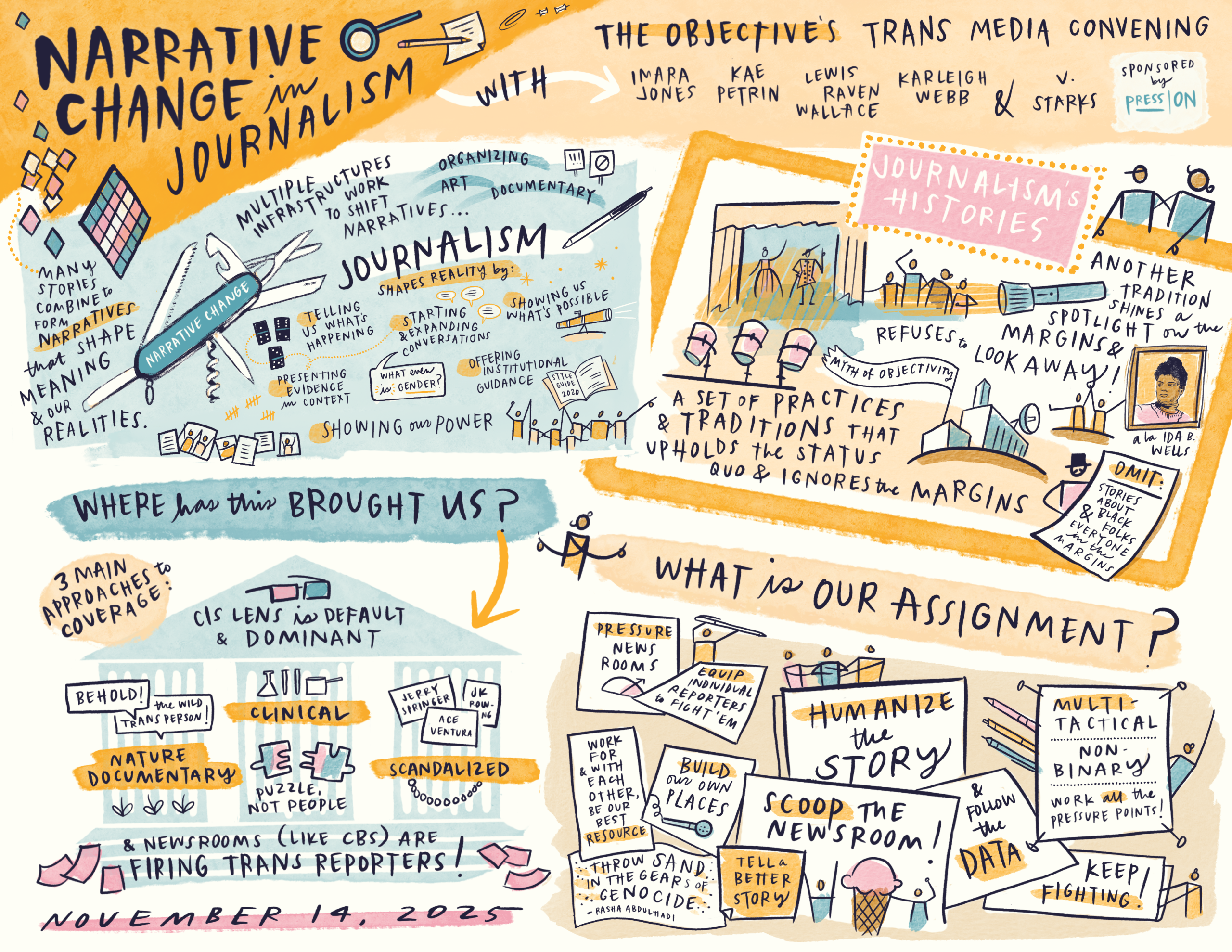
The past year has only underscored further how anti-trans narratives in journalism have fueled real-world harm, from legislation leading to transphobic violence to the removal of important public health data. Major news outlets have facilitated this by platforming misinformation and unreliable “experts” while fear-mongering about trans healthcare.
At the same time, while there are many strategies for action against transphobia in journalism, few events have tried to bring together journalists — more specifically, trans journalists — to learn and ideate on what’s working and what isn’t to make a safer media infrastructure for all.
So it was a joy to facilitate The Objective’s first Trans Media Convening, held virtually, last year on Nov. 14.
This convening, open to trans journalists and allies, was the work of many hands: our seven-person advisory committee, which included trans journalists, communicators, and filmmakers across the spectrum of gender, our event team, our eight panelists and two moderators, our flier designer and graphic recorder, and of course, the more than 70 journalists and allies who came together to discuss a safer media ecosystem for trans people.
Trans media-makers who shared feedback after participating said they felt “inspired”, “grateful”, and “connected” after attending — a bulwark of encouragement amid the hopelessness engendered by a slew of anti-trans legislation over the course of last year.
The Anti-Trans Legislation Tracker followed over 1,000 anti-trans bills introduced in Congress — 126 of which passed, more than twice the number that passed in 2024. The Trans Journalists Association found several major news sources — in the first hundred days of Trump’s presidency — failed to include trans people’s thoughts and reactions to legislation shifting their lives.
The narrative change panel was moderated by cultural worker and inaugural Press On advisory circle member V Starks. Attendees heard from Wallace, the author of The View from Somewhere and Radical Unlearning, TransLash founder and CEO Imara Jones, Outsports contributor and long-time sports journalist Karleigh Webb, and Trans Journalists Association co-founder and board president Kae Petrin.
“We keep doing our excellence,” Webb encouraged trans journalists. “No matter where it is, no matter how small you think it is, we keep doing it, because it does make an impact. It may not make an impact necessarily in their [corporate media] boardrooms, but it makes an impact on our community.”
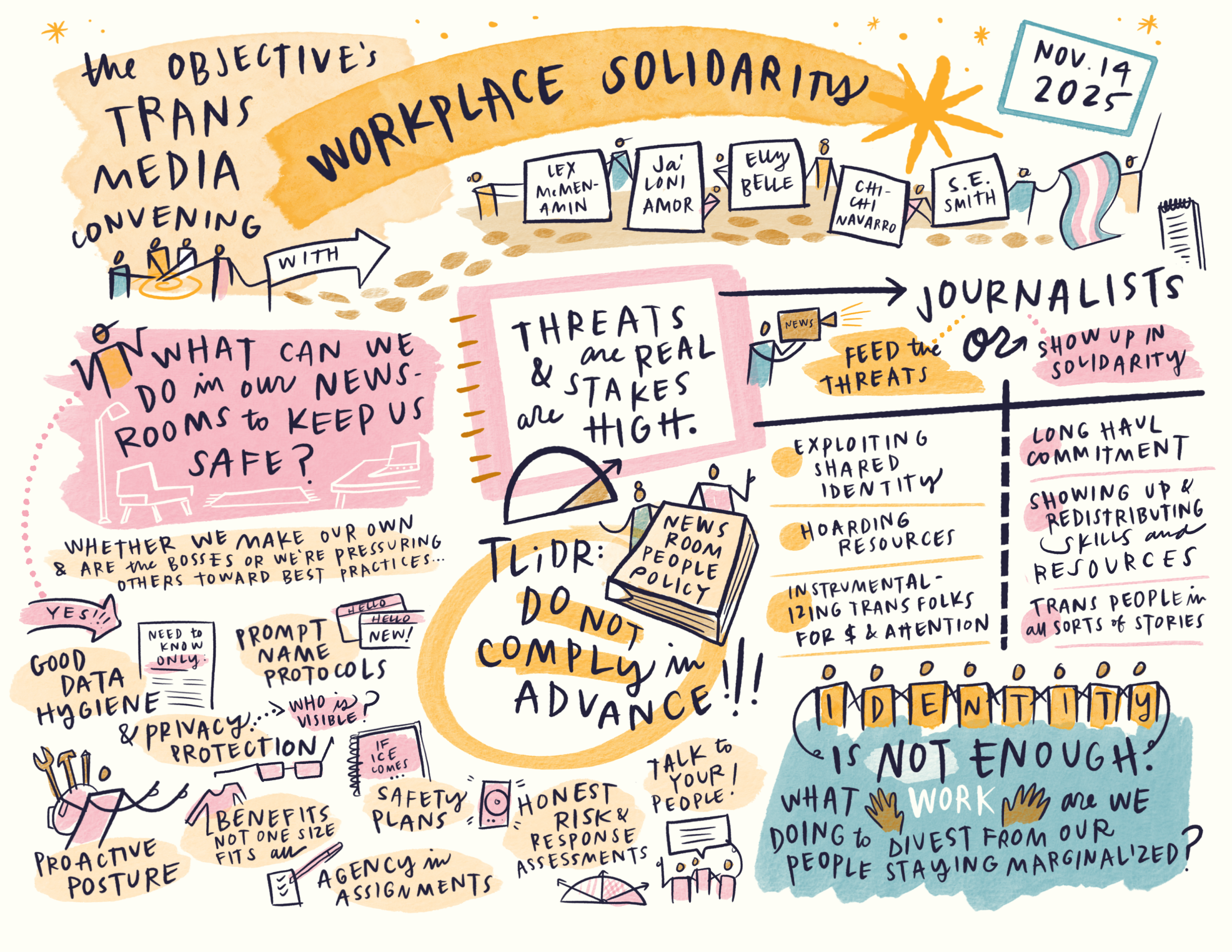
Our workplace solidarity panel was moderated by The Guardian’s movements reporter, Lex McMenamin. The panelists included freelance journalist and organizer Elly Belle, Transfuturist Collective co-steward Ja’Loni Amor, The Flytrap worker-owner s.e. smith, and community advocate ChiChi Navarro.
Much of the conversation revolved around tracing the lines of solidarity between movements for justice — not just trans people, but all people.
“Intersectionality is not about the composition of the faces on your masthead, it’s about the work that you are doing,” smith added. “Any time you are in a position of power that you are not advocating for people who are not in positions of power, you are failing at solidarity and failing at doing the work.”
We ended the day with a social hour, which provided space for attendees to talk with each other about their work and connect about topics they were interested in, ranging from trans archives to social media.
We’re grateful to Press On, a Southern collective for movement journalism, for sponsoring the narrative change panel, and for all involved in the making of the event — whether you shared our flier, passed along word to a friend, or attended the convening.
This year, we hope to compile a distributable zine sharing some of the conversations during the panels, for those who weren’t able to attend and those who wanted to share the takeaways in their own communities. And keep an eye out for more about our next Trans Media Convening, including the date, partnership opportunities, a form to submit ideas for this year’s panels, and registration information.
In the face of increasing attacks on trans rights and the gutting of major media publications, it remains crucial, as Jones said during the narrative change panel, to foreground tenacity in our lives and work.
“The sure-fire way to lose is to stop fighting,” she said.
If you’d like to support our next Trans Media Convening and the work we do, you can contribute here. Or if you’d like to make a larger gift, please reach out to us directly at info@objectivejournalism.org.
Related Articles

Objective co-directors win the 2026 AAJA Award for Leadership in Diversity & Solidarity
One of the Asian American Journalists Association’s Community Awards, the honor recognizes a commitment to the AAPI journalist community and to AAJA’s goals of diversity, inclusion, equity, and belonging.
The Objective wins its first INN Award!
The win was in the Breaking Barriers (Micro Division) category, for a story reported by Alexis Allison covering a New York City newspaper editor’s years-long bullying.
The Objective is a finalist for two INN Awards!
The nominations are both for a story reported by Alexis Allison, which covered a New York City newspaper editor’s years-long bullying.