
Native peoples must be part of an emergent media collective
Jodi Rave Spotted Bear on the necessity of American Indians having a seat at the table to forge a new path in building independent Indigenous media.
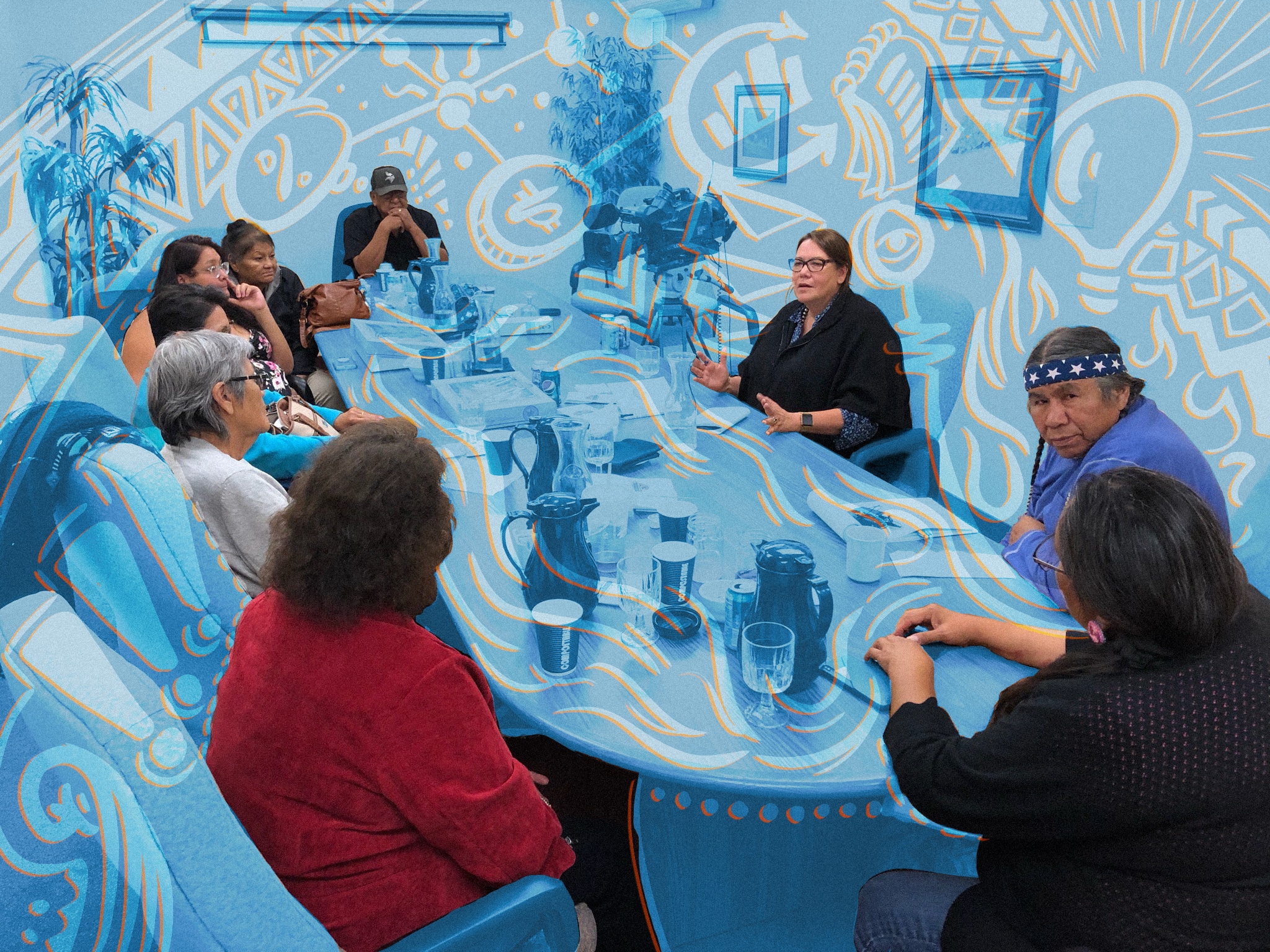
Editor’s note, Nov. 3, 2025: This piece was initially published on Nov. 30, 2023, and the below copy has been updated and fact-checked for the 2025 Civic Media Magazine, a project of The Objective, News Futures, and members of Free Press’s Media Policy Collaborative. You can read the updated letter to the editor and find more pieces from the series here.
Indigenous people are often called the invisible minority. Centuries of genocide have silenced generations of voices, and the mainstream press has never been fully present to consistently, accurately, or fearlessly tell Indigenous stories.
The Indigenous Media Freedom Alliance (IMFA) and its digital news site Buffalo’s Fire is an answer to the call for a free and independent Indigenous media. Buffalo’s Fire is the first nonprofit news organization in North Dakota. IMFA is also one of the few Native-led, Native-founded nonprofit news organizations in the United States. Through local reporting and collaborations across the industry, we’re telling stories the mainstream media has continually failed to write about — and ensuring Native peoples have a seat at the table during this new media emergence.
After centuries of genocide and land dispossession, much work needs to be done to raise Indigenous communities from the lowest rungs of social, economic, and health outcomes. Independent local news organizations can help citizens make informed decisions that improve education, innovation, creativity, personal growth, safety, health, cultural identity, and economic development.
In 1934, the U.S. Congress passed the Indian Reorganization Act, charting a path to reverse assimilation policies, restore land bases, fund education, and strengthen tribal sovereignty. This same act introduced tribes to cookie-cutter constitutions that didn’t emphasize First Amendment rights. While the 1968 Indian Civil Rights Act, also known as the Indian Bill of Rights, is enshrined in many tribal constitutions, there are no guarantees for press freedom, free speech or the right to assemble. That’s because the civil liberties of tribal citizens are often subject to arbitrary tribal court enforcement.
As political unrest proliferates in the United States, we should ask: What is democracy without journalism?
Today disinformation, public distrust, barriers to information access, and social alienation permeate American society. Now, however, a cadre of civic information practitioners remind us it’s time to walk boldly into the future. We can make significant changes as mainstream media downsizes and a new information system arises.
Buffalo’s Fire reports on local news that matters in our backyard, including education, civil rights and tribal government accountability. But that’s not all.
In a multi-stakeholder event in April 2024 that included North American Indigenous journalists, the United Nations Educational, Scientific and Cultural Organization (UNESCO) identified at least a half dozen actions needed to create “an enabling environment for free and independent community media.” That included supportive media policies; financial viability and access to resources; promotion of human rights; increased use of digital platforms; reclaiming the narrative on Indigenous issues; preparedness for emergencies and crises; and increased collaboration, partnerships, and knowledge-sharing among Indigenous media.
IMFA and Buffalo’s Fire are at the forefront of this effort, embracing collaboration, partnerships, and knowledge-sharing with Indigenous and non-Indigenous media organizations. The IMFA has collaborated with national and Native news organizations on reporting projects and media training sessions. We’ve participated in Report for America, The Trust Project, Mississippi River Basin Ag & Water Desk, and Solutions Journalism Network. We’re also the first rural and Indigenous-led newsroom to join the national Documenters.org network.
We’ve addressed press freedom at numerous conferences and venues, including UNESCO Paris, the National Association of Science Writers, Investigative Reporters and Editors, Native Americans in Philanthropy, Indigenous Journalists Association, and the National Congress of American Indians. We’ve also participated in a John S. Knight Community Impact Fellowship at Stanford University.
Mainstream press researchers have ample media archives to assess the state of media, whereas media research on Native communities remains largely absent. The Indigenous Media Freedom Alliance is undertaking this research to help build an independent healthy media ecosystem within Indian Country.
Within the decade, valuable research on Indigenous media, increased financing, and innovative leaders will create a more robust independent American Indian media ecosystem. But we’re not waiting for change. We’re laying the groundwork for a sustainable, Indigenous-led press connecting with an emergent media collective.
It will be an experiment, and that’s OK — experiments tend to lead to great discoveries. The mainstream media has overlooked us for too long. We are building the system that will take its place.
Jodi Rave Spotted Bear, a citizen of the Mandan, Hidatsa and Arikara Nation, is the founder and director of the Indigenous Media Freedom Alliance. She is also the 2023 Native American Journalists Association inaugural recipient of the Tim Giago Free Press Award.
This piece was edited by James Salanga. Copy edits by Bettina Chang. Fact-checking by Bashirah Mack.
We depend on your donation. Yes, you...
With your small-dollar donation, we pay our writers, our fact checkers, our insurance broker, our web host, and a ton of other services we need to keep the lights on.
But we need your help. We can’t pay our writers what we believe their stories should be worth and we can’t afford to pay ourselves a full-time salary. Not because we don’t want to, but because we still need a lot more support to turn The Objective into a sustainable newsroom.
We don’t want to rely on advertising to make our stories happen — we want our work to be driven by readers like you validating the stories we publish are worth the effort we spend on them.
Consider supporting our work with a tax-deductable donation.

James Salanga,
Editorial Director
Related Articles

The local news contract is broken. Civic media can fix it
Darryl Holliday on how City Bureau’s Documenters’ program models the new social contract needed for local news and the civic media system emerging today.

Media policy: Local news for the people
Five key policy-making principles and concrete proposals to support civic information needs.
To save the free press, newsgathering must be reclaimed as a public trust
Michael Swerdlow on the necessity of publicly funding the news media.