
Legislation is nice, but freelance media workers can achieve more through collective action
I’m a part of the IWW Freelance Journalists Union, which seeks to leverage collective power to improve the compensation and conditions of media contract workers.
I work as a freelance writer and journalist to supplement my income. Until early October, I was waiting on $500 for a piece I submitted to an outlet eight months ago and another $500 for a piece I submitted a little more than a month after the other.
Delayed payments for freelance journalism work isn’t an uncommon phenomenon: The Freelancers Union, a nonprofit organization that advocates for freelancers, found that at least 74% of its 750,000 members reportedly had to deal with delayed payments as of 2022.
Late last month, California Gov. Gavin Newsom signed the Freelance Worker Protection Act into law. The new legislation in California, advanced by Sen. Scott Wiener, aims to better support freelancers — but still falls short in some regards. So a group of freelancers, including me and other members of the IWW Freelance Journalists Union, are using collective action to try to secure life-altering agreements for freelancers in the media world, whether they’re journalists, writers, bloggers, photographers, or illustrators.
New freelance legislation provides some support but isn’t enough
The Freelance Worker Protection Act, which takes effect at the start of 2025, does feature several key provisions that better protect freelancers and better value freelance labor.
If a freelance contributor provides services for $250 or more, the act requires that the hiring party furnish a legitimate contract. Hiring parties will be prohibited from retaliating against a freelancer for pursuing payment. Likewise, the act’s language helps ensure a hiring party cannot demand a freelancer do more work than what’s specified in a contract — or force a freelancer to accept less than the originally agreed upon compensation — in exchange for faster payment.
Unfortunately, the act stops short of fixing a problem that’s been a frequent thorn in the side of many freelance workers: the issue of delayed payment. While it requires hiring parties to pay freelancers no later than 30 days after the latter completes their work, that provision only applies if their contract does not stipulate a different date for payment.
Trying to better our lot by primarily relying on legislation and the state and then, if contracting parties disregard it, litigation, is a naïve premise. It places the onus of responsibility on those with greater capital and on institutions heavily influenced by concentrated capital to take care of us, the source of the labor they exploit.
Individual freelance workers are, like other workers, at a disadvantage vis-à-vis accumulated wealth, whether it’s vested in a media publication that hires a freelancer to write a 2,000-word news feature or in corporate power that largely controls the state and skews the criminal-legal system so it best serves those who own the most.
Our greatest power as freelancers and as workers lies in our ability to organize and take action together — as freelancers and as workers whose labor companies depend upon, yet systematically undervalue. That’s why I’m involved in a nascent campaign with other FJU members to help ensure freelancers receive prompt payment for completed work, along with contracts that raise the bar for what independent contractors can and should expect in return for still woefully undervalued labor.
The FJU is affiliated with the longstanding Industrial Workers of the World, the “One Big Union” organizing workers across industries, and the IWW has historically eschewed collective bargaining.
That’s because bargaining can obfuscate class struggle and direct the focus away from where working people’s power really resides, and it’s also because the typical negotiated agreement between a union and an employer comes with a no-strike clause restricting employees from collectively withholding their labor.
It’s worth noting that as independent contractors, freelance workers are not typical employees; our ability to decide not to contribute to an outlet when others choose not to contribute to it doesn’t have to be infringed by a freelancer-friendly agreement we can collectively pressure contracting parties to accept.
Collective action could bring about a new future for freelancers
In the struggle for freelance labor rights and conditions, the FJU has made modest, if meaningful, gains in the struggle for freelance labor rights and conditions. In early 2020, the union won a settlement, via the National Labor Relations Board, which mandated a media company cease and desist its union-busting tactics. A few months later, the FJU successfully pressured a publication to pay $150,000 in overdue invoices.
Going forward, we want news media outlets to adopt a collective agreement that would afford a number of protections and rights to all freelance contributors.
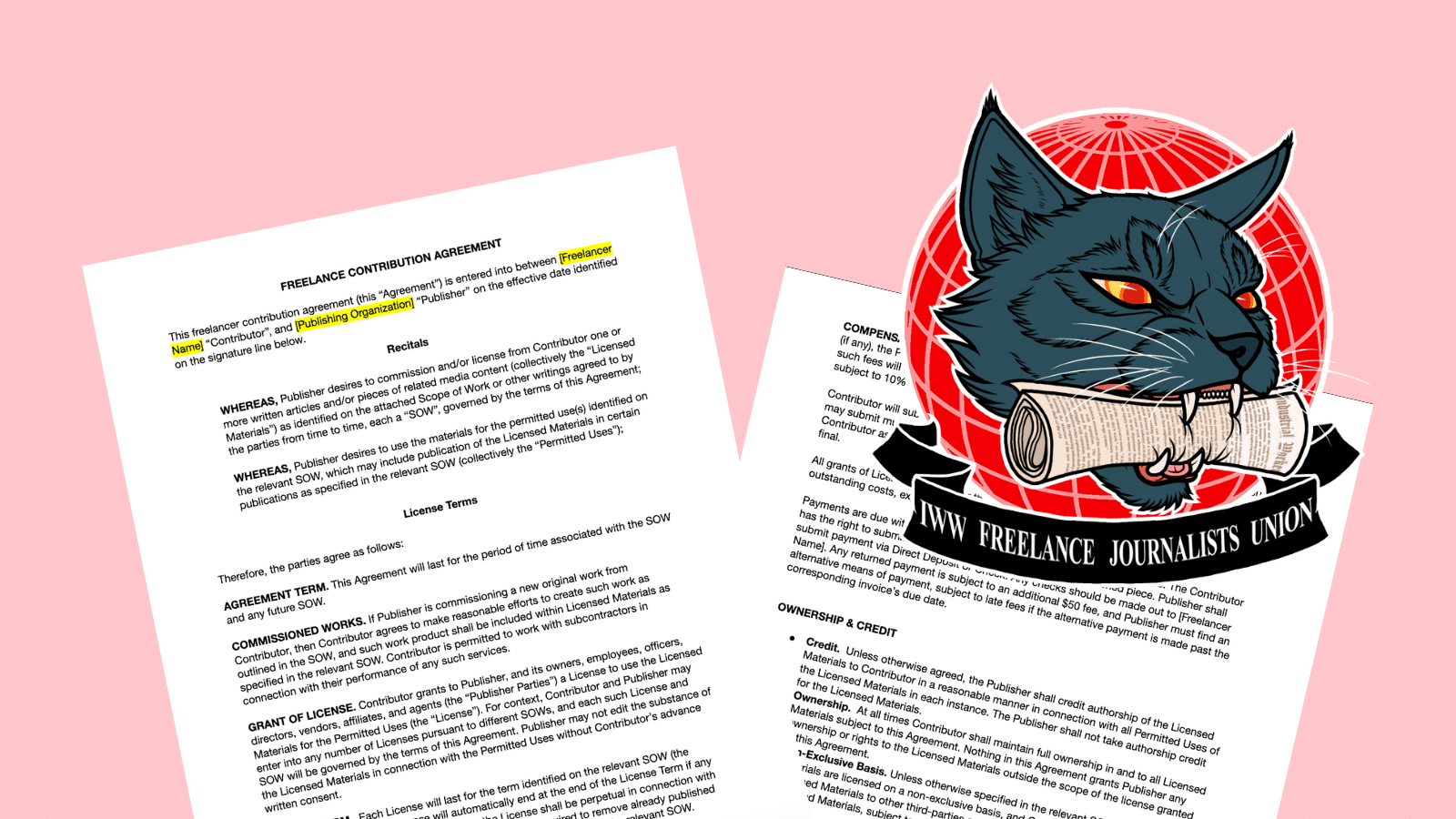
As part of this developing campaign, we drafted a model contract with membership feedback and legal review that we’ve made available for freelancers to use as a resource.
There’s precedent for union campaigns like the one we’re waging. The National Writers Union previously negotiated agreements with The Nation, In These Times, and Jacobin. The FJU legal committee reviewed each of those contracts, and we tried to improve upon what was included in all three by crafting a template that further empowers freelancers and that addresses other concerns important to our members, as indicated in an in-house survey we conducted.
We want a freelancer to retain ownership and cross-publication rights of submitted work. We want payment within two weeks of submitting an invoice, following publication of contracted work. We want an outlet to pay for our work even if editors opt not to publish it, unless a “kill fee” is specified; if the outlet specifies a “kill fee” when contracting with the freelancer, that remuneration should be at least 60% of the initial rate offered.
That’s all spelled out in the model contract intended for individual use and available on our website.
There is some flexibility. The exact numbers to be used in a standard written agreement with a given publication — which establishes minimum rights and protections for all freelancers who labor for that outlet — could change, based on what our members decide they want and are willing to do. That’s also dependent on whichever outlets adopt the agreement.
In the same vein, we can push for higher levels of compensation than what most outlets offer — levels to be determined democratically by FJU members vis-à-vis a targeted publication.
To take the next step in this campaign and in the organizing drive it entails, we created a survey any freelance media worker can fill out.
Freelancers can let us know which outlets they work for that fail to offer contracts or offer sub-par contracts. They can share with us which outlets might be amenable to adopting a model agreement, sans union pressure, and which publications they think the union and our allies might be able to persuade or effectively pressure to adopt a standard agreement.
Freelance media workers interested in getting involved in FJU’s model contract campaign can complete the aforementioned survey and contact us at freelancejournalists+outreach@iww.org, as can decision-makers at media outlets who want to voluntarily adopt a union-approved collective agreement that will better value the labor of contributors.
James Anderson is from Illinois but now resides in Southern California’s Inland Empire. He is a member of the IWW Freelance Journalists Union and has authored articles for a number of outlets. He has taught community college classes, and he works as a lecturer in the labor studies program and in the media and cultural studies department at the University of California, Riverside.
This piece was edited by James Salanga. Copy edits by Gabe Schneider.
We depend on your donation. Yes, you...
With your small-dollar donation, we pay our writers, our fact checkers, our insurance broker, our web host, and a ton of other services we need to keep the lights on.
But we need your help. We can’t pay our writers what we believe their stories should be worth and we can’t afford to pay ourselves a full-time salary. Not because we don’t want to, but because we still need a lot more support to turn The Objective into a sustainable newsroom.
We don’t want to rely on advertising to make our stories happen — we want our work to be driven by readers like you validating the stories we publish are worth the effort we spend on them.
Consider supporting our work with a tax-deductable donation.

James Salanga,
Editorial Director
Related Articles
It’s healthy for student journalists to raise concerns about AI
Generative AI isn’t a real solution to the issues facing newsrooms. Students are right to point that out.
How disaster reporting hit home for two Appalachian journalists after Helene
Disaster journalism is vital, but can be traumatizing for both journalists and sources. We can make it better by treating disaster survivors — and ourselves — with more humanity.
‘Almost media silence’: National, local news ignores trans Americans amid 2025’s anti-trans attacks
The failures of newsrooms to substantively cover anti-trans legislation in 2023 and 2024 have compounded over the first year of Trump’s second term in office.