
Journalists can learn from student journalism’s response to immigrant criminalization
Many mainstream newsrooms are failing to reckon with state violence’s impact on both journalists and the communities they report in.
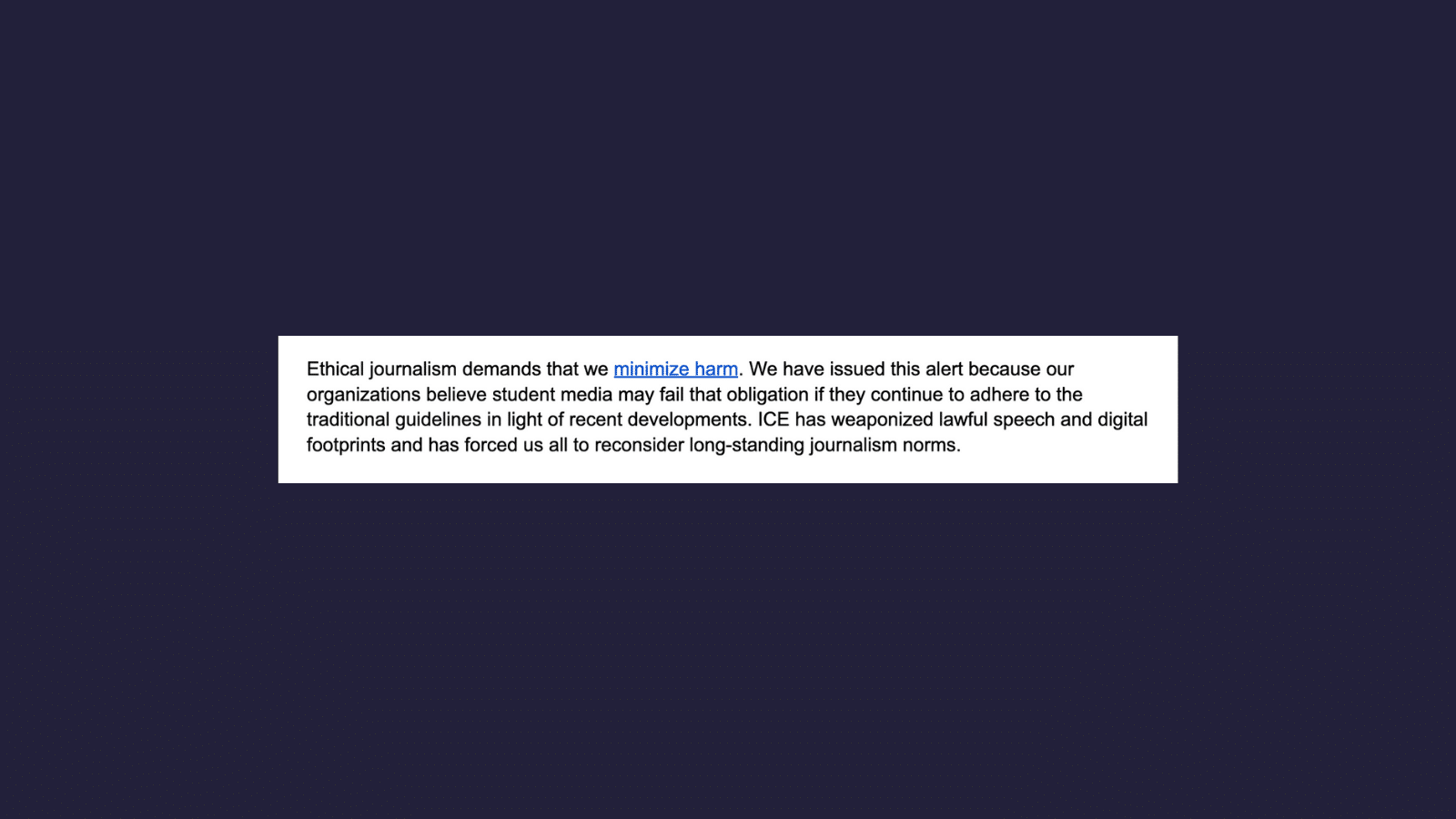
There have been over 300 and counting visa revocations of college students across the U.S. So six student journalism organizations — Associated Collegiate Press, College Media Association, Journalism Education Association, National Scholastic Press Association, Quill & Scroll, and Student Press Law Center — issued an alert calling for the revision of student newsroom takedown and anonymity policies as needed.
“Ethical journalism demands that we minimize harm,” the organizations wrote. “We have issued this alert because our organizations believe student media may fail that obligation if they continue to adhere to the traditional guidelines in light of recent developments.”
What’s happening in student journalism is a microcosm for the broader failures of journalism writ large. Many mainstream newsrooms are failing to reckon not just with how the Trump administration is harming communities, but also with how journalists are affected by the harm caused by state violence.
The Society of Professional Journalists’ position paper on anonymous sources first and foremost states, “the public is entitled to as much information as possible on sources’ reliability.” Yet its code of ethics also maintains the importance of minimizing harm by balancing the public’s need for information against potential harm or discomfort.
Student journalists have long dealt with these questions — in 2019, the Northwestern Daily issued an apology for its photographic coverage of then-Attorney General Jeff Sessions on campus and the removal of an initially included source, given that Northwestern is among the U.S. universities that do not grant amnesty to student protesters.
The Student Press Law Center previously cautioned student media to exercise restraint in taking down, altering, or even de-indexing published material — but in the letter, they and the other five signatories acknowledge “the political and legal climate has changed in America.”
“Today, granting retraction or anonymity requests could protect those most vulnerable from being punished for their speech,” they wrote.
But journalism, even unintentionally, has worked hand-in-hand with the state to criminalize migrants. Even as far back as 2004, ICE agents used a CNN documentary to find identifying information to arrest the family at its centerpiece.
Veteran journalist Maria Hinojosa helmed the piece. Even three years ago, the founder of Futuro Media Group and current host of LatinoUSA told Columbia Journalism Review that she often uses only first names when interviewing migrants.
“My role as a journalist is to get the story in their voice,” Hinojosa said, saying she regrets using certain identifying information in the past. “And to do no harm.”
Tufts University graduate student Rümeysa Öztürk was on her way to iftar when ICE agents arrested her. She co-authored a March 2024 op-ed with three other graduate students for the Tufts Daily calling for divestment from Israel and acknowledgement of the genocide of Palestinians in Gaza.
The Trump administration is moving the goalposts — using a sparsely used Cold War-era law to criminalize free speech and, in particular, someone who voiced their opinion in a quintessentially American format — a newspaper op-ed.
More broadly, Immigration and Customs Enforcement (ICE) are invoking the seldom-used adverse foreign policy provision to revoke student visas, particularly those belonging to non-white and Muslim students, as two California lawsuits filed this week highlight. Race and immigration status have long been deeply intertwined with safety in the U.S. — and journalists’ work can change course to reflect that.
Reporting on the visa revocations, for example, requires a proper analysis of how different systems of oppression create a disproportionate impact on those most at risk.
And they need to advocate for policies that protect not just journalists, but everyone with different immigration status. When it comes to anonymity, Define American’s toolkit for immigration reporting and El Tímpano’s guidelines for including immigrant sources provide good starting places for reworking those guidelines and reevaluating how to tell accurate stories without endangering journalists or those whose stories they’re sharing.
Press freedom and free speech have always been legal issues for non-U.S. citizens. Having siloed these conversations solely to an ethical debate, rather than taking concrete action, is a disservice to the journalistic principle of “do no harm.” Especially when the people whose visas are being targeted now are those who have been excluded from the U.S. immigration system throughout history.
James Salanga is the co-director of The Objective and the podcast producer for The Sick Times.
This piece was edited by Gabe Schneider.
We depend on your donation. Yes, you...
With your small-dollar donation, we pay our writers, our fact checkers, our insurance broker, our web host, and a ton of other services we need to keep the lights on.
But we need your help. We can’t pay our writers what we believe their stories should be worth and we can’t afford to pay ourselves a full-time salary. Not because we don’t want to, but because we still need a lot more support to turn The Objective into a sustainable newsroom.
We don’t want to rely on advertising to make our stories happen — we want our work to be driven by readers like you validating the stories we publish are worth the effort we spend on them.
Consider supporting our work with a tax-deductable donation.

James Salanga,
Editorial Director
Related Articles
It’s healthy for student journalists to raise concerns about AI
Generative AI isn’t a real solution to the issues facing newsrooms. Students are right to point that out.
How disaster reporting hit home for two Appalachian journalists after Helene
Disaster journalism is vital, but can be traumatizing for both journalists and sources. We can make it better by treating disaster survivors — and ourselves — with more humanity.
‘Almost media silence’: National, local news ignores trans Americans amid 2025’s anti-trans attacks
The failures of newsrooms to substantively cover anti-trans legislation in 2023 and 2024 have compounded over the first year of Trump’s second term in office.