
A newsstand that serves the information needs of Black communities
The multimedia exhibition — “Black Futures Newsstand Presents: Riot to Repair Soundscape Exhibition” — showcases work reflecting on the historic events that took place five years ago and imagines the kind of reparative narrative ecosystem needed to serve the health and well-being of Black people and Black communities.
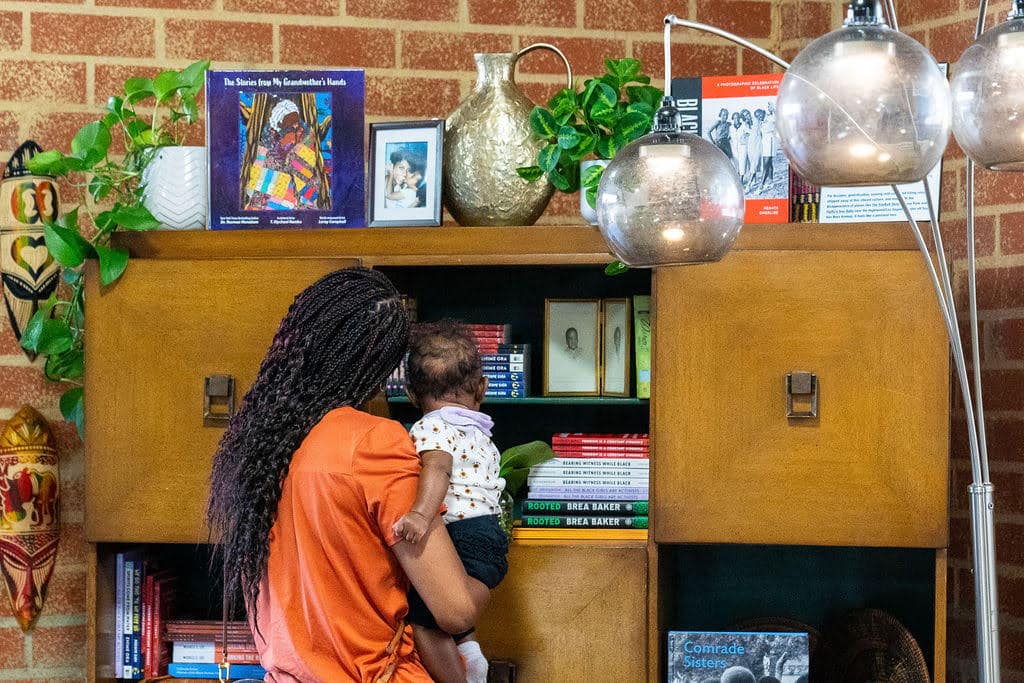
May marks the fifth anniversary of one of the largest uprisings in our nation’s history when millions of people took to the streets — following the murder of George Floyd by a Minneapolis police officer — to call on our nation to acknowledge and redress its history of racism.
Now, a new multimedia showcase that debuted over the weekend in Los Angeles — “Black Futures Newsstand Presents: Riot to Repair Soundscape Exhibition” — will showcase work that reflects on the historic events that took place five years ago and imagine the kind of reparative narrative ecosystem that is needed to serve the health and well-being of Black people and Black communities.
The Media 2070 project — in collaboration with the Charlotta Bass Journalism and Justice Lab at the University of Southern California, MediaJustice, ZEAL Co-op, the Racial Equity in Journalism Fund, Black River Life Media and Axle Impact Studios — are the hosts of this multimedia exhibition. Instead of featuring a traditional newsstand, like the ones located on a busy city sidewalk — stuffed with newspapers and magazines — this newsstand will be symbolically represented by “grandma’s living room,” found in the homes of many Black grandmothers.
Printed works from Black news outlets from across the country will be on display, sitting on top of a living-room table or resting on a bookshelf. The works of Black artists will adorn the walls. Headphones will allow visitors to listen to the Riot to Repair collection of interviews conducted by USC students from the Journalism and Justice Lab.
In these interviews, Los Angeles-area residents reflect on the lessons they learned from the 2020 uprisings. Miss Rodgers, a community organizer, reminisces in one interview about how “people felt empowered” and became “the best versions of themselves.” In another, Billy Taing, an activist in the Asian Pacific Islander community, recalls how the uprisings further demonstrated the importance of solidarity between members of communities harmed by systemic oppression.
Representing a grandmother’s living room as a newsstand captures the kinds of values we need in a communication infrastructure that serves Black communities’ information needs: prioritizing safety, access, and care. The newsstand also underscores the need to repair the history of anti-Black narrative harm that continues to be weaponized to deny Black people their civil and human rights.
Making meaning
The late cultural theorist Stuart Hall argued that the powerful always attempt to ensure that the meaning we receive from consuming media — narratives — is fixed and cannot change. But Hall said that “meaning depends on a certain kind of fixing” even though meaning “can never be fixed,” including by the powerful, since it is always changing.
Media 2070, a project of the advocacy group Free Press, is a media-reparations project calling for our nation’s media system — and its institutions — to redress their history of anti-Black racism. We are attempting to change meaning in how the Black community, and the larger public, understand a central function of our media system.
We argue that our nation’s powerful media institutions, supported by government policies, have always — and continue to — support the goals of racial capitalism in upholding racial hierarchies. This is accomplished through the distribution of racist narratives that criminalize Black communities and portray Black people as morally inferior — all to ensure that the meanings of these narratives remain fixed.
Our nation’s very first continuously published newspaper — The Boston News-Letter — stated that Black people were addicted to stealing and lying. Today, local TV newscasts air a continuous stream of stories that portray Black people as criminals. Powerful social-media platforms have become sites of anti-Black hate.
But as Hall said, meaning isn’t fixed.
The civil-rights struggle challenged racist narratives to expand democratic and human rights for Black people and other historically marginalized communities. The 1960s civil rights movement resulted in a new phase in the struggle for a multiracial democracy; the 2020 uprisings marked the latest chapter.
The Movement for Black Lives pressured local and state governments, the federal government, and public and private institutions to address systemic racism. Several media organizations apologized for their histories of racism and made pledges to do better. In their apologies, both The Los Angeles Times (2020) and The Oregonian (2022) acknowledged that their papers had once respectively served the goals of upholding white supremacy and maintaining white racial hierarchies.
The 2020 uprisings began at the start of a global pandemic that further revealed systemic inequities. Public support for reckoning with systemic racism gained traction and spread beyond the Black community. But powerful right-wing institutions contested this growing support. The right successfully constructed a new Trojan horse by rebranding the DEI commitments of public and private institutions as anti-white racism. This racist, sexist and anti-trans backlash has now accelerated. President Trump signed executive orders stripping away anti-discrimination federal protections — protections won during the civil-rights struggle over the past 60 years. This racist backlash now fuels the Trump administration’s authoritarian ambitions.
The administration is also attacking media companies to silence dissent and to shape and shift culture. The Federal Communications Commission has reinstated complaints against ABC, CBS, and NBC the Biden FCC dismissed. The agency has launched investigations into Comcast and Disney over their DEI policies. The FCC chairman has also launched investigations against NPR and PBS while calling for the defunding of both. Media companies Disney, Gannett and Thomas Reuters — parent company of the Reuters news service — made changes to some internal practices, reportedly to comply with the Trump administration’s anti-DEI directives. And The Los Angeles Times and The Washington Post are both preventing columns critical of Trump from appearing on their editorial pages.
Our nation is now descending into a full-blown authoritarian state. Its failure to redress systemic racism and racial capitalism — including in our media and information ecosystem — are primary reasons for the dangerous and uncertain future we face.

An illustration for redress
Reimagining a traditional newsstand as a grandma’s living room is an attempt to depict a place that exists where an information infrastructure nourishes Black people, Black families and Black communities. In this setting, nourishment is not just about being fed food; it’s also about sharing and receiving knowledge.
In grandma’s living room, you will find books, magazines, records, paintings, and newspapers created by Black people that serve their communities’ information needs. Stories are told that need to be remembered and passed down to each new generation. It’s a safe place to dream and ask questions knowing your elders and loved ones are invested in your well-being. Differences have a better chance of being worked out. And grandma is not going to charge you for the nourishment she is providing.
But once you leave her home, you are surrounded by people who are influenced by the harmful stories powerful media and tech companies have told. These companies have little regard for you and your community.
The elements that exist in places like grandma’s living room inform the kind of reparative policies and practices that need to be replicated and scaled. These elements and values either do not exist or are unable to survive in a corporate media infrastructure where the primary goal of media owners and corporations is to maximize profits, including for their shareholders. And racism is profitable for these companies.
We also have to reckon with the role our nation’s racial hierarchy has played in ensuring that Black media and Black information infrastructures lack the resources needed to more robustly serve their communities. Throughout our nation’s history, the government and corporations have silenced the dissident voices of Black journalists and Black media outlets.
The California Reparations Task Force has recognized this history, stating in its final report that both the “state and federal government had failed to protect Black “artists, culture-makers, and media-makers from discrimination” and called for California lawmakers to create a reparative fund or fellowship program for Black media institutions to “repair the harm caused” by anti-Black narratives.
This is an important start in the ongoing process of redress and repair.
Malkia Devich-Cyril, a founder of MediaJustice, has said that reparations are about dismantling the levers of systemic oppression “one by one” — noting that reparations are a “tool and process by which we reclaim resources owed to a people” in the struggle “to recompense justice, freedom and power.”
This May, Black Futures Newsstand provides an opportunity for the public to engage with the work of artists who are trying to make this possible.
Joseph Torres is the senior advisor for reparative policy and programs at Free Press and is a co-founder of the Media 2070 project, a project of Free Press.
We depend on your donation. Yes, you...
With your small-dollar donation, we pay our writers, our fact checkers, our insurance broker, our web host, and a ton of other services we need to keep the lights on.
But we need your help. We can’t pay our writers what we believe their stories should be worth and we can’t afford to pay ourselves a full-time salary. Not because we don’t want to, but because we still need a lot more support to turn The Objective into a sustainable newsroom.
We don’t want to rely on advertising to make our stories happen — we want our work to be driven by readers like you validating the stories we publish are worth the effort we spend on them.
Consider supporting our work with a tax-deductable donation.

James Salanga,
Editorial Director
Related Articles
Journalists aren’t the only ones sharing the news, and that’s a good thing
A new framework from Journalism + Design Lab invites newsrooms to build on the abundance, diversity, and momentum already in our communities to strengthen local news.
The Black press has always faced an inequitable funding landscape. Its future can’t be the same
Looking to historical models can provide some clarity and inspiration in an environment once again hostile to funding Black journalists and the Black press.
It’s healthy for student journalists to raise concerns about AI
Generative AI isn’t a real solution to the issues facing newsrooms. Students are right to point that out.