
A “Jim Crow” law made MLB leave Atlanta. Sports reporters should’ve asked why they went back.
Journalism’s hesitance to reckon with sports’ political context is exemplified by incomplete coverage of the All-Star Game’s return to Atlanta, where a voter suppression law that prompted the game’s leaving in 2021 has since been worsened by local politicians and legacy media.
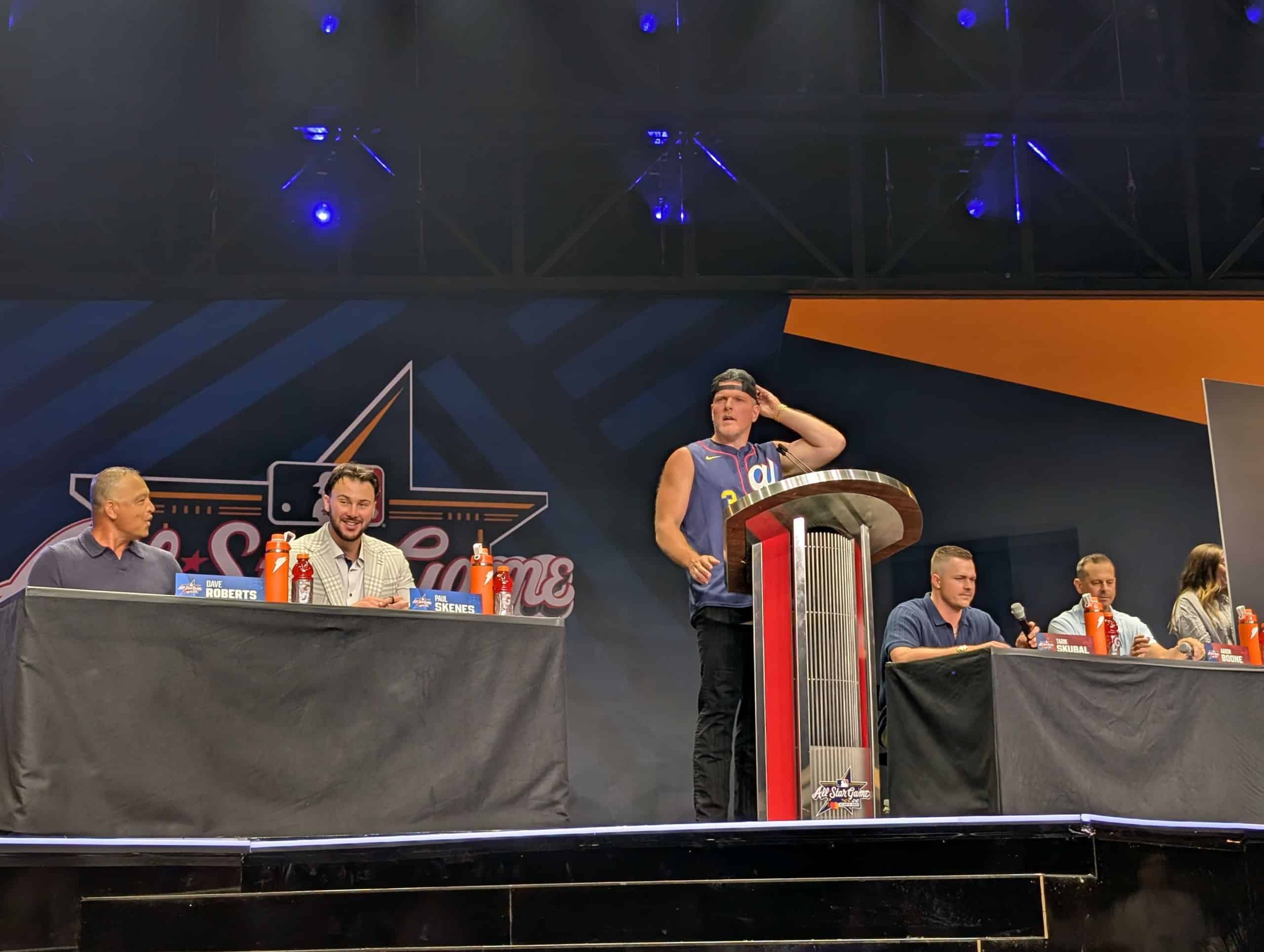
Ahead of this year’s Major League Baseball All-Star Game in Atlanta, sports and mainstream media coverage of the All-Star Game failed to address important context about the city: The Election Integrity Act, an elections law which spurred the All-Star Game’s 2021 move out of Atlanta and which former president Joe Biden called “Jim Crow of the 21st Century”. The law changed who held the power to control election integrity boards, handing it to the Republicans in office who control the majority of the state legislature.
At the time, Los Angeles Dodgers manager, Dave Roberts, who managed this year’s National League team, said that speaking up about racism is “just being relentless with our voices. This is not just something that’s an isolated moment in time that we’re talking about.”
Yet the law was on the books when Commissioner Rob Manfred announced, to both criticism and fanfare, in Nov. 2023 that the All-Star Game would return to Atlanta, and is still on the books as of publishing. This incongruity was finally covered in more news stories after I asked Roberts about his 2021 comments and several articles mentioning the law.
Roberts — who was supportive of the decision to move the game out of Atlanta — gave what seemed like a canned, PR-trained answer: “I’m not a politician. I do feel that everyone has their right to voice thoughts. But right now I just really choose to focus on the players and the game and be excited to be here.”
“Sportswriting is access journalism,” a baseball industry source told me.
But long before my question in the press conference, that access should’ve compelled reporters to hold MLB officials accountable for MLB causing harm to communities that they profit from — from daily games to this year’s All-Star Game. Baseball media’s attitude toward international players is increasingly dangerous as the Trump administration hones into targeting migrants. Journalists are no exception: Atlanta is the only city where a journalist has been detained by ICE for doing his job.
Related: Sports media shouldn’t dehumanize international players
Before the game, coverage was sparse. The two main exceptions were op-eds written by Republican Rep. Todd Jones (GA-25), one in AllOnGeorgia and another in the Atlanta Journal-Constitution, where Jones argued MLB got it wrong in the first place.
Another sports reporter, who spoke with me under the condition of anonymity due to employment concerns, said the current administration may have created an unwillingness to tackle the game’s context head-on for fear of “being called out … or draw[ing] unwanted attention to being attached to an opinion, even if no opinion was presented.”
“I would say there was more momentum in a Biden/Democratic presidency to write about issues that involved politics and every American,” the sports reporter told me. “There’s less comfort and consensus, I think, in the sports journo ranks on when to act.”
Yet as a USA Today story published the day before the All-Star Game leads: “The All-Star Game is back on in Georgia. But the conditions that caused its removal in 2021 have not changed. In fact, voting expert rights say, conditions have only worsened for potentially disenfranchised voters.”
Legacy media in Atlanta have contributed to this: Aja Arnold wrote in Scalawag that the Atlanta Journal-Constitution has a history of inciting harm, with the most recent example being the editorial board’s support for Cop City, a massive police training facility, in spite of sustained public opposition.
“The publication’s manufacturing consent for a wider use of state force in response to a moral panic its publishing sensationalizes is not new,” Arnold wrote. “It is symptomatic of the AJC’s long history of co-signing police terror and inciting racist vigilantism for the sake of maintaining ‘public order.’”
Though the media holds the capacity to report and document the news while also holding people accountable, it’s also a powerful venue for advancing narratives, whether through the frames in opinion and editorial pieces or the use of a passive voice headline. The lack of coverage of the All-Star Game’s move out of Atlanta in 2021 — and the frames used to discuss it — are also a narrative that seeks to strip history of its context.
The Atlanta Journal-Constitution published a reported piece that cited criticism of the elections law, ending with a kicker from Attorney General Chris Carr, who planned to attend the event: “The most important thing is we got the game back. That’s a testament to our state, its leadership and the policies we put forth. And having the game in Georgia is an acknowledgment that what Democrats said about the law in 2021 was just not true.”
But Atlanta-based editor and publisher Alex Ip says that from his own reporting and others’, local politicians have “repeatedly sidestepped popular will when it came to policing, transit, and infrastructure, and ignored protests against environmental injustices, pedestrian deaths, and federal job and funding cuts by the Trump administration.
“Atlanta’s ruling class has worked overtime to commodify the city’s civil rights legacy for rich owners and clueless tourists,” he said, naming the city council’s warming shelter restrictions, the city’s lack of sidewalks, and a city encampment sweep that bulldozed Cornelius Taylor, a homeless man, to death to make way for dignitaries before MLK Day. “I would be surprised if democracy was on their radar, and that speaking up against the MLB’s decision to bring the All-Star Game back to Atlanta was even on their minds.”
I spoke to many media members in the press box and on the field during All-Star Week. Many applauded me for asking Roberts about his 2021 stance; some told me that I was right for asking them: “Why did no one cover this before the week started?”
More importantly, I read people saying, “Why weren’t there more reporters asking about this?” And that’s the real question — where are they?
Jen Ramos Eisen is a Central California- and Las Vegas-based sports labor and economics journalist and has covered Minor League Baseball since 2013.
This piece was edited by James Salanga.
We depend on your donation. Yes, you...
With your small-dollar donation, we pay our writers, our fact checkers, our insurance broker, our web host, and a ton of other services we need to keep the lights on.
But we need your help. We can’t pay our writers what we believe their stories should be worth and we can’t afford to pay ourselves a full-time salary. Not because we don’t want to, but because we still need a lot more support to turn The Objective into a sustainable newsroom.
We don’t want to rely on advertising to make our stories happen — we want our work to be driven by readers like you validating the stories we publish are worth the effort we spend on them.
Consider supporting our work with a tax-deductable donation.

James Salanga,
Editorial Director
Related Articles

Journalists aren’t the only ones sharing the news, and that’s a good thing
A new framework from Journalism + Design Lab invites newsrooms to build on the abundance, diversity, and momentum already in our communities to strengthen local news.
The Black press has always faced an inequitable funding landscape. Its future can’t be the same
Looking to historical models can provide some clarity and inspiration in an environment once again hostile to funding Black journalists and the Black press.
It’s healthy for student journalists to raise concerns about AI
Generative AI isn’t a real solution to the issues facing newsrooms. Students are right to point that out.