
What is nonprofit news infrastructure solving for?
We need new questions to guide flourishing news ecosystems that don’t treat nonprofit status as the end-all, be-all fix.
At a recent dinner party, I mentioned that I had co-founded a nonprofit local newsroom and that much of my work over the last decade has been adjacent to, if not squarely in, the nonprofit news space. A guest across the table from me guffawed. Isn’t all news nonprofit now? It stung a little, the way a comment mocking the Philly Flyers’ undeniably absurd mascot would sting even a transplant Philadelphian, if slung by anyone from outside the Delaware Valley.
Yes, the news industry is seeing its wells dry up as we struggle under the weight of our own late-stage-capitalism-fueled collapse. But I recoiled at the conflation of a buckled business model’s inability to profit with the mission-driven work of publicly-supported newsrooms across the country.
Except the longer I sat with his rhetorical question, the more my discomfort grew. If a critical mass of independent news — particularly at the local level — is “nonprofit” now (as in not sustainably or reliably generating enough income), not by intentionally elected tax status but by collapse, then what is nonprofit news infrastructure actually solving for?
The proliferation of the nonprofit newsroom model, particularly over the last two decades, emerged to respond to journalism’s structural challenges. I’ve seen my fellow nonprofit newsroom founders build these newsrooms out of necessity and with a healthy imagination for what’s possible, resulting in news products that have become a lifeline for communities. We have demonstrated the case for our work as a public good and for all intents and purposes, we have answered the question “Who deserves good journalism?” But the structural issue of how to sustain it remains largely untouched.
A brief history of nonprofit newsrooms
In 1908, there were just two bonafide nonprofit newsrooms in the United States —the Associated Press and the Christian Science Monitor. For most of the 20th century, U.S. newsrooms were structured as for-profit entities, underwritten predominantly by classified and commercial ad sales, with NPR and its affiliates being noted exceptions. Before the bottom fell out, most reporters, editors, and columnists worked for corporate-owned but locally-rooted outlets.
However, by the time the financial crisis hit in 2008, Craigslist had changed the game for classifieds, Google and Facebook had cornered ad revenue, ownership was consolidating left and right, and hedge funds had begun strip-mining newsrooms. Institutional philanthropy entered the conversation in a new way, filling a vacuum, and a handful of national foundations granted the early crop of nonprofit newsrooms funding for investigative, service, and more community-driven journalism — the kind of labor-intensive work for-profit newsrooms were increasingly unable to dedicate resources to. A model that was once an aberration became the talk of the town. So in 2009, the Institute for Nonprofit News (née the [nonprofit] Investigative News Network) was born to support the rapidly expanding community of nonprofit, public-service-oriented news organizations.
“We’d found a way to continue making sure people were getting the “good stuff we need to keep democracy working,” as Jim Barnett wrote for Nieman Lab shortly after INN’s launch.
Early experiments like ProPublica, The Texas Tribune, and The Marshall Project instilled some hope in the nonprofit model as a promising opportunity to ensure high-quality civic and investigative journalism would continue to reach audiences. Hundreds of new nonprofit newsrooms emerged on the scene between 2008 and 2018 covering everything from state politics, to gun violence, to schools — but their model structure born of crisis, not intentionality, was not geared for permanence.
An April 2025 study authored by Pace University professor Katherine Fink concluded that the jury is still out on the ideal funding breakdown for long-term sustainability of a nonprofit newsroom. One thing Fink’s study made clear, though: the majority of nonprofit news organizations still heavily rely on philanthropic support.
What’s more, the nonprofit news model inherits two of the most limiting constraints of the nonprofit-industrial complex: dependence on funding that is restricted in how its used and a need to constantly perform worthiness for funding — both of which are at odds with the slower, more labored pace of community-centered, deeply-investigated journalism.
Yikes.
Replacing our guiding questions for nonprofit newsrooms
Philanthropic support, whether of the institutional or individual variety, has stepped in to keep the lights on, but it can’t prop up the fourth estate forever. In trying to solve for independence from market forces (spoiler alert: unsolvable, barring major societal change), nonprofit newsrooms have inadvertently tethered themselves to a different kind of unsustainable infrastructure.
The question I’m wrestling with now is: must nonprofit news leaders continue tapdancing to reinforce this revolving stopgap solution to post-financial crash realities amid ongoing economic instability, or are the basic tenets established by nonprofit news enough for our industry and its allies to now reimagine what a truly durable and accountable news and information infrastructure could look like?
The American Journalism Project asserts that “[n]onprofit news is a sustainable business model that allows journalists to focus on producing accountability journalism, public-service coverage, watchdog reporting and coverage that builds trust and connection.”
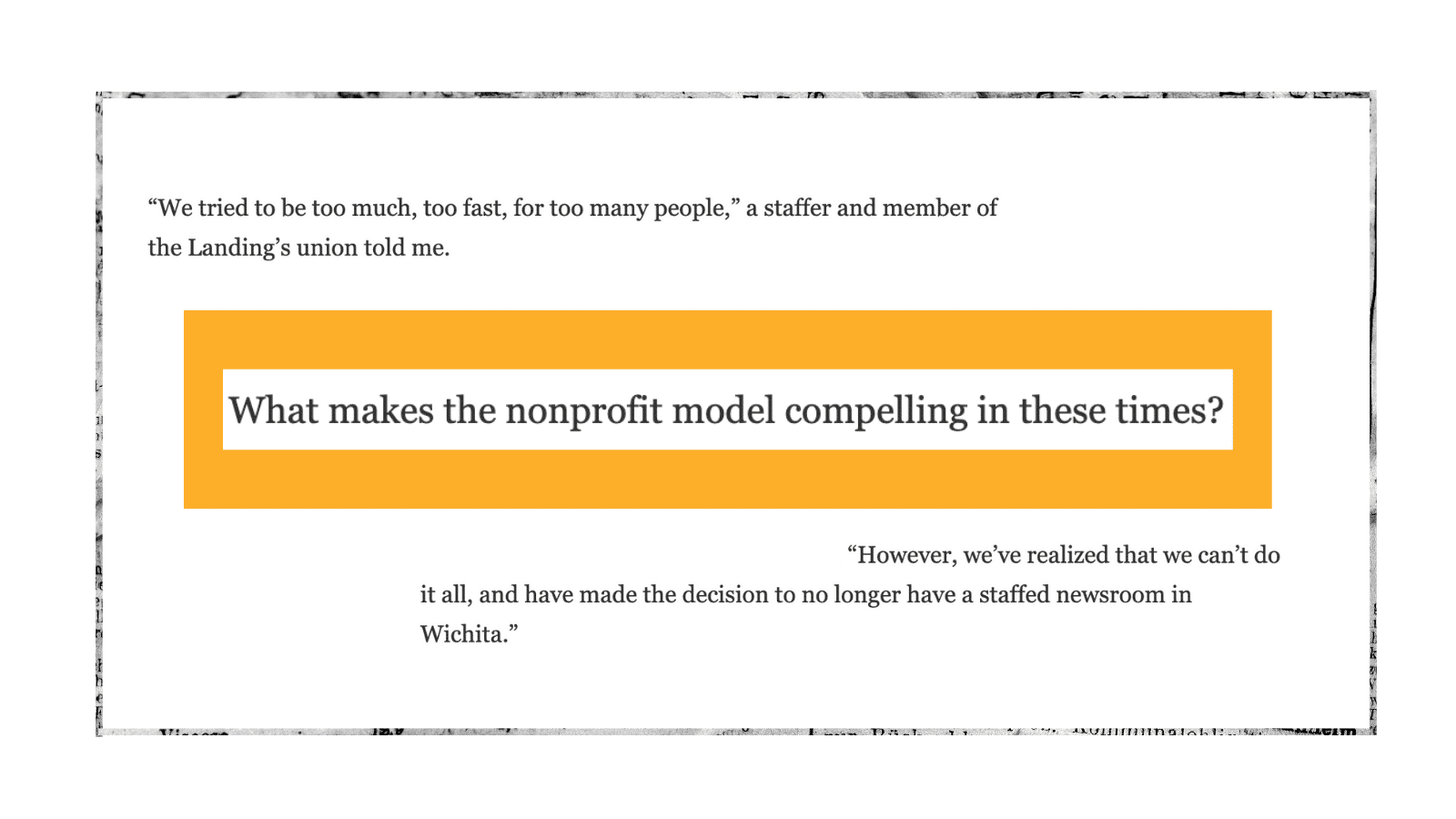
But anecdotally, it feels like nonprofit news leaders — myself included, at my former role as co-executive director of Resolve Philly — find themselves investing more of their capacity in fundraising than they do in anything else. One- or two- year restricted grants force impossible tradeoffs: Should leaders grow audience or editorial depth, operational backbone or the revenue team? There are rarely resources for more than one effort at a time. Look at the Wichita Beacon’s difficult decision to close in late 2024. The reason for its closure? It “[couldn’t] do it all.” Even with early investment from the American Journalism Project, a similarly situated Houston Landing shuttered earlier this year, citing an inability to support operating costs.
A (very) recent INN survey indicated that “tiny” newsrooms — those with budgets of less than $250,000 — are facing similar instability, with many relying on emergency fundraising appeals to stay afloat.
We talk about independence, yet the whole nonprofit sector, including journalism, is still impacted by the shifting winds of donors — now more than ever. I fear that we’ve confused survival with solvency. Until we reckon with that, nonprofit news will remain necessary, but insufficient. It isn’t a sustainable business model. It’s a workaround we bet on in the wake of commercial collapse.
The field’s default questions about growth, scale, and sustainability belong to a media ecosystem that no longer exists. Instead, we need new questions for the next two decades of nonprofit news and beyond. What if instead of “How do we sustain this model?”, we asked, “What does this moment demand of us and how do we fund that?”
What if we created conditions where journalism, particularly at the local level, could organize itself around civic need and not donor comfort?
Whether we want to acknowledge it or not, we are shaping our work around what funders feel safe supporting, just as much as we are shaping it around what communities need.
We must reclaim nonprofit news’ potential by building practices and partnerships that are responsive to real community dynamics and the pace at which they evolve while acknowledging the complex, interconnected, power-inflected realities of life.
The good news is there’s already a blueprint: There are so many newsrooms already doing this accountable, resonant, and deeply place-specific work. They represent the most promising kernels of what news can do and be, especially at the local level: a public utility providing community fellowship, cross-sector collaboration, civic education and engagement. And their impact is tied to people, practices, structures, and values that center power-sharing and trust, not to a tax status.
CivicLex is doing deep civic skill-building and reporting work in Lexington, KY, Black By God is offering a nuanced portrayal of the Black experience in Appalachia, Outlier Media is providing accessible service journalism to Detroiters, and the outlet I co-founded, Resolve Philly, continues to produce high-impact community-oriented journalism for the City of Brotherly Love. The work that is worth protecting is already happening in earnest.
The most important question now: What do we need to build around that work for it to last?
The task at hand involves completely reimagining infrastructure and building it collaboratively, especially and necessarily with those outside journalism. If we want flourishing news ecosystems, we have to stop treating nonprofit status as the fix. It bought us some time, but the next chapter can’t be about propping up what we built in the midst of turmoil.
It won’t be easy and it won’t be instant (take note, philanthropy), but anything meant to serve the public should be built in public, with the same care, generative tension, and trust it takes to build a community.
Cassie Haynes is a strategist working at the intersection of local news, democracy, and civic power.
This piece was edited by James Salanga. Copy edits by Jen Ramos Eisen.
We depend on your donation. Yes, you...
With your small-dollar donation, we pay our writers, our fact checkers, our insurance broker, our web host, and a ton of other services we need to keep the lights on.
But we need your help. We can’t pay our writers what we believe their stories should be worth and we can’t afford to pay ourselves a full-time salary. Not because we don’t want to, but because we still need a lot more support to turn The Objective into a sustainable newsroom.
We don’t want to rely on advertising to make our stories happen — we want our work to be driven by readers like you validating the stories we publish are worth the effort we spend on them.
Consider supporting our work with a tax-deductable donation.

James Salanga,
Editorial Director
Related Articles

Journalists aren’t the only ones sharing the news, and that’s a good thing
A new framework from Journalism + Design Lab invites newsrooms to build on the abundance, diversity, and momentum already in our communities to strengthen local news.
The Black press has always faced an inequitable funding landscape. Its future can’t be the same
Looking to historical models can provide some clarity and inspiration in an environment once again hostile to funding Black journalists and the Black press.
It’s healthy for student journalists to raise concerns about AI
Generative AI isn’t a real solution to the issues facing newsrooms. Students are right to point that out.