
Food reporting should go beyond buzzwords
Food reporters shouldn’t just write about what’s on their plate — they need to interrogate how it got there.
This piece is a part of our series “The Food Media Reckoning” — a collection of reporting, essays, and criticism about the holes that still exist in food media — and what its future could look like when we look to its past. Read more here.
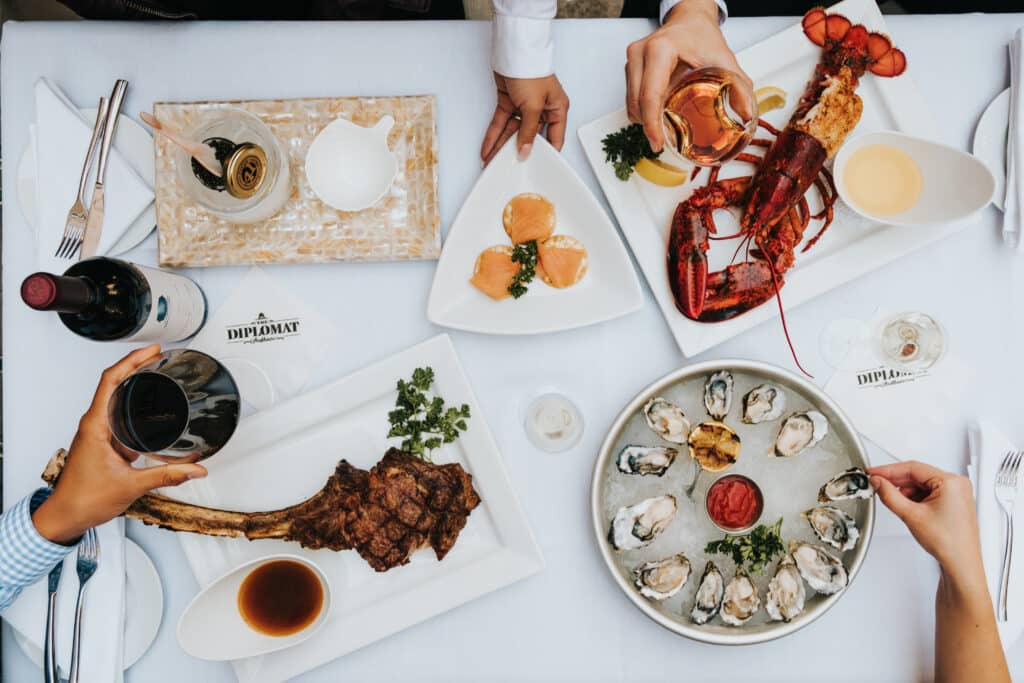
There is arguably no faster way for a restaurant to catch the eye of that certain class of Yelp-minded yuppies than to declare itself a member of the farm-to-table movement.
The Deer’s Head Inn in Elizabethtown, New York, is one such restaurant embracing the ethos. Chef Spencer Coplan partners with roughly a dozen farms within a 50-mile radius of his restaurant to craft the restaurant’s ever-adjusting seasonal menu.
Speaking with The Objective in January, Coplan explained that the farmers are his mutual collaborators, and he hopes to pass that ethos down to his customers, teaching them about where their food is coming from.
“There are days when I’ve ordered turnips and the turnip field is flooded,” he said. “And the customer, I think, is a little more understanding because they know that we actually use these farms and we have good relationships with them.”
Though some restaurants have always been in the habit of partnering with regional purveyors — a historic practice that long outdates our now-international food system — the past decade has seen more and more eateries jumping on the bandwagon, touting sustainable, grass-fed beef from such-and-such farm and seasonal stone fruit harvested within a stone’s throw of their kitchens.
“The relationship between ag and the diner has gotten closer,” according to Benjy Egel, who’s had a front-row seat to the trend’s flourishing as the food and drink reporter for The Sacramento Bee.
Nestled in the California Central Valley, which produces a quarter of the nation’s food, Sacramento seeks to establish itself as a hub for the farm-to-table movement. Officials declared the city “America’s farm-to-fork capital” in 2012, and the moniker has since been emblazoned on a prominent water tower off Interstate 5.
“There’s a real demand for farm-to-fork dining in Sacramento and a lot of other cities,” says Egel. “People enjoy going into the farmers markets, having relationships with their local farmers, knowing that when they’re eating at a restaurant, things come from a place down the road.”
At its best, this back-to-basics ethos narrows the gap between producer and consumer, with chefs and shoppers aligning their menus with in-season produce purchased at area farms. It’s a practice that promises greater economic stability for local farmers and an improved education for diners about the food system keeping them fed.
The popularity of movements like farm-to-table has grown alongside broader appetites for consciously-sourced food. The International Food Information Council’s 2022 Food and Health Survey found that roughly four in ten Americans (39%) say environmental sustainability has an impact on their decisions to buy certain foods and beverages, a 12% increase from three years earlier. And a majority of millennials (73%) and Gen Zers (71%) said they had “greater concern about the environmental impact of food choices than other generations.”
But while customers are likely to flock to restaurants using the right buzzwords, journalists should be wary of taking trends at their purportedly ethical face value. The farm-to-table movement asks customers to consider how their food arrived at their plate, and if journalists are committed to accurately reporting on the food industry’s pursuit of equity, they would be wise to do the same — whether a restaurant has three Michelin stars or none.
Who defines “farm-to-table”?
Like with all trends, the buzzwords associated with clean eating and ethical restaurant-going have warped over time. The first farm-to-table restaurant was arguably Alice Waters’ Chez Panisse in Berkeley, which offered a daily, rotating, prefixed menu that highlighted local, high-quality ingredients in an attempt to push against the mass-made meals of the mid-20th century.
But without standard definitions for terms like organic or slow food, everyone from enterprising grifters to trend chasers can claim aspects of the health food movement for themselves, and there are few ways to ensure terms aren’t being used duplicitously.
Is a restaurant that buys its chickens from an inhumane, but nearby, slaughterhouse less or more farm-to-table than another that exclusively sources Mary’s Free-range Chicken from a farm slightly further away?
Even well-meaning institutions can muddy the waters by broadening the term for their own marketing. Take Sacramento’s Golden 1 Center: Despite sourcing 90% of the ingredients from its menu of loaded nachos and jumbo cheese dogs from “a 150-mile radius of the arena,” can it really claim the farm-to-fork label?
“There’s definitely some fudging of the books,” said Coplan, the New York chef. “In order to get the attention of the customer, to get the attention of the media, in order to charge more money, some people just slap the label on.”
In 2016, reporter and food critic Laura Reiley published a multi-part investigation for the Tampa Bay Times entitled “Farm to Fable.” Local restaurants claiming to work with local farmers or fishermen had been falsely attributing their wares. Fields supposedly filled with local carrots lay fallow. Fishermen had never heard of the restaurants supposedly serving their grouper. And on the grower side, farmers’ market vendors purporting to be local growers were actually resellers, buying rejected grocery chain produce and repackaging it as their own.
Reiley, then a nine-year veteran reporter and reviewer for the Times, said there’s “no accountability” for potential greenwashers — in part because purveyors, consumers, and reporters often lack the resources to do the in-depth reporting that would hold sellers accountable.
“[That story] kind of changed my life,” she told The Objective. “I became much less interested in just telling people about what’s on the plate and more interested in telling people how it got there.”
Other high-level misgivings of the food industry are also becoming more thoroughly reported. In recent years, increased scrutiny has unearthed toxic work environments fostered by restaurateurs including Mario Batali and David Chang. At the local level, the Bee’s Egel investigated a well-known coffee shop owner and supplier in the Sacramento area over workplace harassment and mistreatment of unhoused residents.
But local publications, short-staffed due to budget cuts and layoffs, may not have the resources to prioritize these investigations.
Though Reiley now reports on the business of food for the Washington Post, she said the process of writing and reporting on the claims of both restaurants and farms while at the Times stretched on for over two months — she often undertook the tedious task of driving out to farms across the region on her own.
Egel, who often doubles as a stringer for The Bee’s breaking news desk, said his investigation took two months. (When I spoke to him for this story, he had just returned from a reporting trip covering the effects of a massive flood in the region.)
But the issue goes deeper than coverage bandwidth. The expectation of readers and the industry at large is often to solely center what’s on the plate, and when subjects beyond the food are centered, the default is not to question them but to laud them.
Celebrity is a smokescreen, not the whole story
In 2021, the San Francisco Chronicle published a story revealing that Passmore, a dominant farm-to-table caviar purveyor just outside of Sacramento, had been deceptively purchasing sturgeon roe from overseas and repackaging it as local. As a caviar supplier for famed restaurateurs, including Tyler Florence and Thomas Keller, Passmore’s deception sent shockwaves through the Northern California dining scene.
But the revelation was unnerving for me on a personal level. Just a year prior, while working as a staff reporter at Sactown, a Sacramento city magazine, I had fact-checked a feature-length profile of the business’s owner, Michael Passmore. I spent hours scrubbing through transcripts, going back and forth with Passmore and our writer to ensure we had represented his alluring business model accurately.
I never once suspected he might be hiding something — and, in a way, I had no reason to. My main role was to ensure the subject’s expertise hadn’t been lost in translation, not to question the purveyor himself. After all, he was the story’s main source.
In many ways, this trend is pervasive in restaurant reporting. Journalists extend goodwill to chefs and purveyors who are “experts” in their field, focusing on what makes them noteworthy — a genius chef’s complex background, a deep knowledge of cuisine unfamiliar to most readers, a trendy new menu item.
For The New Republic in 2020, Kate Telfeyan put it this way: “Cooks and food writers are all brutalized to some degree by the imperatives of competition and profit. The economics of restaurants are notoriously inhospitable, which means that chefs need to aggressively market themselves in order to stay afloat, while ad-dependent food media outlets, as well as more traditional newspapers and magazines, naturally gravitate to whatever’s going to bring in clicks and readers.”
From this limited frame, journalists are often inattentive to the ways we carry water for those in positions of authority, in part because it is often to our benefit to do so.
Coplan, the New York chef, has seen the way restaurants vie for media attention by chasing trends and pursuing flashy marketing students. To him, viewing restaurants through the lens of celebrity runs the risk of obscuring what food service should be about: offering everyone the opportunity to enjoy quality food.
“You may have an interesting story,” he said. “You may have come a long way, but are you treating your staff well? Are you paying them well? Do they feel valued as employees?”
When triple Michelin star restaurant Noma — considered the epitome of farm-to-table dining by critics and industry members alike — announced it would be closing its doors in early 2023, it became the biggest food story in the world. (Noma also bore eerie similarities to the restaurant centered in this year’s cinematic thriller, The Menu.)
But according to a former head chef at the Danish restaurant, Dan Giusti, most coverage of the closure highlighted news outlets’ tendency to prioritize glamorous, celebrity-centered stories over the material concerns of members of their local communities.
“I’ve received more interview requests from media outlets today, regarding the closing of [Noma], than I have in the last year about [Brigaid, a business founded to provide “good food” at local institutions] and the work that we do placing chefs in public schools, senior centers, and prisons,” Giusti wrote on Instagram days after Noma’s announced closure.
“It really makes it clear what food media cares about and, maybe more importantly, doesn’t care about.”
For journalists, it can be tempting to champion a silver bullet that will even out our topsy-turvy food ecosystem or a famous chef who seems to have it all figured out (or chronicle their downfall).
But prioritizing ethical purity as a standard for newsworthiness obscures the reality of most restaurant workers. Most restaurants and purveyors exist somewhere in the gray area, making the best food they can with the best resources available to them. Sometimes that looks like farm-to-table and sometimes it looks like Sysco.
“For a lot of reasons — some of it is inflation, some of it is COVID supply chain stuff, some of it is labor, increased labor prices — I think that there is less attempt to source locally in a lot of places,” said Reiley, from the Times. “It’s just harder to do, and it’s really hard to be profitable in this environment if you source entirely — or even mostly — from local farms.”
Buzzwords aside, the restaurant industry and our national food supply chain have never hinged on a single restaurant personality or one purportedly ethical form of consumption — rather, they are the summation of complex systems and trends and policies.
Perhaps it’s not just restaurants that need examining, but the conditions and forces that keep them functioning as they are — often barely breaking a profit while also breaking their workers’ backs.
Reiley, who now reports on the Washington Post’s business desk, not the food desk, remains certain the scope of the restaurant beat must expand.
“Our food system is at the absolute core of two of the biggest threats to humanity: Climate change and lifestyle-related diseases,” she said. “And so, the people who report on food are gonna have to call balls and strikes on a lot of things in upcoming years.”
“It’s not enough to be a wine connoisseur, to know the béchamel is made right. It’s a lot broader than that.”
Curtis Yee is a writer and editor covering the intersection of faith, race, and culture. He is based in Washington, DC.
This piece was edited by Janelle Salanga. Copy edits by Gabe Schneider.
We depend on your donation. Yes, you...
With your small-dollar donation, we pay our writers, our fact checkers, our insurance broker, our web host, and a ton of other services we need to keep the lights on.
But we need your help. We can’t pay our writers what we believe their stories should be worth and we can’t afford to pay ourselves a full-time salary. Not because we don’t want to, but because we still need a lot more support to turn The Objective into a sustainable newsroom.
We don’t want to rely on advertising to make our stories happen — we want our work to be driven by readers like you validating the stories we publish are worth the effort we spend on them.
Consider supporting our work with a tax-deductable donation.

James Salanga,
Editorial Director
Related Articles

Q&A: Alan Chazaro of KQED’s ¡Hella Hungry!
Poet, educator and ¡Hella Hungry! creator Alan Chazaro reflects on coming to food writing as someone from outside the institution of traditional journalism, telling human stories through food and more.

Where the hell is Africa in food coverage?
Despite the growing popularity of food media in recent years, African stories are sparingly included — leaving media coverage of food history incomplete.
The alternate reality of celebrity chefs
Rarely, aside from sexual assault, overt racism, or in the case of Martha Stewart, insider trading, do celebrity chefs get comeuppance.