
U.S. reporting on Palestine fails to live up to basic journalism standards — again
U.S. outlets are complicit in normalizing Palestinian genocide.
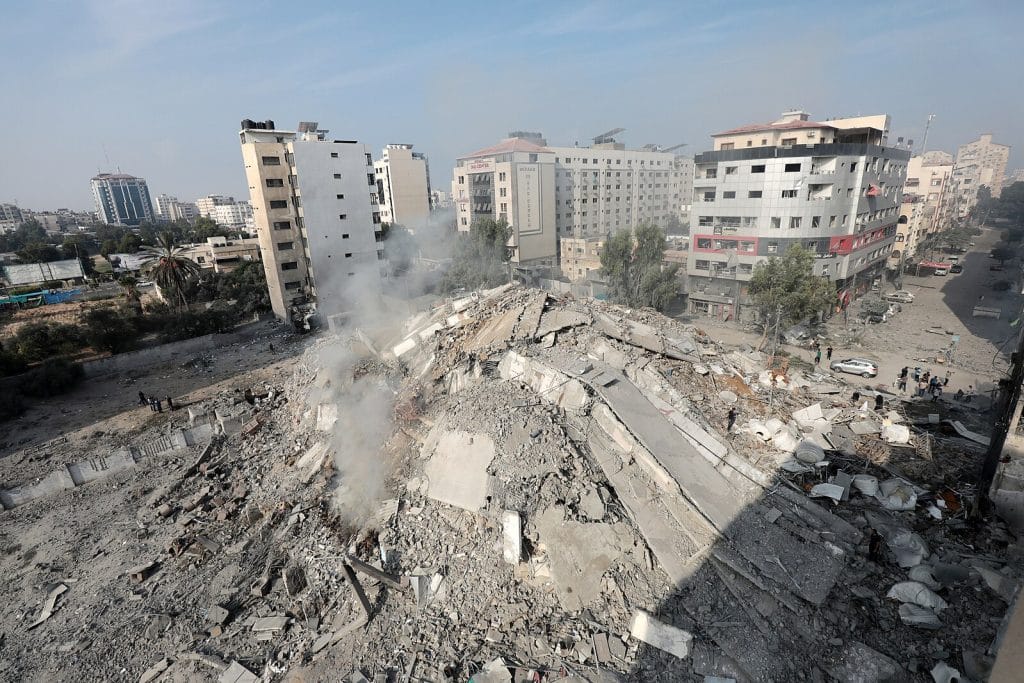

In early October, The Objective’s Omar Rashad spoke with Yousef Munayyer about lopsided U.S. coverage of Palestine, which fails to center Palestinian voices, invalidates their experiences, and erases — according to Munayyer — “the daily violence of occupation and apartheid, which Palestinians live with in every aspect of their life under Israeli control.”
This isn’t a new pattern. It reflects not just a double standard, but a massive failure of journalists to carry out their jobs: Fact-checking, appropriately contextualizing information, using accurate language and centering stories on those most affected.
Flattening narratives using nebulous, general terms, while skirting around naming and discerning details, keeps American audiences from properly understanding Israel’s ongoing occupation of Palestine. That’s not just bad journalism practice — it’s outright harmful.
Related: Q&A: Yousef Munayyer on Western media’s complicity in Israel’s occupation of Palestine
First, reporters need to vet information. Just because we’re covering a U.S. ally does not mean their information is correct. We are not stenographers, both domestically and abroad. If we cannot verify information, we can say or write that.
Hamas, a Palestinian political and militant organization in the Gaza strip, broke through the Israeli military’s security blockade on Oct. 7 and launched a surprise attack which killed over a thousand Israeli military personnel and civilians. Since then, Israel has used the attack to justify a non-stop bombing campaign of Gaza without recourse for civilian life.
Israel — which per international law and consensus, occupies Palestinian territory — has a long history of intentionally manipulating media outlets for its military gains. For weeks, the Israeli government intentionally lied about killing Palestinian-American journalist Shireen Abu Akleh on May 11, 2022. The New York Times reconstructed the incident, demonstrating that Israeli snipers killed Akleh. Since then, the United Nations’ independent investigation has determined the same.
When the attack on a hospital in Gaza happened last week, many reporters quickly assumed that Israeli and U.S. intelligence on the attack would be trustworthy, despite a history to the contrary.
As Munayyer lays out in his Q&A, U.S. outlets have long given deference to Israeli aggression in media coverage, but the ongoing siege and bombardment of Gaza by the IOF in response to the Oct. 7 attack has taken that outright bias to new heights. Notably, CNN, MSNBC, the New York Times, and many other legacy outlets amplified an unverified and now retracted claim — which originated directly from a single Israeli military major — that Hamas militants crossing into Israel beheaded babies.
The outlets quoted an Israeli soldier falsely stating the information, but no one seemed to ask for confirmation or evidence before publishing the story as factual — reminiscent of the pitfalls of accepting police press releases at face value. By the time of retraction, and despite a CNN reporter’s apology, Israel had already secured large-scale international support for what has become the bloodiest attack on Gaza in the city’s modern history.
Second, U.S. media often conflates criticism of Israel with antisemitism. This is a false equivalency.
In some cases, people’s critique of Israel is a springboard to repeat antisemitic rhetoric, and antisemitism and a position critical of Israel are seemingly synonymous.
But crucially, criticizing the actions of the Israeli state — similar to that leveled against any other country — cannot be regarded as antisemitic, according to the working definition of antisemitism outlined by the International Holocaust Remembrance Alliance.
Several Jewish advocacy groups like Jewish Voice of Peace and Bend the Arc condemn both Israel’s occupation of Palestine and ongoing bombings of the Gaza Strip. Human rights organizations, including B’Tselem, Human Rights Watch, and Amnesty International, point to Israel’s occupation of Gaza as apartheid, noting both Hamas and Israel have committed war crimes. Save the Children also published a report last month that found 2023 has been the deadliest year for Palestinian children under Israeli occupation on record.
More so, prominent Jewish people have been criticizing Israel since its inception, as when Albert Einstein and Hannah Arendt criticized the predecessor to current Israeli prime minister Benjamin Netanyahu’s Likud party.
Palestinians and their allies around the world are actively countering the wide swaths of disinformation promoted by Israeli soldiers and politicians and amplified by the wide reach of American media. The Washington Post, like many other outlets, have begun calling the attack by Hamas “Israel’s 9/11” — language that flattens international events by transposing them onto American experiences, oblivious to the stereotypes and connotations invoking the event plants in readers’ minds.
U.S. President Joe Biden has himself referred to the attack as equivalent to “fifteen 9/11s.”
Many Palestinians are mourning loved ones lost in the violence while grappling with falsehoods about their communities that fundamentally rely on the dehumanization of Palestinians, Arabs, and Muslims around the world, with the massive Israeli assault on Palestinians also leading to an uptick in Islamophobic and racist rhetoric. The Objective also previously covered this dehumanizing in 2021 during another disproportionate Israeli attack on Gaza.
Related: Objectivity and Palestine
The Objective exists to counter one-sided narratives posed as authoritative, detailed reporting that makes it so easy, so simple, for major news organizations to remove critical and contextual events from stories. Despite ongoing pressure, journalists around the world have tried to bring the Palestinian story to light.
Unmasking media bias and commitments to mainstream narratives without proper context or fact-checking is a basic task of any journalist. That becomes even more crucial when covering the current situation in Gaza, considering the active Israeli occupation as Palestinians fight for their liberation.
Ensuring journalists understand the unequal power dynamic and historical context, without collapsing antisemitic rhetoric into critique of Israel, is crucial to both human lives and the integrity of news coverage.
Some resources:
- For coverage: The Arab and Middle Eastern Journalists Association has put together a list of ways journalists can improve their coverage.
- To commit to accurate coverage of Palestinian genocide: Media workers are signing this open letter to share their support. There are options to sign anonymously and to provide institutional affiliation when you sign here. (If you’re a media worker who has suffered retaliation for expressing solidarity with Palestine, the National Writers Union is connecting folks with support.
- To provide support to Palestinian journalists reporting on the ground: In the wake of increased danger to their lives, the IWW Freelance Journalists Union and Palestinian Journalists Syndicate are running a fundraiser to provide 50 safety kits.
In solidarity with the global general strike called by Palestine Speaks, The Objective chose not to send out this issue of The Front Page as regularly scheduled on Oct. 20. The Front Page is our twice-monthly newsletter on that examines systems of power and inequity in journalism. Subscribe here.
We depend on your donation. Yes, you...
With your small-dollar donation, we pay our writers, our fact checkers, our insurance broker, our web host, and a ton of other services we need to keep the lights on.
But we need your help. We can’t pay our writers what we believe their stories should be worth and we can’t afford to pay ourselves a full-time salary. Not because we don’t want to, but because we still need a lot more support to turn The Objective into a sustainable newsroom.
We don’t want to rely on advertising to make our stories happen — we want our work to be driven by readers like you validating the stories we publish are worth the effort we spend on them.
Consider supporting our work with a tax-deductable donation.

James Salanga,
Editorial Director
Author

Related Articles
Billionaire newspaper owners prompt deluge of unsubscribers
The decision to not endorse at the LA Times and Washington Post reflects the perilous situation at virtually every major mainstream newsroom: billionaire owners decide without worker input.
Where is journalism going? Ask media workers, not elites
If anything, what’s useful to learn from the New York Magazine piece is what many reporters have already experienced — that some editors and leaders don’t care whether they’re entirely out of touch with their employees.

News’ artificial intelligence fixation deserves more scrutiny
Journalists shouldn’t passively accept the encroaching presence of generative AI into the news industry.