
Israel’s bombing campaign on Gaza is a test for journalism. Mainstream U.S. outlets are failing.
News organizations seem more concerned with policing their own reporters than they do holding powerful actors accountable.
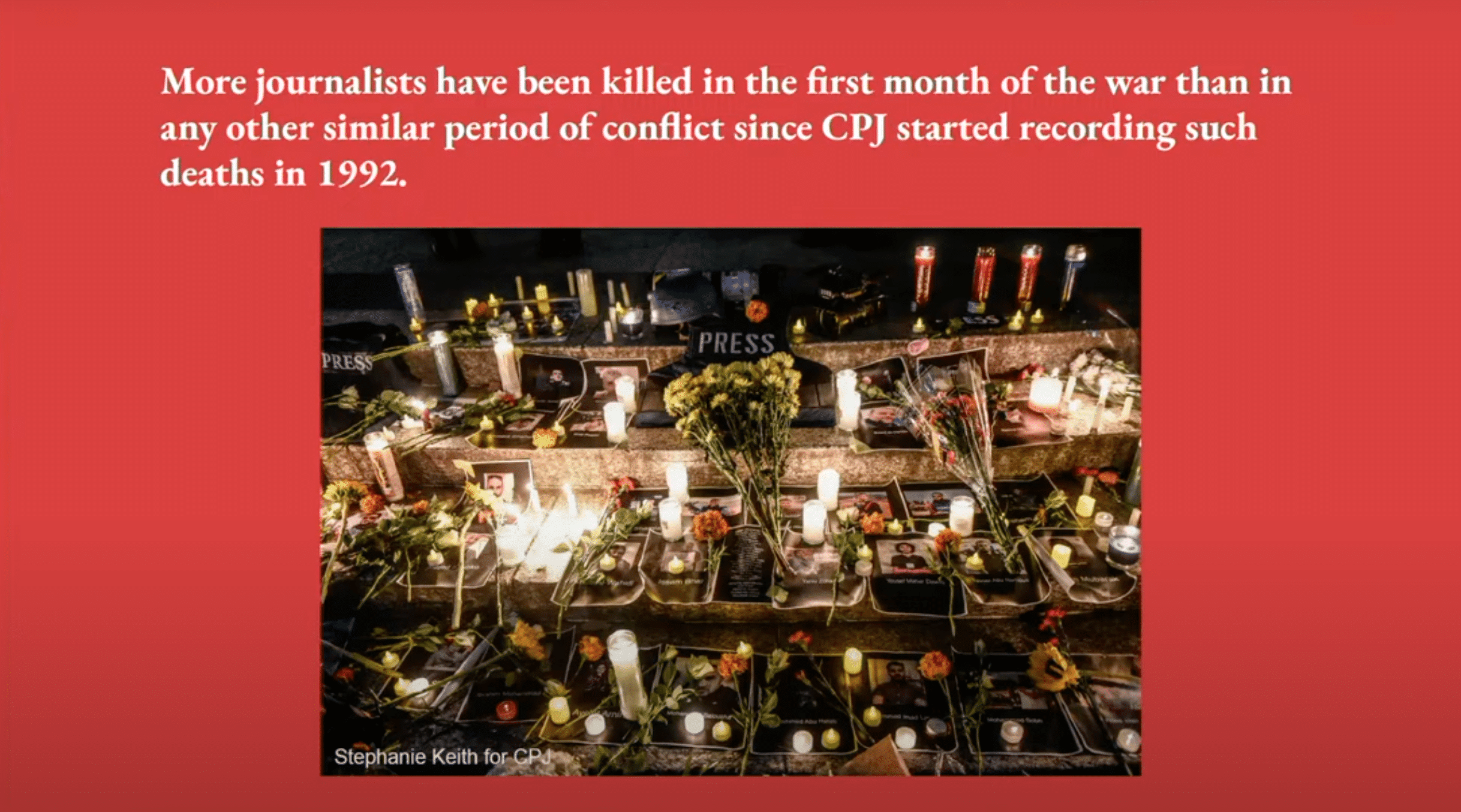
Israel’s airstrikes on Gaza have officially resulted in “the deadliest month for journalists since CPJ [the Committee to Protect Journalists] began gathering data in 1992.”
CPJ’s ongoing tally has found over 42 journalists have been killed in the region since the Palestinian militant group Hamas attacked Israel on Oct. 7 and Israeli’s military responded by waging continued air and ground assaults.
37 of the reporters killed were Palestinian, four were Israeli, and one was Lebanese, CPJ found. The total number of dead outpaces that of any conflict since the organization began tracking journalists’ killings after its founding in 1992. And on top of that, earlier this month, United Nations human rights experts said Palestinians are “at grave risk of genocide.” That includes the Palestinian journalists covering the violence abroad.
That context hung over this week’s meeting of journalists, scholars, and advocates at the 2023 Democracy Summit, an annual forum hosted by Howard University’s Center for Democracy in Journalism to promote honest and accurate journalism about threats to America’s multiracial democracy.
While the main focus of this year’s conference was on anti-democratic forces impacting states and localities, the violence overseas was on many attendees’ minds, as participants grappled with whether and how to speak out about the devastating impact the Israeli military’s airstrikes and siege are having on Palestinians — and journalists covering the violence they’re experiencing, specifically.
“I really have been struck by the lack of collective outrage amongst our profession,” remarked Nikole Hannah-Jones, a conference organizer and the Knight Chair in Race and Journalism at Howard.
During the only panel explicitly programmed to discuss the war, CPJ’s Middle East and North Africa program coordinator Sherif Mansour spoke to the impact this violence is having on the ability to disseminate crucial information about what’s happening in an active war zone, both to those in the region and others following along around the world.
“We have not seen any indication that [journalists’ killings] are getting better, and in fact, that number tells the story of how bad the situation [is], how dangerous it is,” Mansour said. “We cannot allow any government to escape their responsibility against civilians, and specifically for journalists.”
Mansour’s presentation focused on the dire situation for journalists in Gaza. But in the U.S., a sinister, though far less deadly, woe is taking hold in many newsrooms.
As The Objective previously reported, growing numbers of American journalists have faced retaliation or censorship from their employers for drawing attention to the humanitarian crisis in Gaza or otherwise criticizing the Israeli military campaign.
Indeed, in the weeks since that article was published, even more journalists have been silenced. Some other news organizations, meanwhile, have called out individual signees, publishing their names and headshots in stories centered solely on reporters’ participation in the letter. One signee from the Associated Press withdrew their signature at the request of the outlet.
And as recently as Thursday, over 30 staffers at the Los Angeles Times were reportedly reprimanded and stripped of their ability to cover the conflict for three months after signing an open letter with about 1,200 other journalists condemning Israel’s killing of media workers in Gaza and calling on news organizations to more accurately and honestly cover the violence.
“As reporters, editors, photographers, producers, and other workers in newsrooms around the world, we are appalled at the slaughter of our colleagues and their families by the Israeli military and government,” the letter reads. “We are writing to urge an end to violence against journalists in Gaza and to call on Western newsroom leaders to be clear-eyed in coverage of Israel’s repeated atrocities against Palestinians.”
Ironically, that same day, the LA Times editorial board called for an immediate ceasefire — the first American newsroom editorial board to do so.
As the LA Times’ censorship of its reporters indicates, journalists face significant threats to their personal lives and professional livelihoods if they speak out. Younger journalists especially say they feel torn between maintaining the appearance of “performative neutrality” and staying true to their values.
“I’m very conflicted as to how to show up in this work,” Eliana Perozo, a student at the Craig Newmark Graduate School of Journalism in New York, said during one of the Democracy Summit panels. “Both in regards to, like, my own financial well being, as I’m starting [in journalism], and the risk that I’m taking coming from a background where I’m … supporting my family.”
But mainstream news leaders’ demands haven’t stopped some of the biggest names in the industry from pursuing their values — and highlighting how their reporting is made stronger for it.
Earlier this month, award-winning New York Times Magazine reporter Jazmine Hughes was forced to resign from the publication for signing a similar open letter criticizing the war and mainstream coverage of it.
“[T]his was a clear violation of The Times’s policy on public protest,” editor Jake Silverstein wrote in a note to staff. “This policy, which I fully support, is an important part of our commitment to independence.”
Hughes recently spoke out about her decision to sign the letter on “Democracy Now!”
“I wanted to personally hold myself accountable,” she said. “The letter was addressed in part to other news organizations, other journalists that spoke about workplace violations, harassment that people were facing, that spoke about the ways in which the conflict is being covered. And I considered it a conversation within the industry that I wanted to be a part of.”
Asked whether signing the letter compromised her objectivity, as Times leaders alleged, she noted objectivity is “a wonderful, beautiful project for a world that does not exist.”
“I signed the letter as an employee of the New York Times but [also] as a black person, as a queer person, as a woman,” Hughes said. “Every story that I’ve written for the New York Times has been, like, through my very real identity and experiences… all the stories I wrote had a particular voice. And I think that voice translated onto the letter because it’s me.”
Tuesday’s Democracy Summit concluded without any concrete takeaways as to how journalists should best balance their personal ideologies with their professional obligations, as panelists espoused vague platitudes like “follow your values” without interrogating the significant risks such actions pose.
These debates, which have existed within journalistic spaces for decades, continue to persist. Individual journalists can and should continue to take actions consistent with their values, while also recognizing it’s wholly understandable to do so privately to prevent professional retaliation.
But the burden for pursuing clear-eyed and historically-situated reporting should not fall entirely on individual journalists; newsroom leaders and journalistic organizations have a responsibility to do so as well — one many have ducked so far, instead reprimanding the reporters pushing them to do better.
While some news leaders have spoken out, it’s incumbent on the industry writ large to highlight the drastic impact the Israeli military campaign is having on access to information in the region and Palestinian journalists’ lives, even if that means losing access to one-sided coverage agreements negotiated with the Israeli military.
It’s also incumbent on media companies to elevate the voices of journalists within their organizations who have personal connections to Palestine, a guide from the Arab and Middle Eastern Journalists Association notes, not seek to silence them in favor of allegedly “objective” observers who simply don’t exist.
As workers with the Palestinian Journalists’ Syndicate wrote earlier this month, journalists “have a duty to accurately and impartially report facts, especially in situations of conflict, when propaganda and misinformation threaten to obscure dire realities on the ground.”
“Now is the time for courage, honesty, and adherence to the highest principles of our profession,” they said. “Time is running out. We urge our colleagues around the world to do the right thing.”
Editor’s note: Gardenswartz, as well as several members of The Objective, including co-executive directors Gabe Schneider and James Salanga, editor Omar Rashad, and copy editor Jen Ramos Eisen, also signed the open letter.
This piece was edited by James Salanga. Copy edits by Omar Rashad.
We depend on your donation. Yes, you...
With your small-dollar donation, we pay our writers, our fact checkers, our insurance broker, our web host, and a ton of other services we need to keep the lights on.
But we need your help. We can’t pay our writers what we believe their stories should be worth and we can’t afford to pay ourselves a full-time salary. Not because we don’t want to, but because we still need a lot more support to turn The Objective into a sustainable newsroom.
We don’t want to rely on advertising to make our stories happen — we want our work to be driven by readers like you validating the stories we publish are worth the effort we spend on them.
Consider supporting our work with a tax-deductable donation.

James Salanga,
Editorial Director
Related Articles

Trans News Network calls New York Times boycott for accurate trans coverage, following boycott from WAWOG
For years, reporters, media workers, and media accountability organizations have said the New York Times’ reporting and commentary is spreading harmful misinformation about trans people.
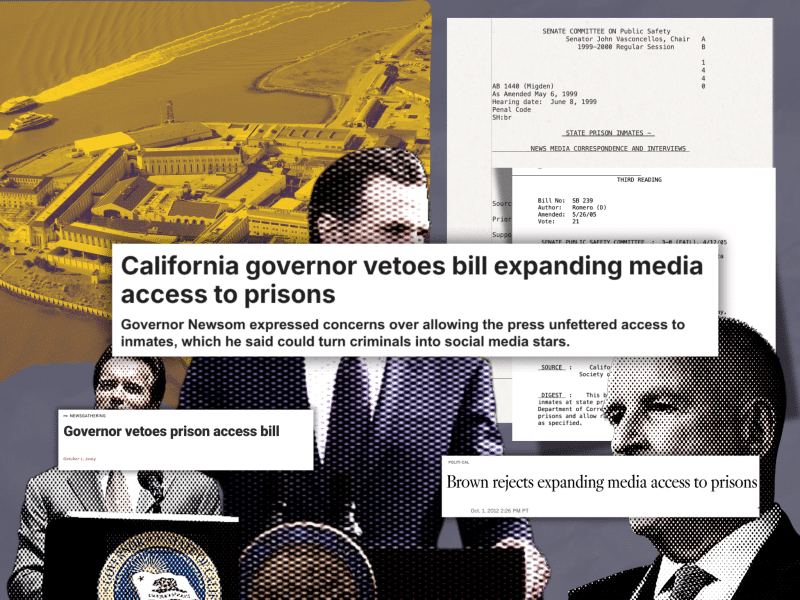
Governor Newsom adds to California’s legacy of stifling prison media access
Governor Gavin Newsom is the latest California governor to consistently veto bills seeking to expand media access and press freedom in prisons, following a precedent set by prior state governors.
U.S. investment in international reporting is shrinking, taking international journalists’ opportunities with it
As Donald Trump wins more attention from news media, one loser has often been international reporting — despite the growing imperative for American readers to have a more expansive view of their place in an increasingly interconnected world.