
Q&A: Kate Cagle
The Spectrum News 1 anchor discusses the structural issues within TV journalism and challenging power in Los Angeles.
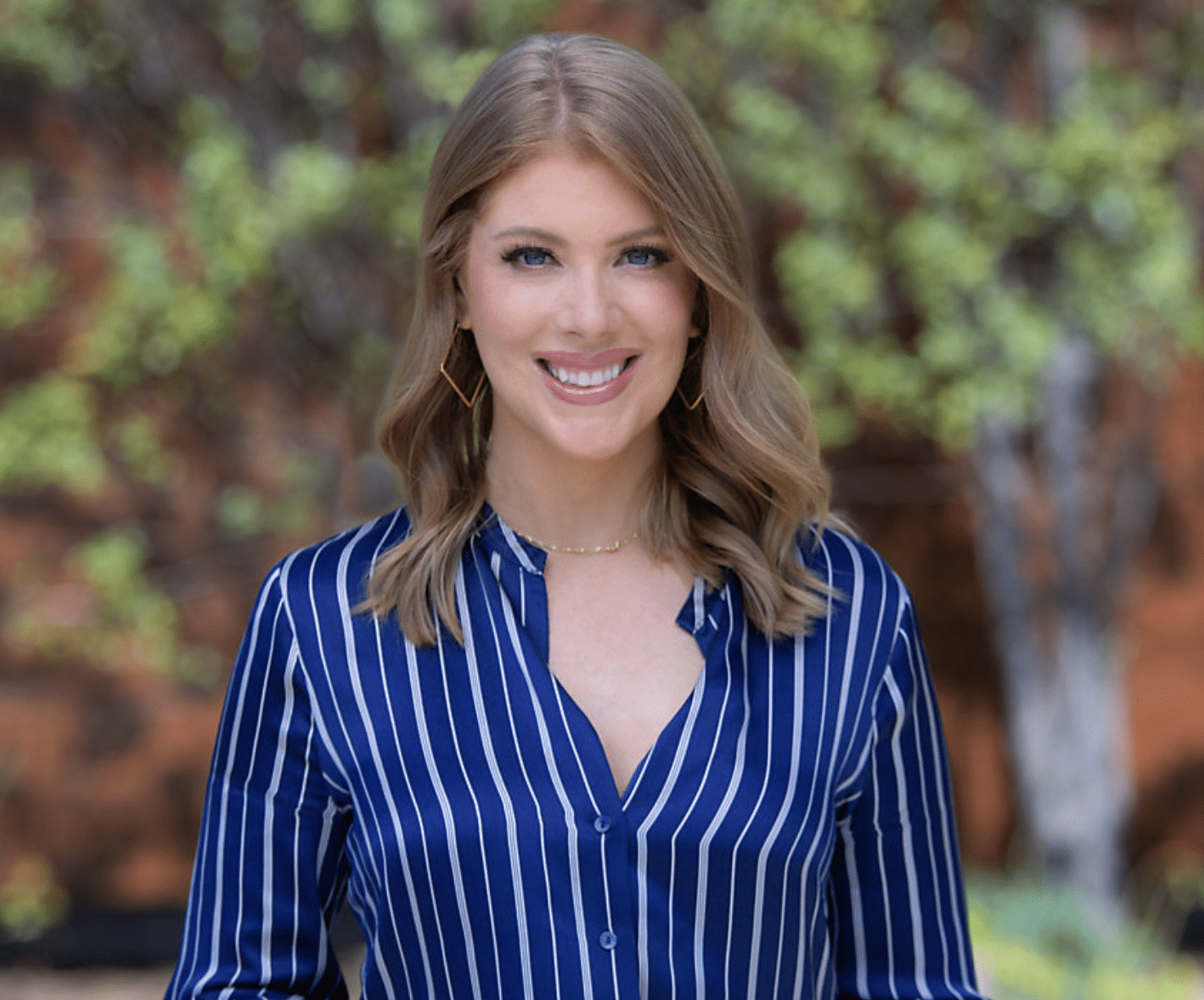
After stints with TV news stations up and down the West Coast, Kate Cagle was ready to leave the TV journalism business altogether in 2016.
She had become frustrated by the type of reporting she was producing in a journalistic medium beset by structural issues — one that dispatched reporters to random crimes or a given “story of the day” without affording them the time to become thoughtful experts on public affairs.
So Cagle moved back to Los Angeles from San Francisco and dabbled in newspapers, taking a job with the Santa Monica Daily Press, which helped widen her understanding of what kind of role, exactly, a local journalist can play.
Then, driving one day to the local courthouse, she heard what seemed like a divine message through the radio: A voice over the airwaves — now Cagle’s boss — announcing a new vision for broadcast news in Southern California, one where TV reporters had actual beats and covered actual issues.
Spectrum News 1.
Fast forward to today, and Cagle’s name is one of the 24/7 network’s biggest, her voice behind top-of-the-hour stories about issues affecting LA’s least powerful with a level of urgency and skepticism not often seen elsewhere in the televised news landscape.
From being detained while covering an encampment sweep to interviewing a Sheriff’s deputy gang tattoo artist, Cagle’s on-camera reporting has uniquely resonated with LA’s online civic audience, a forum in which activists and freelance journalists can more openly challenge prevailing narratives about police and homelessness in an area with high income inequality.
“I think I owe everything to Los Angeles, and it really shaped who I am as a person,” said Cagle, who came to LA by way of USC after growing up on the border of Texas. “And I love living here.”
For many critics of TV news and its often-uncritical reporting of government information, Cagle has set herself apart as someone who will both challenge the official line and hold other outlets accountable when they don’t do the same.
Related: Q&A: Cerise Castle
For The Objective, Brandon Pho spoke with Cagle about how she paved her path in an environment where there seem to be more hard questions these days than reporters who can ask them.
You’ve interviewed everyone from mayors to LASD deputy gang tattoo artists — what got you interested in the kind of journalism you’re doing today?
It really started when we launched Spectrum News 1 in LA five years ago. And one of the first initiatives we did was on the homelessness crisis, and that’s when I started covering homelessness in [a] really on-the-ground sort of way … sitting in encampments and meeting people who are unhoused. [I’ve] probably done a ride-along with every different agency in the city and the county, just trying to really understand what was happening. From there, that was really my foot in the door to getting involved covering criminal justice issues, because so many people who you meet on the street, they’re interfacing with police and prisons and jails.
And I became really obsessed with this question: When someone breaks the law, we can respond very quickly. But if someone just needs help, we respond extremely slowly. So I feel like in the beginning, that [disparity] was really my driving question behind every story I was trying to get at.
What was your journalism experience like before Spectrum?
I went to USC, I graduated from the Annenberg School for Communication and Journalism with a degree in broadcast journalism. I also have a bachelor’s in political science. In TV, you work your way up through city size. So I started in Palm Springs, and then I got a job working for a TV station in Portland, Oregon, and then San Francisco.
I left the business in early 2016. I just felt really frustrated by the reporting that I was doing. I was doing a lot of crime stories [and] it kind of seemed like whatever the worst thing happened, that’s where you would be sent every day. And it just wasn’t the kind of journalism that I had gone into the field to do.
So I quit my job in San Francisco. I didn’t have a fallback; I moved back to LA. And long story short, I ended up taking a job at the Santa Monica Daily Press, which is essentially like a three-person newsroom — an editor and two reporters. And it became the best job I’ve ever had. My first story was about climate policy. All of a sudden I knew the mayor and people were looking for my byline. … I really loved the reporting that I was doing for them, but it didn’t pay great.
And I was driving to the courthouse one day when I heard my now boss on the radio, talking about how they were going to launch a new broadcast network in LA. And reporters were going to have beats, and they were going to cover actual issues — they weren’t going to car chases … or going to do random crime [stories]. And I literally yelled at the radio, “This is the perfect job for me!” Luckily enough, I ended up getting hired at Spectrum News 1 and they really kept their word — … I really believe in the product.
It sounds like, based on what you’ve described, Spectrum very much shared in that vision of what broadcast news should be.
I remember the first week we were on the air, seeing my news director Scott Warren in that hallway, and looking at him and saying, “Oh my God, this is news I would actually watch.”
It just felt so revolutionary to be making a product that was something that we all loved, because we were all doing stories that we loved. And we are exploring the topics that we were interested in, and actually reporting on them in a compassionate way, in a way that, at the end of the day, we want to reflect the fact that we all choose to live in Southern California … We love it here. You don’t typically see that in the news. In our news, you do see that.
It seems like the problems that people have with broadcast news are structural. How did you see Spectrum tackle the challenges that face broadcast news, while still being able to be doing news in a different way?
Traditionally, broadcast stations are very deadline focused, right? So you come into work every day, you’re working for a specific show, maybe the five and six o’clock news. So you come in the morning, there’s an editorial meeting, you’re handed a story, and then the entire day is basically a race against the clock to get something on the air. And Spectrum has thrown out that whole model.
So instead [at Spectrum News 1], reporters have beats. Now I’m anchoring, but as a reporter, I was responsible for three stories a week, instead of five. I was responsible for pitching [those stories], then researching them and putting them together on my own. There is really the mindset that the story airs when it’s done — not when the next show is desperate for content.
Many people paying attention to LA politics and activism might struggle to name another local TV journalist who will not only challenge the official line, but also call out other media organizations who fail to. How did you develop into this type of role in LA?
I think that that’s our job. We have an enormous privilege and platform, and especially working in stories around social justice issues — the fact that I have access to these people, I feel compelled to ask the hard questions. And a lot of people are really upset about how things are going, and I think, rightly so.
I just try to be really aware of power dynamics in my story, and I think that sometimes that gets missed in reporting, but when I’m putting the story together, I’m just very conscious of who has the power over this situation. For my own work, I try to just be really conscious of the power dynamic and the power that I have as a reporter and someone who has a platform, and the risk that people take in speaking out. And if someone is brave enough to share a story with me about injustice, I want to give them agency over how the story is told. And also try to get answers for them.
How would you describe LA’s TV news landscape in terms of its ability to challenge people in power — and how would you compare it to the LA media landscape in general?
I’m just such a believer in beats and expertise, because I think that’s the challenge that most TV reporters face, is that they are sent all over the place. And you could be covering homelessness one day and a random burglary the next right, and it doesn’t really get you the time to become an expert in the issue.
So I feel like that is such an asset when you can really own a topic. That is what really gives power in your reporting. And that’s been especially important covering these systemic issues and law enforcement, because it requires so much following up and fact checking what the official line is. And if you’re just in the daily grind, you just don’t have the same time to scrutinize the information that you’re getting.
What kinds of challenges do you face in doing the type of reporting you do?
I just feel really lucky to work at a place that has supported me in doing this sort of work. I think that persistence is a challenge for anyone, because you have to just keep going … Someone made a remark to me the other day about me being conscious of the amount of vicarious trauma that I take on, because hearing these stories does impact you personally. And I mentioned that to a friend of mine who is an activist, and he said, “You know, Kate, it’s not really vicarious trauma for you. … You’re actually with these people … you’re in the encampment, you’re in the courtroom.”
In many ways, as a reporter, you never want to think of yourself as a participant. But you’re certainly a witness to what’s happening. So I’m glad that there’s been more of an emphasis on reporters and mental health and really taking care of ourselves, because it can feel overwhelming.
How would you describe LA officials’ treatment of reporters during your time working alongside the local press corps?
I have been surprised sometimes by the sensitivity that public figures have to being criticized. But I see that as part of their jobs, and I get a lot of criticism too. This is one of the reasons that I am on social media, and I do share my stories, because I think that reporters should be open to feedback.
And secondly, it’s just a really hard media environment right now. I mean, there’s been historic layoffs in our industry. There just aren’t as many reporters as there used to be, even working for mainstream outlets. So I always say, if people want advice on how to be a mainstream television reporter, a news anchor, I’m happy to give them advice on that. But if you want to do your own thing, and report in your own way, I think that now is the time to do that. I totally support people who are paving their own way.
Where in LA’s media landscape do you find the most compelling and useful information about LA government and quality of life?
It’s really been changing. I feel like I’m in a big reset with the decline of Twitter and the rise of X. It’s really changing the habits I have around newsgathering, because I can’t rely as much on that platform for reliable information … that used to be a place where reporters from all outlets were posting their stories, and you could see what was taking off and doing well. And that’s just not how that website functions anymore.
In fact, when I come in every morning, to be honest, I have the Associated Press website open because I’m following their coverage. I also listen to the radio a lot when I’m driving, so I’m a big KNX fan. I think KNX actually does a great job of covering City Hall and everything happening locally, in a way that I don’t know that many other outlets are matching them.
And then as far as TV, I kind of you flip around the channels just to see what the different stations are covering. And then the nice thing about being established reporters, a lot of stories – they come to me now. So I have a great network of sources, people who feel like they can let me know when important things are happening that I should be paying attention to.
Have you noticed changes in LA’s media landscape since you started covering the area?
I think skepticism is always good. And I think that there’s more avenues for news viewers or consumers, whatever you want to call them, to be critical of what they’re seeing. But as far as the official media landscape, I just think the decline in reporting jobs has been really disturbing. And right now, there are far more stories than there are reporters.
What advice would you give to emerging TV journalists — or journalists in general — in LA?
I would say, don’t give up. It’s a grind, but keep going. And trust your instincts on stories.
Who are some other LA journalists that people should be following?
Well, of course, my colleagues Alex Cohen, Giselle Fernandez, Amrit Singh — they’re doing really phenomenal work covering Los Angeles. Cerise Castle and Keri Blakinger do an amazing job of covering criminal justice issues and the Sheriff’s Department in a way that feels fresh and modern and relevant.
We depend on your donation. Yes, you...
With your small-dollar donation, we pay our writers, our fact checkers, our insurance broker, our web host, and a ton of other services we need to keep the lights on.
But we need your help. We can’t pay our writers what we believe their stories should be worth and we can’t afford to pay ourselves a full-time salary. Not because we don’t want to, but because we still need a lot more support to turn The Objective into a sustainable newsroom.
We don’t want to rely on advertising to make our stories happen — we want our work to be driven by readers like you validating the stories we publish are worth the effort we spend on them.
Consider supporting our work with a tax-deductable donation.

James Salanga,
Editorial Director
Author

Related Articles
Q&A: Karen Attiah says her firing shows mainstream media still fails at talking about race
Karen Attiah, former long-time Washington Post opinion columnist and editor, sat down to talk about objectivity, “Democracy Dies in Darkness”, Black representation in news, and more.

Q&A: Autonomy News wants to cover bodily autonomy as a human right
Garnet Henderson and Susan Rinkunas, co-founders of the worker-owned reproductive justice outlet, on their new newsroom and what covering reproductive justice looks like in this particular moment.
Q&A: Guide for Reporting on Disabled Communities
Ericka A. Dixon and Sebastian Margaret, senior national organizers with The Disability Project at Transgender Law Center, on crafting a guide for better reporting on disability focused on those most at the margins.