
Donald Trump’s NABJ appearance shows the limitations of both-sides journalism
What unfolded during the event highlighted a divide between the principle of objectivity and the abolitionist tradition the Black press was born out of.
This story was originally published by The TRiiBE, an award winning digital news outlet in Chicago that is reshaping the narrative of Black people. It is being republished on The Objective in collaboration with The TRiiBE.
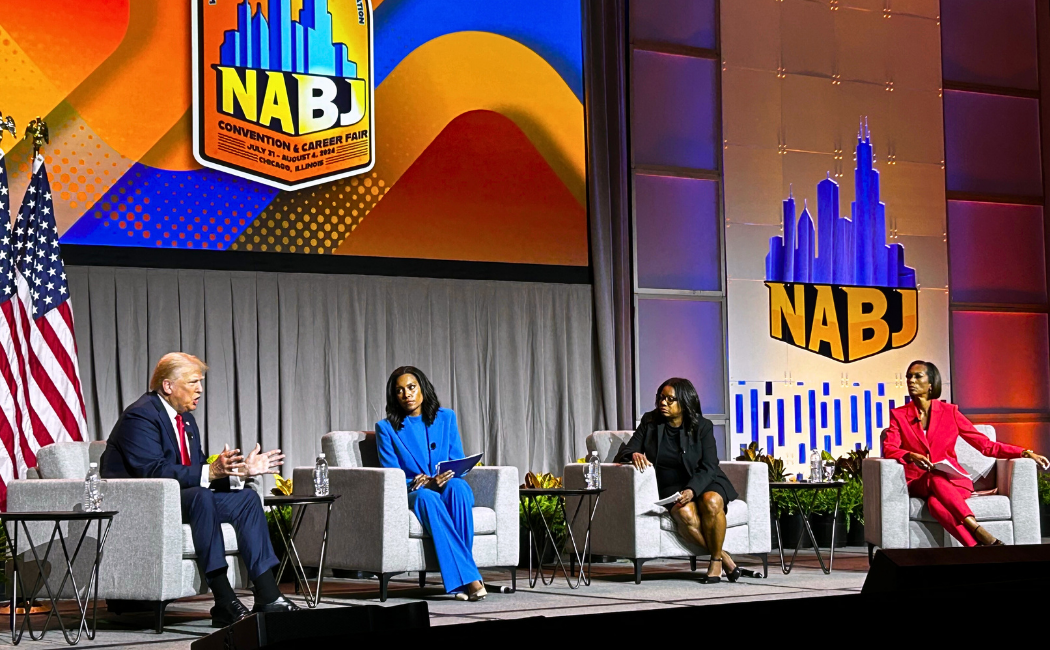
Donald J. Trump did all the things critics said he would do when he spoke at an annual gathering of Black journalists on Wednesday: He lied. He evaded questions. He insulted Black women in a room full of Black journalism professionals. He did so in typical brazen fashion at the convention of an advocacy organization created specifically to call out this exact behavior in white patriarchal newsrooms.
On July 31, the National Association of Black Journalists (NABJ) kicked off the first day of its five-day convention with a Q&A panel with former president Donald Trump, who is seeking re-election in November. The journalism advocacy organization announced its event with Trump just after 9 p.m. on Monday, which caught many of its members and other Black journalists off guard.
What Black journalists in that room experienced wasn’t much different than watching a white male editor or TV news director exercise condescension in a public critique of a Black colleague — and, as is often the case, feeling too disempowered to speak out in the moment.
When NABJ leadership stood 10 toes down on their last-minute surprise announcement to platform a narcissist, they invited millions of onlookers into a sacred space. Given the perception of antiquated practices and a lack of transparency by NABJ leadership, Black journalists were forced to commiserate and critique Trump’s inclusion on social media. This contributed to the spectacle that grew with the chaos and cameras that follow him. The kickoff of the 2024 NABJ Convention and Career Fair in Chicago became a highly politicized affair the magnitude of a nationally televised presidential debate, particularly because the hard-won Black vote is so precious and coveted when democracy hangs in the balance.
It doesn’t matter what set of questions you ask Trump. And it doesn’t matter what audience he’s in front of when responding to the questions. He is accountable only to the script drafted for him to uphold and unleash a blatant set of dangerous and dehumanizing ideals; the same ones he’s traveled the country proudly proclaiming for the past decade of his political career. Now, with NABJ’s participation, Trump’s message of anti-Blackness, division and misogyny is amplified for the world to see through memes and headlines, and misconstrued as a stamp of Black approval.
“You don’t do typical things in atypical situations. You don’t interview a candidate that attempted to overthrow the government in the same way that you interview a candidate who did not attempt to overthrow the government. You don’t interview a candidate that has become part of a disinformation ecosystem in the same way that you interview a candidate who is not,” Columbia Journalism School dean and author Jelani Cobb said.
“We approached this in a typical fashion when we’re in a wildly atypical situation, and that’s why we got the result that we got,” Cobb added.
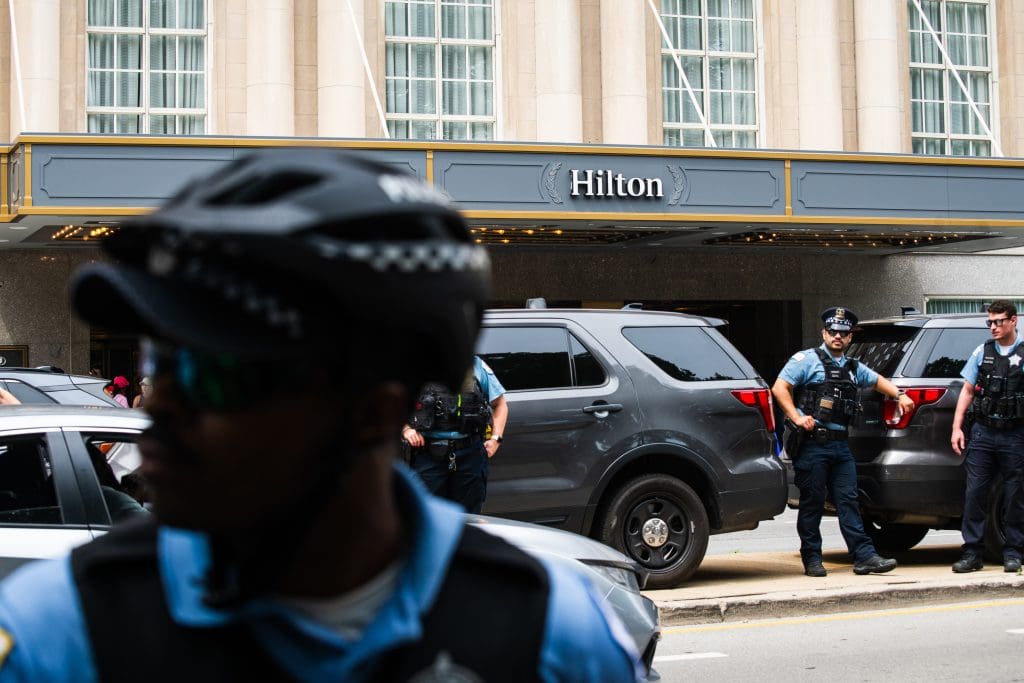
An early estimate of 4,000 people registered to attend the convention, but only about 1,000 or so fit inside the Hilton’s Buckingham ballroom. Beginning in the early morning, the press and NABJ attendees lined up in the lobby awaiting entry. By 10:30 a.m., the line wrapped around the lobby. Around 11 a.m., the line started moving into the ballroom. U.S. Secret Service agents conducted security checks, looking through bags and wanding attendees before allowing them inside.
Once on stage, Trump didn’t shy away from his usual provocative antics. Straight out the gate, he called ABC News senior congressional correspondent Rachel Scott’s question “nasty” and “hostile.” In her opening question, Scott listed the racist remarks he’s said over the years — such as his lies about former President Barack Obama’s birthplace and his attacks on Black journalists — before asking why Black voters should trust him.
“Well, first of all, I don’t think I’ve ever been asked a question in such a horrible manner. You don’t even say hello, how are you? Are you with ABC? Because I think they’re a ‘fake news’ network,” Trump responded. “I think it’s a very rude introduction. I don’t know why you would do something like that.”
Throughout the event, he blamed Scott for the event’s late start and for technical issues with equipment that, he said, made it hard for him to hear Fox News personality and co-moderator Harris Faulkner. Semafor politics reporter Kadia Goba also moderated.
Online and television broadcasts made it easy to mistake the crowd’s initial shock and discomfort for cheers. Just before the event began inside the ballroom, an announcer came over the speaker, asking attendees to remain professional during the conversation. Throughout the panel discussion, any time someone in the audience booed, yelled “lies,” or expressed any form of discontent or rebuttal to Trump’s answers, that person would be shushed and quiet whispers of “you don’t want to be kicked out” could be heard.
Quite a few people, however, were dressed in sparkly red MAGA outfits, clapping loudly for Trump throughout the event. One was P Rae Easley, a Chicago radio host and founder of the conservative PAC the Wells-Washington-Douglass Society. She has received praise from Trump before. Easley went viral in April for slamming Chicago’s spending to help migrants.
In his response to Scott’s question about calling Vice President Kamala Harris a “DEI hire,” he slid into a barrage of racist remarks about the new presumed Democratic presidential nominee (President Joe Biden stepped down from the race in July). First, he asked Scott for her definition of diversity, equity and inclusion (DEI). He then questioned her Blackness.
“She was always of Indian heritage, and she was always promoting Indian heritage,” Trump said. “I didn’t know she was Black until a number of years ago when she happened to turn Black, and now she wants to be known as Black. I don’t know. Is she Indian or is she Black?”
As he does on the campaign trail, Trump mispronounced her name.
What unfolded during the event highlighted a divide between the principle of objectivity and the abolitionist tradition the Black press was born out of. Journalists are taught that objectivity matters above all else, and that both sides of an issue must be incorporated into the news. Objectivity attempts to balance reporting but often becomes a tool to prioritize the white male experience.
However, Trump’s attendance at NABJ made many question both-sides journalism. Black journalists often do a delicate dance, having to choose between objectivity in the workplace while also reporting from the perspective of institutionally marginalized people. As a consequence, there’s always the fear of not being seen as credible or unbiased by the community and by white people at work.
Nabou Ramu, a novice reporter and University of Mississippi student, told The TRiiBE she was excited when she heard Trump was appearing at the panel because it was an opportunity for Black journalists to speak with a former U.S. President ahead of the 2024 election.
But as she took in responses from journalists online who reacted in opposition, Ramu realized their outrage contradicts what she’s learned in school.
“As a reporter and a student, I’m being taught 24/7 to not have an opinion as a reporter and to present yourself as non-biased and be objective, and to be able to ask some questions to anyone,” Ramu said.
“So I was confused, for real, by the amount of reporters who were speaking from an emotional point of view, and I felt like they were speaking as a voter and not as a reporter,” she said. “Then I started questioning myself as a reporter like, am I allowed to have an opinion like this? Does this hurt my credibility as a reporter? Would I be perceived as biased, and I’m looking up to these people. So I didn’t know, like, what’s right or wrong?”
Christina Walker, a graduate student at Washington University in St. Louis, is attending the NABJ conference for the first time, eager to network and participate in workshops. However, she also expressed concern about what the outcome of the event would mean for the organization going forward.
“I’m moreso at this point thinking about what the perception of NABJ will be after this,” Walker said, referring to Q&A, as well as what type of media coverage will come from it. “Those are my concerns right now.”
During the session, a protest took place across the street from the convention hotel. Protesters organized by Chicago Alliance Against Racist and Political Repression (CAARPR) and the U.S. Palestinian Community Network and others posted up around noon.
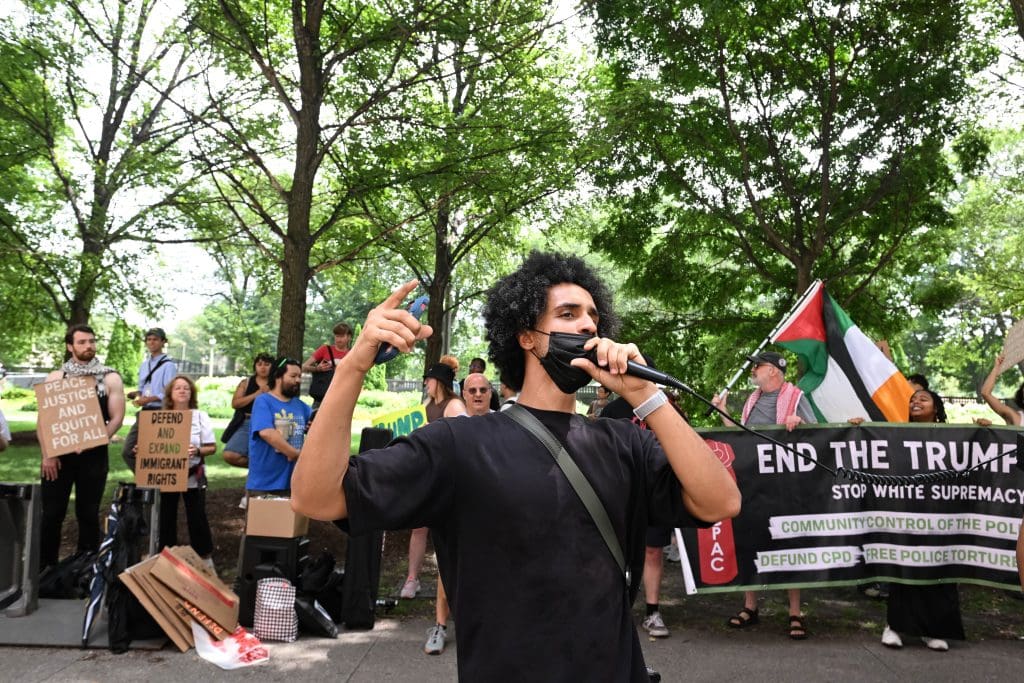
“F*ck Donald Trump! Tell them what they need to hear, racists are not welcome here,” some activists shouted. They could be heard across the street from Hilton Chicago as organizers took to the streets.
“He’s racist, he’s xenophobic, he’s every kind of -ism and -phobia that is negative,” Kobi Guillory, co-chair of CAARPR, said about why the groups decided to demonstrate outside the event.
“It’s extra scandalous for him to be invited by the association of Black journalists. Any kind of organization that is supposed to be about representing the interests of Black people, [it’s] kind of wild of them to invite him and give him a platform,” Guillory said.
Anti-Trump protesters were forced to move across from the hotel. A Chicago Police Department (CPD) spokesperson said the area was designated as the “protest zone” by the Secret Service. Asked why pro-Trumpers were allowed to stay in front of the building, the spokesperson said anyone “not actively protesting” was allowed to stay in front of the hotel.
Guillory said he learned about Trump’s planned appearance the morning of July 30, the day before Trump’s scheduled visit. He began organizing right away.
“We are out here protesting because we are tired of having a government of war criminals,” Angel Gonzalez, 19, said during the protest. Gonzalez is a member of Students for a Democratic Society at the University of Illinois at Chicago. He marched at the Republican National Convention in Milwaukee in July and also plans to march at the Democratic National Convention in Chicago to be held Aug. 19-22.

The event marks just the second time Trump has visited Chicago since 2019. In 2016, Chicago organizers forced Trump to cancel a planned rally at the UIC pavilion in the run-up to his first presidential win.
“That’s the kind of energy that I expect from Chicago,” Guillory said of the 2016 demonstration. “Trump and his friends, whenever they try to make their baseless points, they use Chicago. So Chicago would be the city to show off and run him out of town.”
Trump did just that during the NABJ panel. Asked about the Sangamon County sheriff’s deputy Sean Grayson who killed Sonya Massey and if the deputy deserves immunity, Trump said, ”I don’t know the exact case, but I saw something. It didn’t look good to me.”
Kadia Goba, Semafor politics reporter, asked the question and followed up to ask about the deputy’s chance of receiving immunity if Trump was in the White House.
”He might not. It depends on what happens,” Trump said, before pivoting the conversation to Chicago’s July 4 gun violence numbers.
“Nobody wants that, nobody wants that. We need to have our police officers have their respect and dignity back,” he said. “People are protected by the police unions or their police departments. What I’m saying is if I felt, or a group of people would feel, that somebody was being unfairly prosecuted because the person did a good job with crime or made a mistake, an innocent mistake, there’s a big difference between being a bad person and making an innocent mistake. If someone made an innocent mistake, I would want to help that person.”
Now that the dust has settled, some NABJ members and attendees are calling for their president, Ken Lemon, and other senior leaders to step down. #RolandMartinUnfiltered host, columnist and journalist Roland Martin is among many pushing for transparency so members can understand leadership decision-making practices.
“What happens next is NABJ is going to have to deal with the pushback of what just happened here. They simply cannot defend what the hell we just witnessed,” Martin said. “Leadership has to answer for this abomination and how they allowed for NABJ to get played nationally.”
Tiffany Walden is the editor-in-chief of The TRiiBE and a 2023-2024 John S. Knight Journalism Fellow. Tonia Hill is a multimedia reporter for The TRiiBE. Corli Jay is the community investment reporter for The TRiiBE.
We depend on your donation. Yes, you...
With your small-dollar donation, we pay our writers, our fact checkers, our insurance broker, our web host, and a ton of other services we need to keep the lights on.
But we need your help. We can’t pay our writers what we believe their stories should be worth and we can’t afford to pay ourselves a full-time salary. Not because we don’t want to, but because we still need a lot more support to turn The Objective into a sustainable newsroom.
We don’t want to rely on advertising to make our stories happen — we want our work to be driven by readers like you validating the stories we publish are worth the effort we spend on them.
Consider supporting our work with a tax-deductable donation.

James Salanga,
Editorial Director
Related Articles
The resurrected American Penal Press Contest honors incarcerated journalists
2025 saw the revival of the historic journalism awards, once called the Pulitzers of prison newsrooms, after a 35-year hiatus.
Do newsrooms need a memeologist?
In the age of meme-slop and digital newsrooms shuttering, internet culture reporters say mainstream media is ill-equipped to cover not just trends, but a radicalization that doesn’t look how it used to.
Baltimore media outlets may be exacerbating an already unprecedented overdose crisis
Experts say stigmatizing language and hasty coverage in Baltimore has spread misinformation and steered a city struggling with the overdose crisis away from public health response and toward fear-driven police crackdowns.