
UT-Dallas newspaper reborn after death by internal conflict
After administrative retaliation, escalating tensions between the advisor and staff led to The Mercury effectively disbanding — and a newly independent paper rising in its wake.
In their April 29, 2024 issue, The Mercury’s previous editorial board published their goodbyes to the paper and to the University of Texas at Dallas (UTD). In their final issue, the outgoing managing editor said they were “excited to see what The Mercury does in the future.”
Five months later, no students were left working at the 44-year-old paper after a tense relationship between students and their own advisor and university administration culminated in a strike followed by the paper’s dissolution.
The Mercury exemplifies what happens when school administrators exploit internal conflicts to shut down student press and how students are capable of striking out on their own and shaping their coverage according to their communities’ needs.
A student newspaper can be a house of cards: Students often work for little to no pay, have tenuous relationships with their funding sources or administrations, and may worry about recruiting enough students to keep a paper going. Due to university regulations, papers typically require a faculty advisor — ideally one with journalistic experience — to provide support and knowledge.
At The Mercury, the previous print advisor’s departure in 2022 laid a shaky foundation: The then-interim director of UT-Dallas Student Media was hired on as a broadcast advisor, and ended up advising the whole Student Media wing for a year and a half while potential print advisor replacements fell through. In the meantime, Palestine solidarity protests ratcheted up the tension between students and university administration right as The Mercury’s editorial board underwent a near-full replacement. The new board’s first issue would be the first major step to the newsroom’s house of cards collapsing.
The Mercury falls apart
The Mercury has been in print since 1980. While early issues were very small, it was the first organization to be a part of UT-Dallas Student Media, and was only joined by Radio UTD, AMP, and UTD TV in the 2000s. In its 44 years of print, the paper covered everything from the construction of the UT-Dallas student union and the first undergraduate student class to the building of a new art museum on campus and local Palestine solidarity protests.
Heavy criticism of the university administration’s actions during those protests featured heavily in editor-in-chief Gregorio Olivares Gutierrez and managing editor Maria Shaikh’s first published Mercury issue.
After its publication, the interim UT-Dallas Student Media director was demoted and removed as the print advisor for the paper. The Mercury’s students saw this as retaliation against their coverage, and were on edge for future potential retribution from the university administration.
Senior director of Student Media Jenni Huffenberger then served as interim director for a month and a half and didn’t improve the relationship with students. In particular, Huffenberger walked back previously agreed-upon payment structures allowing students to take on two separate roles.
“Things that had already been approved are now being unilaterally retracted,” Gutierrez said, adding that Huffenberger’s first short tenure only heightened tension between the administration and students.
Then, when the students interviewed journalist Lydia Lum for the print advisor role, Gutierrez was “alarmed” by Lum’s description of her working process with her previous student paper.
“The relationship [with her previous paper] […] was one in which they would show her all of their articles before publication willingly, which is prior review,” he said. “I told her that we would maintain that standard of not allowing [an advisor] prior review or censorship of articles, and she said during that interview, ‘Oh, if that’s the student’s decision, it’s fine.’”
But after being hired, Lum continued to ask for more and more visibility into The Mercury’s processes, asking to sit in on various planning meetings to better understand how a story came to be. In her Sept. 13, 2024 memo to the Student Media operating board calling for Gutierrez’s termination, she wrote that the “info freeze” was why she felt incapable of advising the paper at the time.
“I spent about two hours with Mercury student managers and editors delivering part of my post-production critique,” Lum wrote. “I didn’t get far before disclosing how it was near-impossible to do my job, and near-impossible to offer a fully-informed critique because I needed to understand how a story became a story in the first place.”
Shaikh contested this point of view, admitting that while the editorial board was cold toward Lum initially, they had tried to be more open following Lum’s concerns at their first critique.
“We’re not perfect, and we were coming off the back of a lot of really unprecedented things that made us feel like admin was breathing down our neck,” Shaikh said. “But I do think that, as soon as those concerns were expressed to us in this meeting, we literally jumped to correct it as soon as possible.”
With the ongoing internal conflict, Lum organized a meeting of the operating board on Sep. 13, 2024 to call for Gutierrez’s termination from their role as editor-in-chief, citing multiple bylaw violations. With four of seven members of the board present, the board voted 3-1 to remove Gutierrez, and the remainder of the Mercury students went on strike to demand his reinstatement.
On Oct. 10, 2024, Huffenberger officially removed the striking members of The Mercury from the university’s payrolls, saying they had effectively quit through their actions. The Objective reached out to Lum for comment and was directed to a UTD spokesperson who did not respond to several further requests to interview Lum, Huffenberger, or vice president of student affairs Gene Fitch.
Then, later in October, Mercury sister publication AMP editor-in-chief Sasha Wuu said Lum came to regret her part in Gutierrez’s termination. Lum then worked with Wuu and other members of the Student Media operating board to organize a meeting with Gutierrez to discuss reinstating him. But when Fitch heard about the meeting on Nov. 21, 2024, he placed Lum on administrative leave. The next day, Wuu learned Lum was being let go.
“As much as I’ve had problems with Lydia, she was the one administrative member that tried to turn out for us and tried to amend her mistake,” she said.
When asked again for comment, Fitch replied he was “not interested in conducting an interview.”
Unclear bylaws lead to universal headaches
Lack of clarity weakens student media bylaws. It’s apparent in the current UT-Dallas Student Media ones, which Student Press Law Center staff attorney Jonathan Falk reviewed.
“The current set of bylaws, they have vague and contradictory language in some of the definition set,” Falk said. “Which, if that’s supposed to be your foundation for figuring out who’s involved in what capacity, you’re setting yourself up for failure with those bylaws.”
Lum had justified Gutierrez’s termination using the Student Media bylaws, but Falk’s review highlights they are an unclear and incomplete document. Since being separated from the UT-Dallas university operating handbook in 2018, the bylaws were not changed and were not always followed.
Who can call meetings of the operating board and how? What happens if a decision made by the board is ignored? What happens, like it did in the 2021-2022 academic year, when the student government president just doesn’t provide a list of students and faculty members for the vice president to appoint to the board? All of these questions remain unanswered by the bylaws, and the process for anyone who wanted to change the bylaws isn’t clear, either.
“Is it [the bylaw-changing process] under the purview of the administration? What sort of buy-in should we have with the students?” Falk asked. “All of those sorts of things should be fleshed out for us. And I don’t believe there’s any reference as to how to amend these.”
UT-Dallas’s student government started a committee in Oct. 2024 to review and revise the bylaws, with members of the committee including the remaining Student Media leaders and some administration members.
Two months later, the administration sent a proposed set of bylaws to the committee including language which Falk says actually increases the university’s liability.
In particular, he pointed to a stipulation that the Student Media director is “entitled to see any material before publication and has a responsibility to ensure that student editors-in-chief, station managers, and Student Media staff members are aware of the legal liability that may result from publishing obscene, defamatory, or libelous material.”
Whether or not the director reviews the material before it goes out, that proposed bylaw establishes the assumption of review.
“You say that you were entitled to see this stuff, it went out anyway, whether or not you saw it,” Falk said. “Now we’re going to get the university on the hook and name them in a libel suit. So it serves the university’s best interest to stay out of it as best as possible throughout that process.”
And besides the proposed bylaws’ potential to invite legal liability, institutionalized prior review has further consequences for student press.
“It’s damaging because it encourages self-censorship for not only those reporters who are starting to investigate those questions that interest them, but for the entire group — should we even dedicate the resources necessary to start going down this road if it’s just going to wind up getting this extra set of eyes, this entitlement, to see the material?” Falk said.
Ultimately, the university kicked the can down the road: Last month, leaders proposed the creation of the Committee on Student Media. The senate voted to approve the new standing committee, which serves as the new oversight board and is now tasked with the creation of a new set of official bylaws.
The policy that created the committee included a section that mirrors language in the New Voices laws. Those laws aim to bolster student press rights, and the mirrored language could potentially be reflected in the future bylaws. Falk said two major points codified in the policy are that students can control “the content of their output” and that advisors can’t be punished for just doing their jobs.
“If we didn’t have those sorts of advisor protections, at least at the high school level, explicitly, we see indirect censorship,” Falk said.
While the 1988 Hazelwood v. Kuhlmeier Supreme Court decision said high schools could censor school-sponsored papers with some restriction, the 2005 Hosty v. Carter 7th Circuit Court of Appeals decision later applied that to college newspapers as well. So in Texas, where a New Voices law isn’t currently passed, the language in the policy provides protection that isn’t yet legally present for either students or staff.
It also includes additional language determining the committee’s base operations. This includes a restriction of three days minimum notice for special meetings, which contrasts with Gutierrez’s termination meeting having only been called a day before.
“[Notice] is key. I think that’s crucial … so that the wool can’t be pulled over the eyes of the voting members,” Falk said. “In addition to that, we do have the definition of quorum, so I do think that this is shoring things up in a positive direction … I think this is very helpful as a policy document, a good start. And the bones are there, but I think we need a little more.”
The new policy is not a new bylaws document, which the committee itself is charged with making. There is currently no deadline for the creation of the new bylaws.
Students forsake administration dependence and start anew
Shortly after the strike, Gutierrez and the former staff of The Mercury started The Retrograde, a newly independent student newspaper no longer affiliated with UT-Dallas Student Media. They’re in the process of incorporating as a 501(c)(3) non-profit with the goal of continuing coverage under a new banner. It currently has a board of directors consisting of local journalist Steven Monacelli, freelance journalist Michael Koretzky, and UT-Dallas assistant professor of philosophy Dr. Humberto González-Núñez.
Gutierrez said he isn’t worried about the paper’s financial future. The Retrograde currently has a Patreon and a GoFundMe, and its current reader-funded approach reflects a broader uptick in other digital outlets like Rascal and The Flytrap. The Retrograde still aims to sell ads on their website and in print issues.
Members of The Retrograde say they’re excited as they start up a new publication. Their area of coverage currently remains the same as The Mercury’s, but former Mercury managing editor Shaikh said building a paper from the ground up gave the team the feeling they could pursue more opportunities and were less confined by expectations around coverage and format.
“It’s not that we couldn’t do all of these things with The Mercury,” she said. “It’s just that I had personally never had to think about student journalism in that kind of way before.”
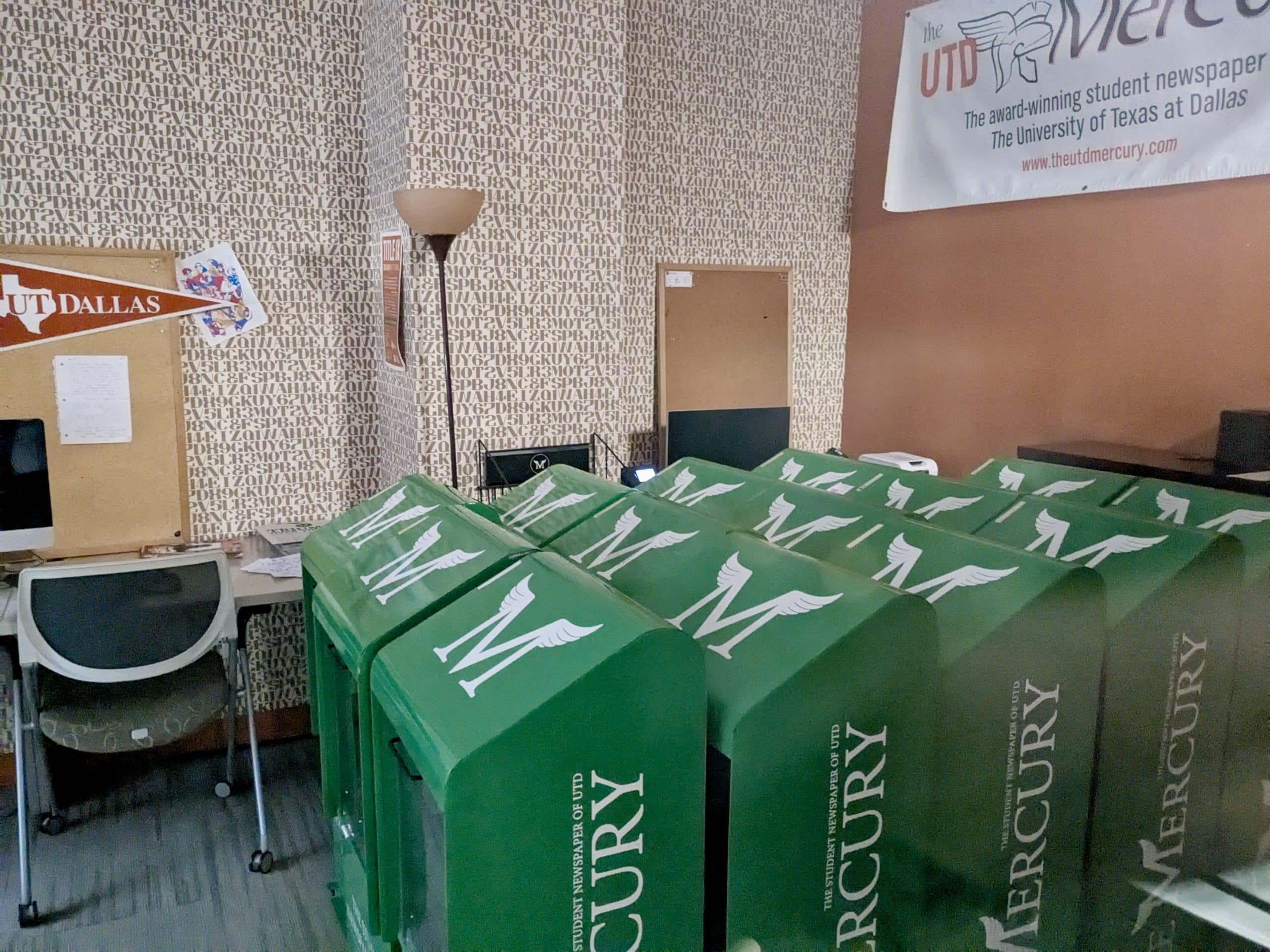
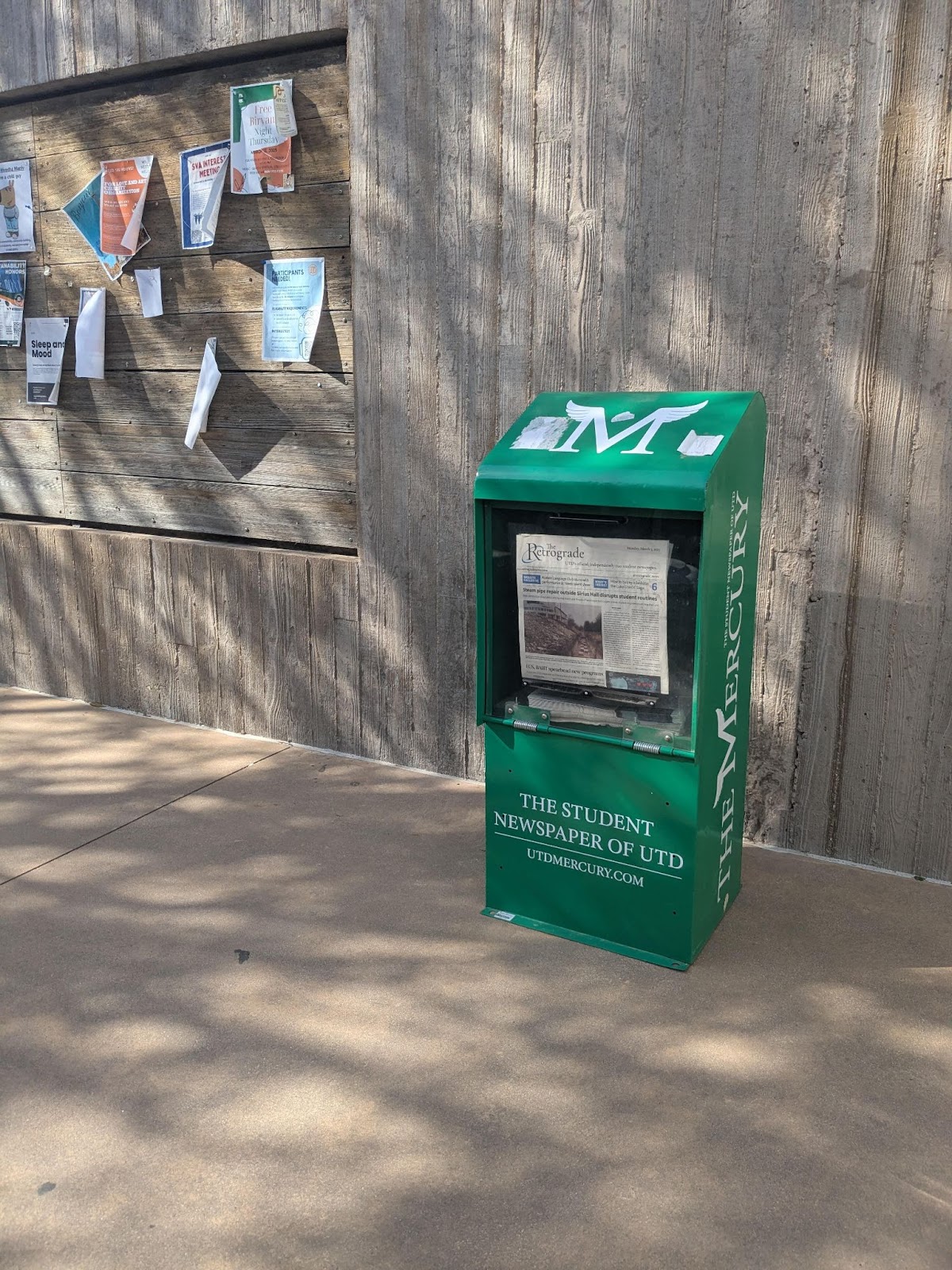
Starting a new newspaper comes with its own growing pains. In some of the initial issues of The Retrograde, they published a series of student government articles under the news section written by student government members, which presented a clear ethics violation. They’ve since learned from their mistakes and moved on, with their first print issue coming out on Jan. 23, despite the administration removing the unused Mercury stands shortly after The Retrograde said they’d use them for distribution.
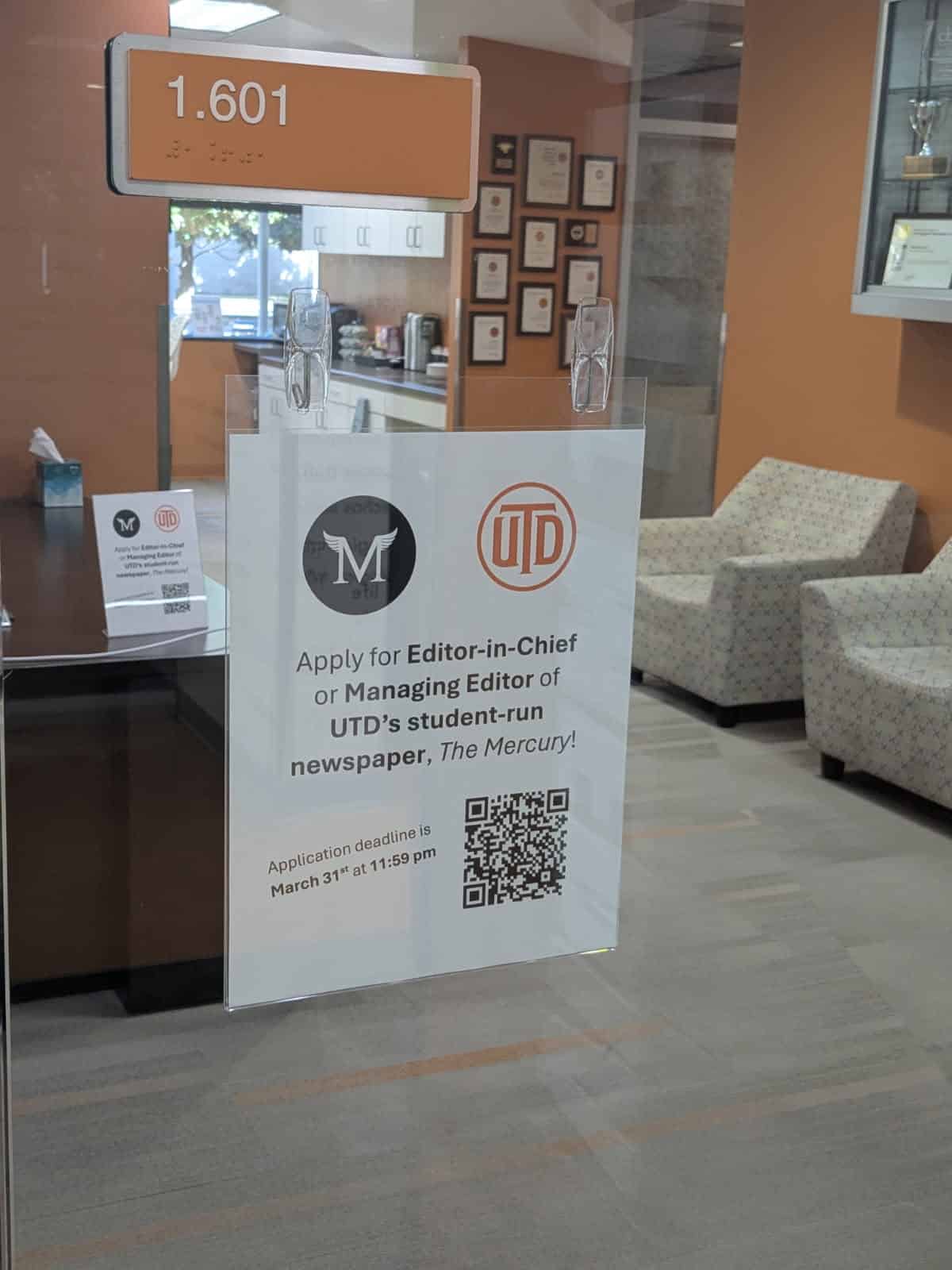
The student press landscape at UT-Dallas is still malleable: The Dallas Morning News reported the administration’s desire to reinstitute The Mercury and The Retrograde’s recent struggles with the university. On Mar. 10, UT-Dallas Student Affairs announced the search for a new editor-in-chief and managing editor for the currently defunct Mercury with flyers posted on campus and on the Student Media door.
The Retrograde in turn dared Student Affairs to find any interested students not already working for them in their own op-ed. In mid-March, UT-Dallas Student Affairs also removed the strike stories that were previously published on the Mercury website and removed the strike branding previously in place.
In that op-ed, the staff at The Retrograde confirm that they are still “set up to continue functioning independently without any university support.” And though the local coverage brought a spike in attention to the outlet, Gutierrez is confident that The Retrograde will be able to establish a lasting presence past the initial excitement.
“We’re just gonna keep on hiring people, keep on training people like we’ve been doing for years,” they said. “We want to have options, and we want to have rules and guidelines in place so that people don’t struggle.”
Benjamin Nguyen is a former editor of The Mercury who left at the end of 2022.
This piece was edited by James Salanga and Gabe Schneider. Copy edits by Holly Rosewood.
We depend on your donation. Yes, you...
With your small-dollar donation, we pay our writers, our fact checkers, our insurance broker, our web host, and a ton of other services we need to keep the lights on.
But we need your help. We can’t pay our writers what we believe their stories should be worth and we can’t afford to pay ourselves a full-time salary. Not because we don’t want to, but because we still need a lot more support to turn The Objective into a sustainable newsroom.
We don’t want to rely on advertising to make our stories happen — we want our work to be driven by readers like you validating the stories we publish are worth the effort we spend on them.
Consider supporting our work with a tax-deductable donation.

James Salanga,
Editorial Director
Related Articles
Native Hawaiians, new newsrooms work to shift journalism norms in Hawai’i after legacy media exclusion
As the Hawaiian Islands grapple with rising natural disaster and a news desert prognosis, a wave of community-stewarded projects centering Native Hawaiians and their values is trying to shift the culture of journalism on the islands.
Fort Worth Report becomes Texas’s sixth unionized newsroom
The Fort Worth Reporters Guild voted 11-1 to unionize, and will begin working with management on collective bargaining for a contract.
Q&A: ‘All journalism advocates’: Anita Varma on solidarity journalism
Journalism professor Anita Varma on her forthcoming book, Solidarity in Journalism: How Ethical Reporting Fights for Social Justice, the limits of the advocacy vs. journalism conversation, and more.