
White House says no comment to reporters with pronouns in bio, in email to one such reporter
This administration has sought to codify criminalization of trans and gender-nonconforming people more explicitly, and this policy sits at the intersection of that discrimination and Trump’s anti-press attitudes.

The White House said they will not be responding to reporters with pronouns in their signature — in an email to a reporter with pronouns in their signature.
“Any reporter who chooses to put their preferred pronouns in their bio clearly does not care about biological reality or truth and therefore cannot be trusted to write an honest story,” White House Press Secretary Karoline Leavitt told The Objective in a statement for this story.
Leavitt’s response is another example of the administration’s attack on trans rights. It’s also emblematic of the administration’s push to limit critical coverage and free press, from the White House sitting on pool reports it finds unflattering to barring AP reporters from Oval Office coverage and attacking public media funding.
“If the White House or any other government institution is ignoring press requests based on visible markers of identity, it undermines our constitutional rights to free speech and a free press,” said Ken Miguel, president of the Association of LGBTQ+ Journalists. “Journalists should not face barriers to access based on how they identify or present themselves professionally.”
Yet the administration continues to pursue policies implementing those barriers; cisgender journalists with pronouns in their signature also faced the same rejection and rebuff from the White House Press Secretary. After a judge ruled the First Amendment prohibited the exclusion of reporters based on their viewpoints, the White House chose to eliminate wire services’ specific access to the president, instead incorporating them into the rotating pool.
Systemically erasing trans and gender-nonconforming people has been a major focus of the Trump administration. Anti-trans policy has been on the rise even before the presidential shift, with hundreds of anti-trans bills being proposed in state and federal legislative halls. But this administration has sought to codify criminalization of trans and gender-nonconforming people more explicitly, emboldening anti-trans policymakers — the number of anti-trans bills proposed so far this year has already more than surpassed the total in 2024.
So far, President Donald Trump has signed executive orders solely recognizing two incontrovertible sexes, restricting gender-affirming care for youth, banning trans military members, seeking to scrub government data and websites of gender diversity, blocking passports for trans and nonbinary people, banning trans girls from school sports, monitoring K-12 curriculum, and more.
Mainstream media’s blasé attitude towards covering transphobia and its deadly implications — particularly along the lines of other marginalizations — has fomented this rise of de facto discrimination against trans and gender-nonconforming people. The New York Times’ reporting has been used by lawmakers to justify these proposed, and increasingly enacted, anti-trans policies.
Related: Legacy media helped create this anti-trans moment. Now they’re reporting on it.
Even now, major media outlets haven’t centered those most affected in their coverage of these policies. Last month, GLAAD released an analysis of 35 stories covering these executive orders and found only 6 included a trans person who contextualized inaccurate rhetoric.
“When only 28% of non-LGBTQ Americans say they personally know a trans person, news stories about our community are an extraordinary opportunity to humanize, or demonize us,” Shane Diamond, GLAAD’s director of communications and transgender advocacy, said in the release. “All media must commit to basic standards that hold the administration accountable and ensure their stories accurately reflect the community under attack.”
There has been legal pushback against the administration’s policies: Several lawsuits are underway opposing Trump’s anti-trans executive orders, and in a number of cases, have halted their implementation. The Associated Press sought another court order to have the earlier First Amendment ruling respected, but a judge declined the challenge on Apr. 18. However, despite the lawsuits, few major outlets have released letters or notes defending their colleagues for their identity or their press access.
James Salanga is the co-director of The Objective and the podcast producer for The Sick Times.
This story was edited by Gabe Schneider.
We depend on your donation. Yes, you...
With your small-dollar donation, we pay our writers, our fact checkers, our insurance broker, our web host, and a ton of other services we need to keep the lights on.
But we need your help. We can’t pay our writers what we believe their stories should be worth and we can’t afford to pay ourselves a full-time salary. Not because we don’t want to, but because we still need a lot more support to turn The Objective into a sustainable newsroom.
We don’t want to rely on advertising to make our stories happen — we want our work to be driven by readers like you validating the stories we publish are worth the effort we spend on them.
Consider supporting our work with a tax-deductable donation.

James Salanga,
Editorial Director
Related Articles
Q&A: ‘We’re winning when media reparations is common-sense’: Media 2070’s new chapter
In the midst of attacks on Black press and journalists, Media 2070 charts a tangible future for Black narrative power and media reparations.
Journalist’s Resource downsizes
After “several funders did not renew their grants,” the Harvard-based hub making academia accessible to reporters cut its program director and managing editor positions.
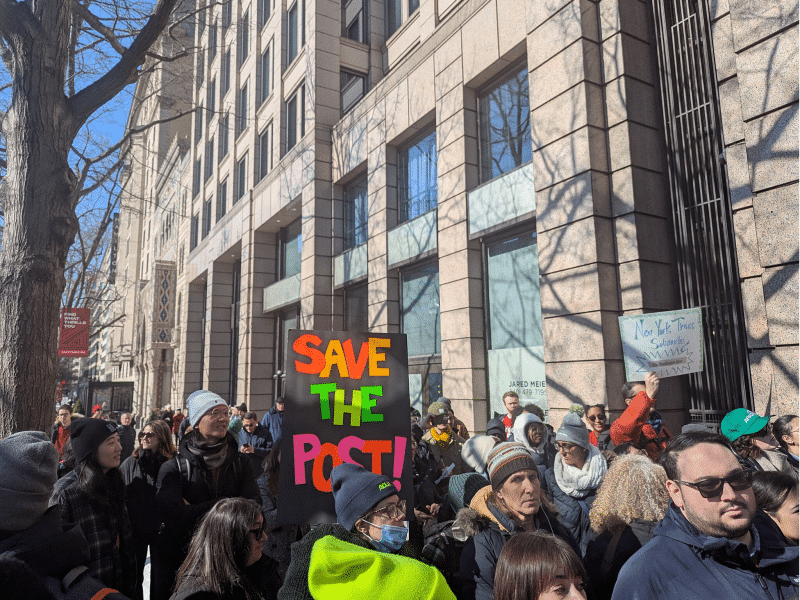
Washington Post lays off race and ethnicity reporters
After cutting around one-third of staff, the Washington Post says it will concentrate on “areas that demonstrate authority” — with a national reporting desk that is now overwhelmingly white.