
A focus on the process, not just product: Healing through hearing
Even when we can’t offer justice, movement journalism can offer healing or catharsis. We’re not just responsible for our stories, but for the ways in which we listen, for the space we create in the process.
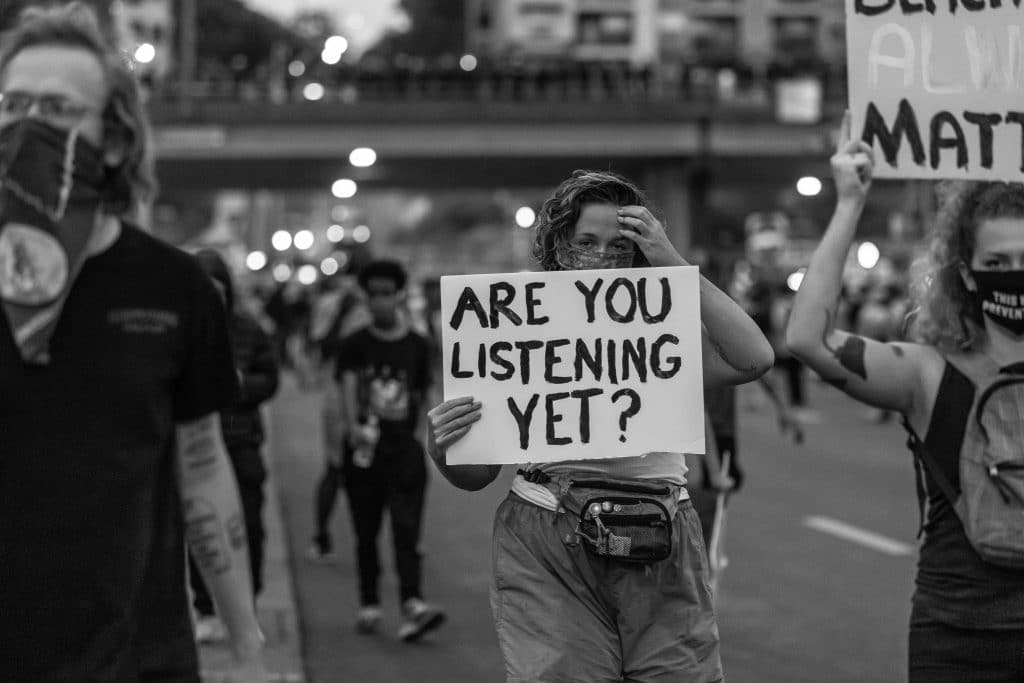
This piece is part of the column series ‘The Case for Movement Journalism‘. Read other column installments here.
Over the years, I have sat and held a microphone through hoarse sobbing, grief-filled and rageful venting. People have shared things they never shared before, and thanked me for listening and holding them. I’m not sure if healing can happen in a prison, and if it can, as wounds close, new ones open. Still, some of my most vivid memories of healing and catharsis took place in Dayton Correctional Institution, a women’s prison.
In 2015, I visited the Dayton, Ohio prison every two weeks for months. I was there to create a series of radio stories for WYSO, a community-driven public radio station in southwest Ohio, to reflect the women’s voices in the prison and allow participants to both learn radio skills and share stories with a larger audience. It was part of an ongoing program at WYSO, called Community Voices, that trains community members to make stories across the station’s diverse region.
I saw firsthand the potential power movement journalism has to be a part of someone’s healing or to provide the experience of catharsis — in a final listening session after months of work on these stories, many, many tears were shed as we listened to each person’s delicate, crushing, or amusing story. Afterwards, people described both the listening and the sharing as healing.
Sometimes the moment that makes the most change is an intimate one, like our listening session in the prison. To propose that movement journalists or practices of community journalism are going to heal people is a big claim. But to be aware of the potential power that journalism has to be a part of someone else’s healing, or to provide an experience of catharsis, is a key awareness. It means we are responsible not just for the resulting stories, but for the ways in which we listen to them, for the space we create in the process.
There were lots of barriers to teaching a radio course in a prison, access, censorship, trust, and equipment among them. To even enter the prison and teach, we had to be affiliated with an academic institution. Even though WYSO was licensed to Antioch College at the time, our class took months of negotiation to get off the ground. The women didn’t have computers or software to learn to digitally edit, but we agreed that we could bring in recorders and instruct on their use. The prison also enforced a strict media policy about stories coming out — no one was allowed to speak on the recordings about their convictions, why they had done what they did, or any assertions of innocence. On top of that, there was a frequent and implicit self-censorship for anyone who had a chance of one day being paroled; everything they did and said could count towards time where they might be free, if they gave the right performance for the parole board.
But within all these constraints, we selected a group of people who were mostly long-term incarcerated, and found dozens of other stories to tell. Many people shared about the root causes of their encounters with violence: their abuse or neglect as children, their spirals into addiction. One young woman who’d spent most of her adulthood in prison recounted in detail how she had a pet bunny once, whom her father had killed as an act of punishment. Many also shared about their own and others’ acts of generosity and ingenuity: one story focused on the prison yard cat named Fancy, another on how to make fun food out of mediocre commissary products, another on art as therapy.
In the Women’s Voices project I have described, the process may have been the most impactful part of the story. In those cases, movement storytellers need to give a special attention to the process and be cautious of potential conflicts of interest. In this case, I mean conflicts of interest between the storytellers, the editors, and the audience.
Subscribe and get each issue in your inbox
When I first started recording other people’s stories of violence and trauma over 10 years ago, I hoped to “help,” but over time, I felt ashamed by the skimpy nature of journalism’s offerings to people in this circumstance. They are seeking justice; we are offering a listening ear, and usually a story that truncates, that fits their experiences into an “angle” for an outlet that insists on that, for an audience that is frequently numb to their pain.
Here is an example. I’m walking down a wide street in South Dakota, where I have traveled for a story about trans youth. Approaching an eight-lane intersection near the center of Sioux Falls, I see a tiny gathering of people with signs and megaphones, loud for their size.
As I approach, the signs come into focus: Fuck The SFPD, one reads in giant hand-painted print. Justice for Jacob James, reads another. The gathered people — one young man, two middle-aged women, a tattooed teenager, and two babies — say nothing to me as I cross, focused on the convening of two separate police vehicles at the intersection.
“Fuck you pussies,” the man yells through the megaphones directly at the cop cars. “Justice for Jacob James. Justice for my son.”
I stop to speak to Jacob James’ mother Kim, my hand on my chest, my heart contracting. It’s been nearly three years since the Sioux Falls police killed him. The cops claim the 21-year-old Native American man was armed and shooting, but his family and supporters contest the claim and continue to push for the release of the body cam video.
There has been no apology, no response, no justice — and, Kim told me when I stopped to talk and meet her, no decent coverage from any local outlet, either. Here is a place where movement journalists, when they are careful and honest, can potentially step in and make a difference.
When I explain to Kim that I’m a journalist and might want to do a story, she eyes me skeptically. This is not my first conversation with a pained and angry parent of a murdered child, killed by the state. So I am careful not to overpromise: this is fair, given the crap coverage she’s had, given I’m from out of town and am not a staff reporter, given that journalists often smile and suck up to victimized families right before doing stories about them depicting their deceased children as perpetrators, or right before doing nothing at all.
That’s what I mean when I say conflict of interest: the families want to talk to journalists for justice, but the editors and the audiences want a story. I have been a part of creating stories multiple times that used people’s personal traumas to make a “larger” point about something.
From my position as a journalist, I passionately and carefully covered the police murders of John Crawford III in Beavercreek, Ohio; Kevin Matthews in Dearborn, Michigan; and most recently, Aaron Rainey in Philadelphia. Each story created a small archive of pain, and a little splash of exposure. In Crawford’s case, no one was ever held accountable for his death, and his family received a settlement — a story we covered again ten years later. In the case of Kevin Matthews, the officer who shot him died by suicide. For Aaron Rainey, time will tell. The hundreds of families around the U.S. who have fought for their deceased loved ones’ stories to be in the news after a police killing have experienced surges of hope followed by surges of cruel backlash as their loved ones’ names fade into the churn of the news cycle.
Now, when I interview parents of children killed by police, I encourage them only to do the interview if they truly feel it would be healing or cathartic to tell their story. I can’t honestly claim that the story getting out to the world will make the difference they often desperately hope it will. Sadly, exposing the robbery of Black lives over and over again has not been enough on its own to shift the culture, law, and policy that steals them away.
This isn’t to say the parents of children killed by police have worked in vain — only to say that the hope that telling your story in public will galvanize a mass movement or bring justice has been dashed for family after family, and ethical journalists should not mislead people in that way. Instead, we should be careful to craft these moments in ways that honor and respect the storytellers and recognize that the process may be even more important than the product.
Passing by Jacob James’ family in South Dakota, I wonder, can healing happen on a street corner? What about catharsis? What can be released in the raising of voices, or the telling of a story? I don’t pretend to know. But if there is anything a piece of movement journalism could do for this family, it would be at least to offer the experience of being listened to — and at least in a moment, being deeply heard.
Lewis Raven Wallace is the Abolition Journalism Fellow at Interrupting Criminalization and the author of The View From Somewhere: Undoing the Myth of Journalistic Objectivity and the forthcoming title Radical Unlearning. They live in North Carolina.
This piece was edited by James Salanga.
We depend on your donation. Yes, you...
With your small-dollar donation, we pay our writers, our fact checkers, our insurance broker, our web host, and a ton of other services we need to keep the lights on.
But we need your help. We can’t pay our writers what we believe their stories should be worth and we can’t afford to pay ourselves a full-time salary. Not because we don’t want to, but because we still need a lot more support to turn The Objective into a sustainable newsroom.
We don’t want to rely on advertising to make our stories happen — we want our work to be driven by readers like you validating the stories we publish are worth the effort we spend on them.
Consider supporting our work with a tax-deductable donation.

James Salanga,
Editorial Director
Related Articles
The Objective’s favorite media reporting and criticism of 2025
A non-comprehensive list of The Objective’s co-directors and readers’ picks for media coverage and commentary this year.

The local news contract is broken. Civic media can fix it
Darryl Holliday on how City Bureau’s Documenters’ program models the new social contract needed for local news and the civic media system emerging today.

Media policy: Local news for the people
Five key policy-making principles and concrete proposals to support civic information needs.