
Wall Street Journal shirks apology for publishing anti-trans misinformation after Charlie Kirk shooting
Over two-thirds of Americans don’t know a trans person themselves. As right-wing efforts to connect trans people with violence continue escalating after Charlie Kirk’s shooting, journalists must be rigorous in covering rhetoric from anti-trans activists without verification or clarification.
Just hours after Christian nationalist and conservative podcast host Charlie Kirk was shot, far-right online spaces were consumed by one prevailing question: Could the shooter be linked to trans people?
“I don’t think it was a coincidence that the shot rang out when you have a question about transgender mass shootings,” hinted Jason Chaffetz on Fox News shortly after witnessing Kirk’s death. Another far-right witness from Kirk’s final show made the same point, saying Kirk had been referencing “transvestite shooters” when he died.
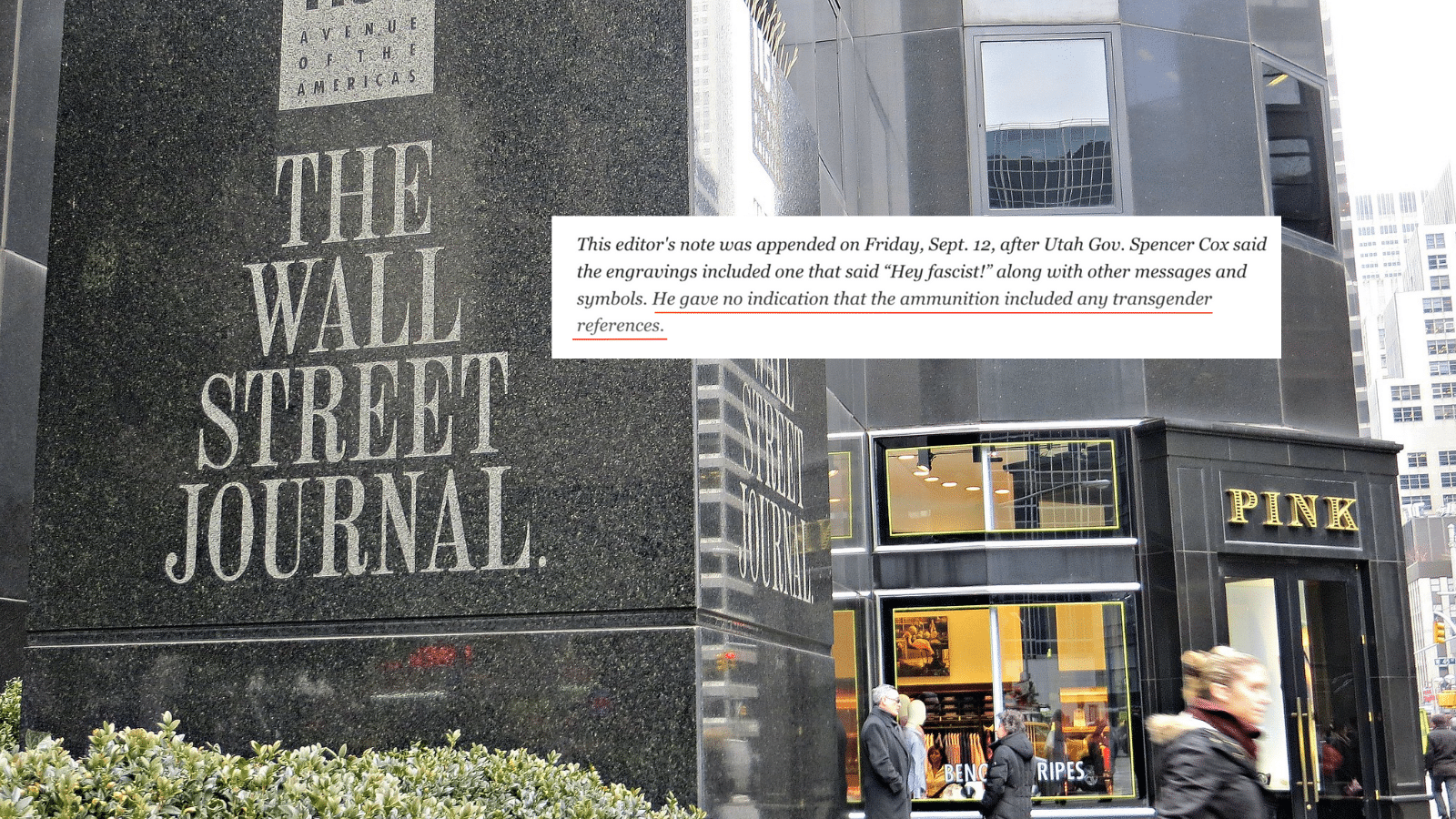
It was in this context that the Wall Street Journal ran with an anonymously sourced law enforcement bulletin, later proven false, vaguely claiming the bullets used in the shooting had engravings linked to “transgender and anti-fascist ideology.”
Right-wing efforts to connect trans people with violence have only accelerated in the week after Kirk’s shooting, but such attempts have been around for years, increasing in step with growing numbers of anti-trans legislation. And it’s clear that the current administration would like to act on these fears to strip the trans community of basic constitutional rights: CNN reported that the Department of Justice was looking at ways to ban trans people from gun ownership after a Minneapolis Catholic church shooting. Last week, independent journalist Ken Klippenstein reported anonymous senior officials at the FBI say it is discussing designating trans people as a subcategory of extremist threat. Republican lawmakers South Carolina Rep. Nancy Mace and Texas Rep. Ronny Jackson also called for trans people’s mass institutionalization.
Research shows trans people are four times more likely than cis people to be victims of violence. In this climate of anti-trans hate and misinformation under an administration that has explicitly targeted trans people’s right to exist in public, journalists have a responsibility to take into account the context of the far-right’s ongoing campaign of hatred and demonization against a vulnerable minority when reporting on breaking news events where a link to transgender people or their “ideology” is claimed.
Related: Legacy media helped create this anti-trans moment. Now they’re reporting on it.
After the story, the Trans Journalists Association published guidance for outlets reporting the information, calling for news organizations to be “as transparent as possible” to both increase accuracy and build trust in a breaking news environment. Part of that, the association adds, includes defining so-called “transgender ideology” — a phrase developed by anti-trans activists with no fixed definition.
“As it is often unclear what actions or political positions the phrase actually refers to … reporters should be careful about using this term; it is used exclusively to attack a minority group for political gain,” the group’s guidance explains.
To avoid using this politically-charged, partisan term, the Trans Journalists Association suggests, “When the term ‘transgender ideology’ is used by a government source, news organizations should prioritize direct quotes and, to the greatest degree possible, identify the source and evidence.”
The Wall Street Journal did not do this, allowing their reporting to amplify both a false narrative and a highly-charged, partisan framing of a targeted community of people. Shortly after their story published, other news organizations attempted to verify the information about engravings on the bullets — including the New York Times, which found law enforcement sources who stated that the bulletin publicized by the Journal “did not match other summaries of the evidence.”
The use of an unverified law enforcement bulletin was another red flag, says Lewis Raven Wallace, who is the Abolition Journalism Fellow at Interrupting Criminalization.
“I immediately didn’t believe that story, and could tell that the sourcing was shoddy,” Wallace said. “It’s important for journalists to not just repeat police narratives, especially in these hot moments where something has just happened, because there’s no way to verify a claim like that.”
For their part, a spokesperson for the Wall Street Journal justified the reporting publicizing the false bulletin by saying it was published in the context of a live blog. Eventually, the paper amended the story, without an apology, and added a lengthy editor’s note describing the inaccuracies in their initial reporting.
“Like many news organizations, we stand up live blogs in breaking news situations so that we can report on information as it becomes available,” wrote the Journal’s vice president of external communications, Lauren McCabe.
“It’s important to note that we did not correct the blog post you referenced; we reported on information contained in a law enforcement bulletin issued Thursday by the Federal Bureau of Alcohol, Tobacco and Firearms and cited the bulletin as the source of our reporting,” McCabe continued. “We updated it with new information and later (on Friday) added an editor’s note to the post to explain what transpired since the initial reporting.”
To Wallace, this explanation was insufficient, because law enforcement bulletins have been shown to frequently contain inaccurate information, and therefore should not be treated as facts.
“I have a wealth of evidence that journalists should not repeat law enforcement bulletins directly after things like this happen,” he said. “It’s irresponsible and dangerous.”
Many reporters are questioning the practice of treating police statements as facts, with Interrupting Criminalization publishing several guides for approaching coverage of law enforcement.
But although the Wall Street Journal’s initial coverage rested on false information, the right-wing appetite for finding a transgender person to blame continues unabated. As information came to light that the shooter was a young man from a conservative family, blame among those on the right soon settled on his roommate and alleged romantic partner. This roommate is a young person of unknown gender who the shooter’s mother reportedly told law enforcement was in the process of transitioning, but who is not publicly out as trans.
This thin reed of connection between Kirk’s cisgender male shooter and a possibly trans person, combined with a recent school shooting by a person with a history of transition, has seemingly been enough for the FBI to discuss designating transgender shooters as a subcategory of violent extremist. This is despite the fact that transgender people rarely commit mass violence, and most political violence in the U.S. comes from the far right.
The far-right Heritage Foundation, which authored Project 2025, has urged the administration to go further and create a new category of “transgender-ideology inspired violent extremism” that would categorize any speech drawing attention to the harm caused by anti-trans activities as incitement to violence.
Despite the democratic backsliding, there’s still reason to hope Republicans lack the power to exclude millions of trans Americans from the protections of the constitution — the GOP dropped an effort to ban federal Medicaid funding of gender-affirming care for trans people in its national budget bill earlier this year. However, many restraints on the executive branch seem to be failing, meaning social movements and public outcry, which provided a check on Trump’s power in his first term, may be the primary remaining defense against overreach by this administration.
Related: New York Times cited 29 times to justify decision limiting trans healthcare
Advocates have stressed the danger that errors in reporting can present, particularly when reporting can have a major impact on perceptions of trans people: over two-thirds of Americans say they don’t personally know a trans person.
“Running with inaccurate and incomplete information, especially about a marginalized community, is irresponsible reporting at its worst,” a spokesperson for GLAAD wrote in a statement to The Objective.
Wallace echoed that sentiment and stressed the vital importance of reporters providing readers with the full context of ongoing efforts on the right to force a transgender connection to major shootings and paint transgender people as supposedly violent, dangerous, and extreme.
“In the case of the Charlie Kirk story, I continue to see no reason why transgender people should ever have been named or connected to this story — I just don’t see enough evidence here for that,” Wallace said. “I think the responsible thing on the part of mainstream media would be to really aggressively fact check those kinds of assertions, and not just fact check, but also trace the development of this narrative, which has been a deliberate scapegoating of this community over many decades. Anything short of that is endangering our communities.”
Evan Urquhart is a journalist and founder of Assigned Media, an independent trans news website.
This story was edited by James Salanga.
We depend on your donation. Yes, you...
With your small-dollar donation, we pay our writers, our fact checkers, our insurance broker, our web host, and a ton of other services we need to keep the lights on.
But we need your help. We can’t pay our writers what we believe their stories should be worth and we can’t afford to pay ourselves a full-time salary. Not because we don’t want to, but because we still need a lot more support to turn The Objective into a sustainable newsroom.
We don’t want to rely on advertising to make our stories happen — we want our work to be driven by readers like you validating the stories we publish are worth the effort we spend on them.
Consider supporting our work with a tax-deductable donation.

James Salanga,
Editorial Director
Related Articles

Fort Worth Report becomes Texas’s sixth unionized newsroom
The Fort Worth Reporters Guild voted 11-1 to unionize, and will begin working with management on collective bargaining for a contract.
Q&A: ‘All journalism advocates’: Anita Varma on solidarity journalism
Journalism professor Anita Varma on her forthcoming book, Solidarity in Journalism: How Ethical Reporting Fights for Social Justice, the limits of the advocacy vs. journalism conversation, and more.
When The Baltimore Sun can’t get journalists to lower their standards, it turns to generative AI
The Baltimore Sun ”once again disparaged … human reporters and their work” by publishing two AI-generated political analyses, the newspaper’s union said.