
Jewish Currents reporter, 15 other journalists detained on humanitarian flotilla to Gaza
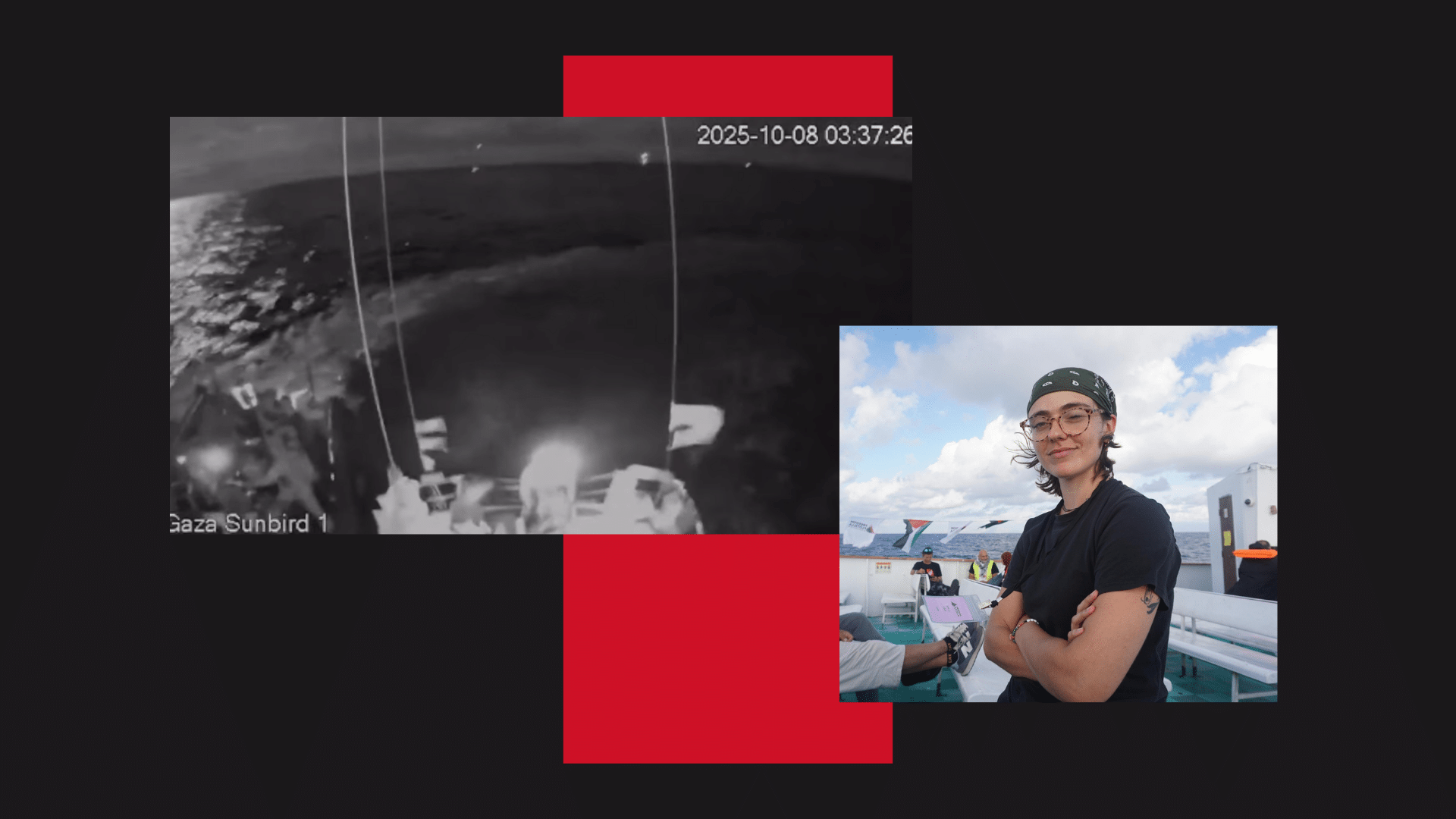
Israeli military forces detained several freedom flotilla ships on Oct. 8, in a latest effort to stifle reporting on the ongoing genocide in Gaza. Nearly 100 passengers, including journalist Emily Wilder, are onboard The Conscience, the flotilla’s flagship vessel.
Update, 1:09 p.m., Oct. 10:
As of 7:08 a.m. PT, Jewish Currents reporter Emily Wilder was deported to Istanbul alongside many other flotilla participants onboard ships detained by the Israeli military on Oct. 8, per Jewish Currents. The magazine reported she is safe and “hopefully heading home to LA shortly.”
Original story below:
In the early hours of Oct. 8, the Israeli military illegally detained nearly 100 passengers aboard freedom flotilla ship The Conscience, including Jewish Currents correspondent Emily Wilder and 15 other journalists covering the flotilla’s efforts to break Israel’s siege and blockade of food aid in Gaza. Since passengers were detained, Hamas and Palestinian factions have reached an agreement with Israel on the first phase of the Gaza ceasefire framework proposed by U.S. President Donald Trump.
The Conscience was the flagship vessel among eight other ships sailing to Gaza with the Freedom Flotilla coalition, all of which were detained by Israeli forces on Oct. 8. In total, 145 passengers are now in Israeli detention, in addition to over 10,000 Palestinians and a majority of 450 passengers detained when the Israeli military intercepted another fleet of the Global Sumud Flotilla. Activists and international journalists from the Al Sumud flotilla who have been released from detention recounted Israeli military mistreatment during their experience, despite Israeli officials’ rebuttals.
“The way we were treated was … pushing the mistreatment and the humiliation to the limit that they could afford,” Italian journalist Lorenzo D’Agostino told CNN. “People coming from countries that are not allied [with Israel] were harmed physically.”
The Committee to Protect Journalists’ Middle East and North Africa regional director Sara Qadah said, in a statement to The Objective, that CPJ is “deeply concerned over the Israeli detention of several journalists who were on Al Sumud flotilla and the humanitarian flotilla bound for Gaza.”
“Detaining journalists who are attempting to document humanitarian conditions is a direct violation of press freedom norms, and in this instance potentially a violation of international maritime law,” Qadah said. “Such actions chill independent coverage precisely where the story is most urgent.”
This is the latest in Israel’s efforts to stifle reporting on the ongoing genocide in Gaza as it passes its two-year mark. Since Oct. 7, 2023, Israeli military attacks have killed over 67,000 Palestinians and more than 276 journalists in Gaza, with foreign journalists barred from entering the Gaza Strip without Israeli military supervision.
“I am here to witness this historic moment … to document this historic movement and, hopefully, to report from on the ground in Gaza,” Wilder told Democracy Now about her trip aboard The Conscience. “But I am under no illusions that there is a deficit of evidence .. of Israel’s atrocities in Gaza, and of the ever-worsening conditions there for everyone there, but including and especially for Palestinian journalists and healthcare workers.”
Jewish Currents editor-in-chief Arielle Angel, said the newsroom’s support of Wilder’s reporting aboard the flotilla was important with Israel “silencing Palestinian journalists and nobody else is allowed in.”
“We’re getting less information from Gaza, and that is heartbreaking and totally unacceptable,” Angel said. “We really wanted to both tell the story of what is happening on these flotillas and tell the story of the blockade on the journalists who are on the ground, those trying to get in, and the encumbrance on the free exchange of information and the safety of journalists in general.”
Related: The last journalists in Gaza are pre-writing their obituaries
The Committee to Protect Journalists has said Israel is “engaging in the deadliest and most deliberate effort to kill and silence journalists that CPJ has ever documented.” Over recent months and years, CPJ has also documented a range of repressive measures, including detention and deportation, by Israeli authorities against foreign and Israeli journalists alike.
“Israeli authorities often frame such detentions or expulsions as security measures, branding journalists or flotilla participants as ‘propaganda’ agents or claiming ties to hostile groups, without providing independent evidence,” Qadah told The Objective. “In light of this history, the detention of a journalist aboard a humanitarian flotilla would not be an isolated incident but rather a continuation of a long-standing, state-level strategy of constraining independent observation and reporting from Gaza.”
Israeli forces have specifically targeted journalists in Gaza for their work, with Palestinian journalists saying their press vest makes them targets.
While censorship has accelerated after Oct. 7, 2023, journalists in the U.S. who have pushed for better coverage of Palestine and Israeli apartheid in the region have long been sidelined from news stories or faced retribution from their newsrooms. Wilder was among them; in 2021, just 16 days into a job at the Associated Press, she was fired days after tweeting about the media’s inability to acknowledge bias in language when writing about Israeli actions as “war” as opposed to “siege and occupation”.
The AP initially neglected to specify the reason she was fired before saying her tweet could have put AP journalists in danger and risked AP’s credibility. Yet throughout the past two years of genocide, major newsrooms like the New York Times continue to allow reporters and editors with ties to the Israeli military to report on Gaza.
The Arab and Middle Eastern Journalists Association, which has also published a guide about best practices for reporting on Israel and Palestine, released a statement on Oct. 8 about journalist safety being non-negotiable. Wilder is also a member of the organization.
“AMEJA calls on relevant authorities to ensure the immediate protection and release of all journalists currently held and to respect press freedom as a core international obligation,” the organization wrote. “We further urge government(s) to facilitate access for international media to Gaza, enabling reporters to work safely alongside their local colleagues.”
AMEJA also published a fact sheet on violence against journalists in Gaza in May 2025.
United Nations special rapporteur Irene Khan, in an Oct. 8 press release, also expressed concern for passengers aboard The Conscience and other flotilla vessels.
“Israel has an obligation to ensure the rights of all those being arbitrarily detained, including access to healthcare and their rights to be free from torture and ill-treatment,” Khan said. “We call on Israel to grant them immediate access to their legal representatives and consular services.”
In the U.S., there has been some legislative support for flotilla passengers previously and currently detained: Democratic U.S. Rep. Rashida Tlaib and 18 other members of Congress sent a letter to Secretary of State Marco Rubio last week calling on the Trump administration to protect detainees.
“While the Trump administration fails to use its immense leverage to end this blockade and fulfill the United States’ binding legal obligations under the Genocide Convention, the activists on board the flotilla are an example of profound solidarity and humanitarianism,” the lawmakers wrote.
One of Wilder’s representatives, U.S. Rep. Jimmy Gomez, has issued a statement calling for her safe treatment and immediate release, stating that his office is “actively liaising with the U.S. State Department, the Israeli Embassy, and relevant counterparts to ensure Ms. Wilder’s safety, consular access, medical care, and eventual return home.”
Jewish Currents has encouraged readers to continue contacting Wilder’s senators and representatives to call for her safe release and reaffirm the right of journalists to report on the Israeli blockade of Gaza.
“What we’ve always felt is that it’s our job to advocate in the realm of journalism for things like better standards in a newsroom,” Angel said. “This is related to the work we do. While these journalists can be killed, we are all endangered.”
8:30 a.m., Oct. 9: This story was updated with quotes from a statement from the Committee to Protect Journalists.
This is a developing story and will continue to be updated.
James Salanga is the co-director of The Objective. Edits and copy edits by Jen Ramos Eisen.
We depend on your donation. Yes, you...
With your small-dollar donation, we pay our writers, our fact checkers, our insurance broker, our web host, and a ton of other services we need to keep the lights on.
But we need your help. We can’t pay our writers what we believe their stories should be worth and we can’t afford to pay ourselves a full-time salary. Not because we don’t want to, but because we still need a lot more support to turn The Objective into a sustainable newsroom.
We don’t want to rely on advertising to make our stories happen — we want our work to be driven by readers like you validating the stories we publish are worth the effort we spend on them.
Consider supporting our work with a tax-deductable donation.

James Salanga,
Editorial Director
Related Articles
Fort Worth Report becomes Texas’s sixth unionized newsroom
The Fort Worth Reporters Guild voted 11-1 to unionize, and will begin working with management on collective bargaining for a contract.
Q&A: ‘All journalism advocates’: Anita Varma on solidarity journalism
Journalism professor Anita Varma on her forthcoming book, Solidarity in Journalism: How Ethical Reporting Fights for Social Justice, the limits of the advocacy vs. journalism conversation, and more.

When The Baltimore Sun can’t get journalists to lower their standards, it turns to generative AI
The Baltimore Sun ”once again disparaged … human reporters and their work” by publishing two AI-generated political analyses, the newspaper’s union said.