
Pre-reporting is a part of being a freelance journalist. Is it free labor?
As a result of an increasingly precarious journalism industry, freelance journalists are often toeing the line between their actual profession and marketing their work.
In mid-July 2023, an editor for a major tech publication reached out to me for a story about Shein’s plans to bring local manufacturing to Brazil, offering a sum of $2,000 for the story. As a journalist who lives in Brazil and often reports about the country, I was clearly a great candidate to take this on. But there was a catch: Before they could officially commission me, I needed to write a pitch (even though they reached out to me) and do some pre-reporting to find a Shein factory already operating in Brazil (though the publication did have people on staff who spoke Portuguese, they weren’t available to do the initial research for this story, allegedly).
I started looking for leads but soon hit a wall: Shein factories were not yet operating in Brazil. No factory, no story. I had just spent hours tracking down union leaders and factory workers across the country, writing a pitch, translating Portuguese language reports — and now, all of that would be uncompensated. The publication would neatly receive the information that there was no story, move on to the next commission, and I would have no work and no payment.
The Pew Research Center estimates that about a third of journalists work on a freelance or self-employed basis. As a result of an increasingly precarious journalism industry, freelance journalists are often toeing the line between their actual profession and marketing their work. This falls more heavily on freelancers from the Global South and those without a primary source of employment or generational wealth.
Pre-reporting — the first fact-finding steps a reporter takes to understand the story they are pitching — falls into a grey area of labor compensation, as freelance journalists have to advocate for the story they are trying to sell. If the editor in question decides not to greenlight the story, hours of pre-reporting work can potentially go uncompensated. Conversely, if the story is greenlit, there’s profit for the freelancer, and the information gathered in pre-reporting supports the final article.
For some freelancers, there’s only so much pre-reporting they are willing and able to do before moving on to the next story or editor. The Objective spoke to three freelance journalists about their experiences with pre-reporting to understand the effects of this expectation in an increasingly unstable journalism industry.
While there are limited studies on the demographics of freelance journalists, a 2023 survey by the Institute for Independent Journalists determined that women, journalists of color and younger professionals are the most affected by media layoffs, leaving a large swath of marginalized journalists to fend for themselves in the unregulated landscape of freelance journalism. According to the Trans Journalists Association, fewer than 100 members report having full-time staff jobs in newsrooms.
“I do think that pre-reporting is crucial to good journalism, but freelancers aren’t being given the resources to be able to do that across the board,” freelance journalist Elly Belle said.
Belle added that freelancers with generational wealth or a primary source of employment are able to juggle pre-reporting better than low-income freelancers, which means that under the current model, newsrooms are missing out on more diverse perspectives and reporting.
“People of color, trans people, and disabled people who would do an incredible job at reporting don’t have the time and energy to do in-depth reporting and only be paid $300 for an article,” they said.
Related: Freelance writing done by young journalists is still labor
That’s not to mention journalists from the Global South who usually are unable to network with other freelancers to understand standard practices. Often, freelancers like me are the only connection between editors and the story being covered. In the case of the Shein pre-reporting, I was the involved professional able to read and translate Portuguese, not to mention understand cultural nuances.
The relationship a freelancer has with their editor is essential to equalizing this dynamic. For culture and immigration journalist Andrea Gutierrez, doing pre-reporting for an editor she trusts is different from doing so for an editor she hasn’t worked with before, because the likelihood of a story being greenlit is higher. Part of the problem is that freelancers have a different, more urgent workflow than most editors, who are likely salaried. Being paid per assignment delivered necessarily requires freelancers to limit unpaid pre-reporting.
Gutierrez said the gap between pre-reporting and commission is most evident to her as a prior staff producer. She worked for NPR but was laid off in November of 2023.
“It’s really been an adjustment … because when you’re on staff somewhere, you’re usually on the clock, you’re getting paid for that,” she said. “It gets sticky if you still don’t have the green light and they still want you to do work. That’s where it feels egregious.”
Compounding the issue is how low rates continue to be despite inflation and rising costs of living. Though they used to do “a lot of pre-reporting” at the beginning of their journalism career, Belle said they now calculate how much they are making an hour for the final story as part of setting better boundaries around their time and work.
“There was an article opportunity that I gave up this summer because the article that I pitched and really cared about needed a significant amount of pre-reporting to more accurately understand what was going on,” Belle said. “This was a trans-related story, and they were only paying $250 for a thousand words. That’s pretty standard across the board these days, and that is so heartbreaking.”
For John Loeppky, a journalist based in Saskatchewan, Canada, the pre-reporting debacle is a motivator to treat freelance reporting like a business rather than a profession. Loeppky explained that he sees pre-reporting as a part of his business because he built it on pre-existing relationships with outlets. This allows him to do pre-reporting while working on stories he has already been commissioned to write.
”Sometimes I interview somebody and I go, ‘I have never thought about that before, that’s going to be a good story,’” Loeppky said. “That very quickly becomes, ‘Let me just shoot a message to my editor.’”
But this business mindset might put beginner freelancers and less established journalists at a disadvantage when trying to get bylines. Particularly when new journalists are trying to make a living off being full-time freelancers, it’s difficult to have boundaries around how much pre-reporting to do while doing work that will impress editors.
In writing this story, I found my pre-reporting notes. Nearly 1,700 words of facts, contacts, quotes, and links for a story that never materialized. And in 2025, I found out that the Shein contract eventually fell through — that $2,000 would’ve never hit my account.
Nicole Froio is a Brazilian-Colombian journalist and feminist cultural critic currently working in Rio de Janeiro, Brazil.
This story was edited by James Salanga. Copy editing by Jen Ramos Eisen.
We depend on your donation. Yes, you...
With your small-dollar donation, we pay our writers, our fact checkers, our insurance broker, our web host, and a ton of other services we need to keep the lights on.
But we need your help. We can’t pay our writers what we believe their stories should be worth and we can’t afford to pay ourselves a full-time salary. Not because we don’t want to, but because we still need a lot more support to turn The Objective into a sustainable newsroom.
We don’t want to rely on advertising to make our stories happen — we want our work to be driven by readers like you validating the stories we publish are worth the effort we spend on them.
Consider supporting our work with a tax-deductable donation.

James Salanga,
Editorial Director
Related Articles
Fort Worth Report could become Texas’s sixth unionized newsroom
The Fort Worth Reporters Guild will vote on unionization next week after management decided not to voluntarily recognize the union.
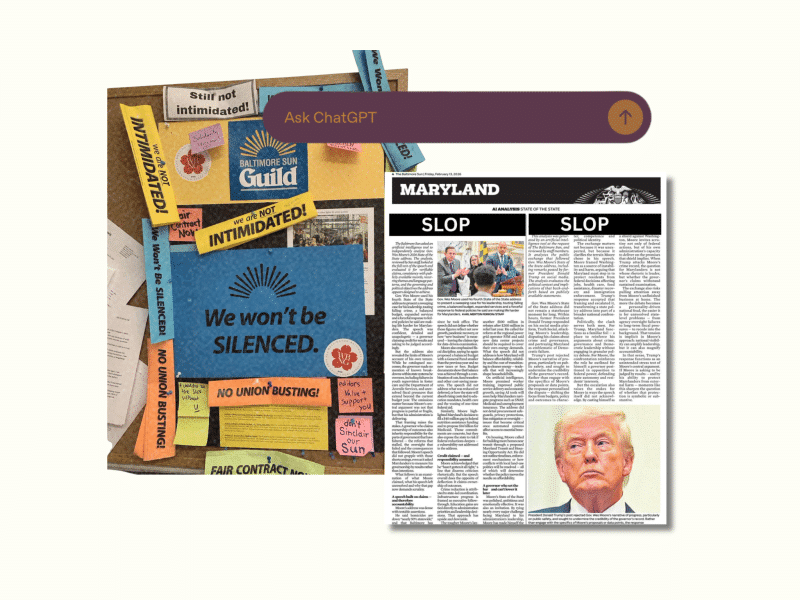
When The Baltimore Sun can’t get journalists to lower their standards, it turns to generative AI
The Baltimore Sun ”once again disparaged … human reporters and their work” by publishing two AI-generated political analyses, the newspaper’s union said.
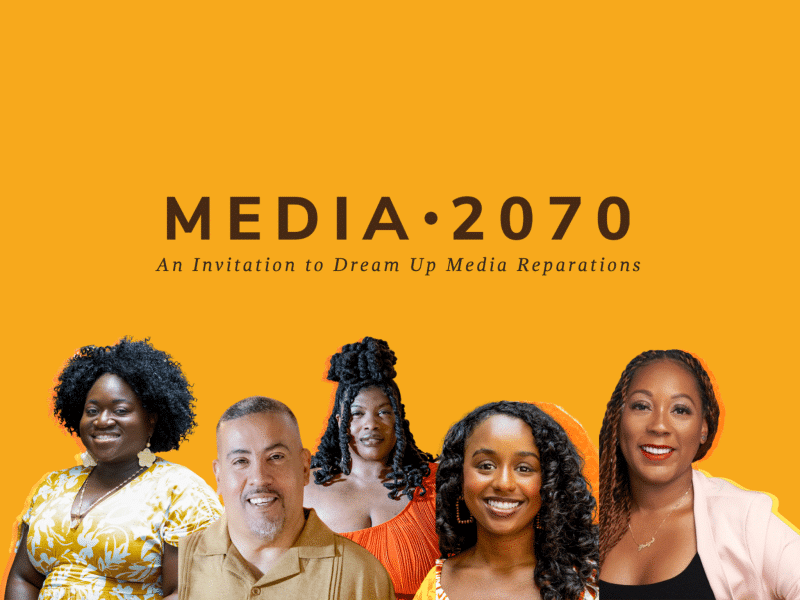
Q&A: ‘We’re winning when media reparations is common-sense’: Media 2070’s new chapter
In the midst of attacks on Black press and journalists, Media 2070 charts a tangible future for Black narrative power and media reparations.