
When The Baltimore Sun can’t get journalists to lower their standards, it turns to generative AI
The Baltimore Sun ”once again disparaged … human reporters and their work” by publishing two AI-generated political analyses, the newspaper’s union said.

In the midst of a years-long labor battle, The Baltimore Sun used generative artificial intelligence (AI) to publish two pages of political analyses. The articles, buried in the middle of the paper’s Feb. 13 issue, focused on recent political events in Maryland: one of Gov. Wes Moore’s 2026 “State of the State” address and another on the resulting barbs between Moore and President Donald Trump.
Both stories in the Baltimore Sun disclaimed that they were “generated by an artificial intelligence tool,” but they still drew criticism from The Baltimore Sun Guild, the paper’s union. On Bluesky, the Guild said, “Sun management has once again disparaged our talented human reporters and their work.” In a subsequent post, they noted one of the articles referred to Donald Trump as the “former president” twice, casting doubt on the Sun’s claim both articles were reviewed before publication.
The Sun’s AI usage is an extension of a power struggle that’s been brewing inside the nearly 200-year-old paper’s newsroom since it was acquired by JTF Publications back in 2024. JTF Publications is controlled by David Smith, a media mogul and the executive chairman of Sinclair Broadcast Group. Armstrong Williams, a right-wing radio personality who’s faced scrutiny for serious violations of journalistic ethics, homophobia, and multiple allegations of sexual harassment (now settled), also owns an undisclosed stake of JTF.
The Objective reached out to the Sun’s management for comment on the incident and labor relations in the newsroom several times, but received no response ahead of publication.
Immediately, the acquisition sparked criticism and concern from readers, journalists, and the Guild itself. The Sun’s coverage shifted right. It dissolved its features section, which focused on Baltimore’s thriving cultural landscape, and failed to disclose its ties to Smith while covering his involvement in local politics. The paper increased its coverage of youth crime, despite crime’s sustained decrease in Baltimore, and began publishing Williams’ opinion column and interviews, which run the gamut from discussions about “radical Islam” to pushing false information about transgender healthcare.
Dan Belson, the Baltimore Sun Guild’s chair, told The Objective that in the early days after the acquisition, management took a hands-on approach to curating the paper’s content: It tried to feed them specific stories and angles. He recalled an assignment on the crime beat where he was given a story about the failures of Baltimore’s Safe Streets program, a harm reduction approach to crime reinvigorated by Baltimore mayor Brandon Scott — whose losing opponent David Smith had funded.
“Not to toot our own horn here, but we’re just too good at reporting for that,” Belson said. “It kind of fails when you cook up something and assign it to a reporter that’s good at reporting.”
So management changed tack. Union-represented reporters, including Belson, said the paper shifted from controlling the reporters they had to hiring new ones and quashing dissent from those who objected to the paper’s deteriorating standards.
One former Sun reporter, Maddi O’Neill, was fired after criticizing the journalistic integrity of a story that ran on her beat in an internal Slack chat. She noted that the story “threatened her relationship with a source” when it was published excluding relevant information, which the Sun corrected after. While the union filed charges to challenge the lawfulness of the firing, they were ultimately dismissed.
Belson echoed that the lowered quality of reporting coming out of the Sun had shaken trust they’d built with longtime sources.
O’Neill wasn’t the only Guild reporter who parted ways with the Sun in the past two years. Since the acquisition by JTF, Belson said the labor union’s numbers have been whittled down from 55 members to only 31, as its reporters left for other outlets like the relatively new Baltimore Banner.
To Belson, it’s not a coincidence. He said there’s been an “unprecedented hostility” towards the union, including efforts to reduce its power by filling union positions with non-union employees. He alleged management began a practice of hiring reporters with the title of editors, so they’re contractually not obligated to be Guild employees.
Belson also alleges — as do unfair labor practice charges the union filed with the National Labor Relations Board — that management has taken a “my-way-or-the-highway” approach to negotiations, instead of participating in the good-faith bargaining required by law. At the bargaining table, which he says management has repeatedly walked away from, they’ve sparred over issues of broad contract terms, including a policy that makes staff submit to any medical exams management deems necessary and another policy the Guild has argued is functionally a “gag order.”
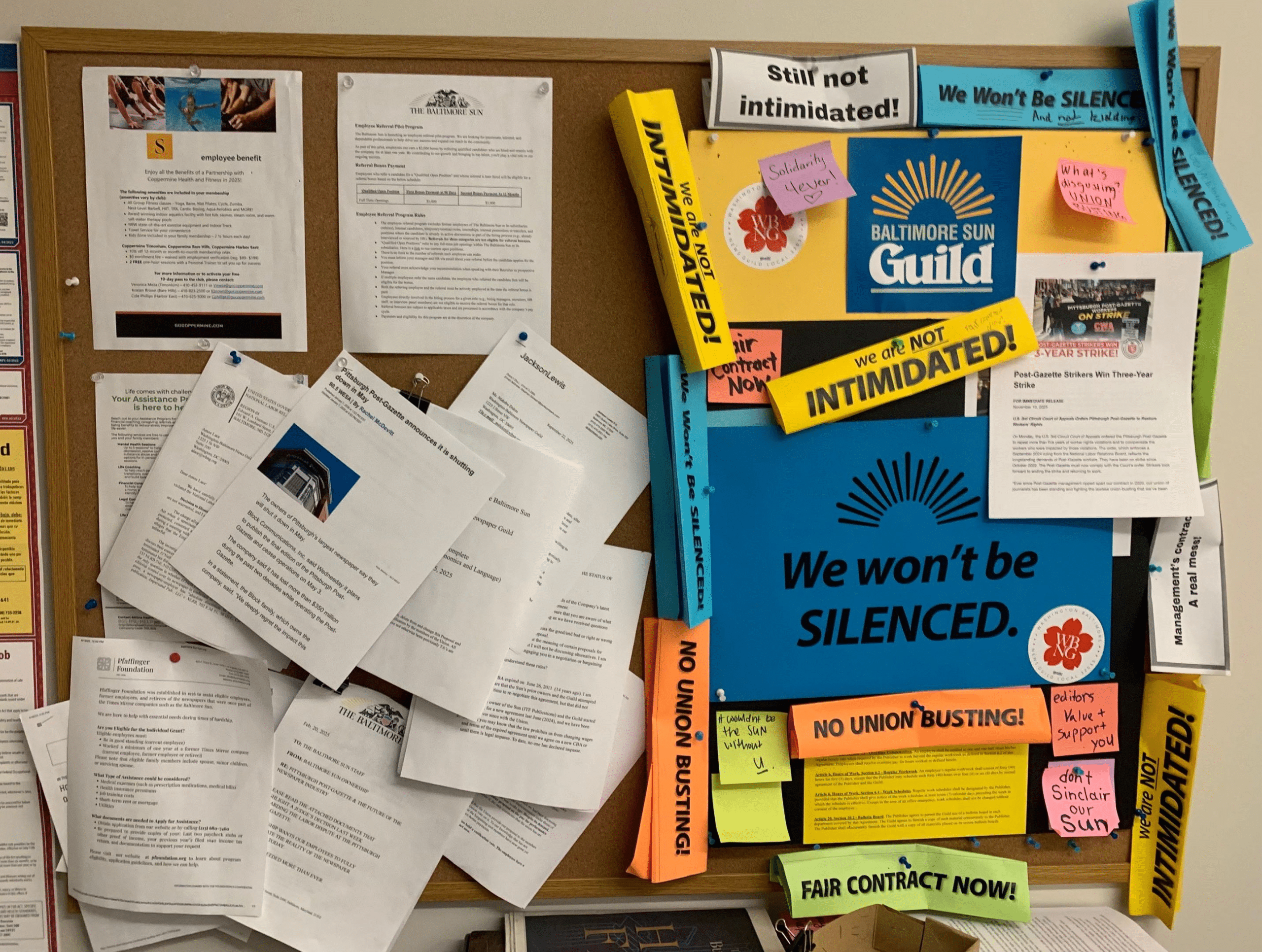
While The Baltimore Sun did not respond to a request for comment, their relationship with the Guild is an adversarial one, depicted by a photograph The Objective obtained of the newsroom’s bulletin board.
It’s divided into two segments: one, belonging to the Guild, filled with colorful papers of pithy pro-union slogans like “Respect, not pizza,” and the other, management’s side, covered in a barrage of news clips documenting the destruction of the Pittsburgh-Post Gazette in the aftermath of its own union strike.
Related: The Pittsburgh Post-Gazette is closing
And while the role of generative AI in news has been put under the microscope since its advent in late 2022 with the public release of OpenAI’s ChatGPT, further conversation continued after a Feb. 14 op-ed from an Ohio editor went semi-viral on Bluesky. Author Chris Quinn argued AI is “the future” of newsrooms because it now handles work that historically would’ve been done by teams of reporters, saving journalists valuable time.
But the reality is more fraught. Generative AI is eroding trust in news organizations, harming the environment, and being weaponized to abuse women online. It’s clear many journalists are concerned about its reckless implementation in newsrooms, as the New York Times’ Guild and others are fighting for guardrails around usage of generative AI — some unions successfully, as at Vox and Politico. Plus, the Sun’s loaded history of devaluing its reporters’ labor makes the publication of AI analysis that much harder to swallow for the Guild.
“Management is constantly telling us to work harder, take on new responsibilities, and give up our rights,” the Guild told The Objective, “so to see our hard work suddenly replaced by incoherent slop one day is just extra demeaning.”
Despite the current state of the newsroom, another former Sun reporter, Hannah Gaskill, said she’s still rooting for her “siblings in The Guild.”
Gaskill said: “The Baltimore Sun can — and should — be better.”
Madisyn Parisi is a trans journalist from Maryland and the writer behind The Backbone, a weekly newsletter dedicated to stories that hold powerful people accountable.
This piece was edited by James Salanga. Copy edits by Jen Ramos Eisen.
We depend on your donation. Yes, you...
With your small-dollar donation, we pay our writers, our fact checkers, our insurance broker, our web host, and a ton of other services we need to keep the lights on.
But we need your help. We can’t pay our writers what we believe their stories should be worth and we can’t afford to pay ourselves a full-time salary. Not because we don’t want to, but because we still need a lot more support to turn The Objective into a sustainable newsroom.
We don’t want to rely on advertising to make our stories happen — we want our work to be driven by readers like you validating the stories we publish are worth the effort we spend on them.
Consider supporting our work with a tax-deductable donation.

James Salanga,
Editorial Director
Related Articles

Native Hawaiians, new newsrooms work to shift journalism norms in Hawai’i after legacy media exclusion
As the Hawaiian Islands grapple with rising natural disaster and a news desert prognosis, a wave of community-stewarded projects centering Native Hawaiians and their values is trying to shift the culture of journalism on the islands.

Fort Worth Report becomes Texas’s sixth unionized newsroom
The Fort Worth Reporters Guild voted 11-1 to unionize, and will begin working with management on collective bargaining for a contract.
Q&A: ‘All journalism advocates’: Anita Varma on solidarity journalism
Journalism professor Anita Varma on her forthcoming book, Solidarity in Journalism: How Ethical Reporting Fights for Social Justice, the limits of the advocacy vs. journalism conversation, and more.