
Q&A: ‘All journalism advocates’: Anita Varma on solidarity journalism
Journalism professor Anita Varma on her forthcoming book, Solidarity in Journalism: How Ethical Reporting Fights for Social Justice, the limits of the advocacy vs. journalism conversation, and more.

Looking at solidarity in journalism, University of Texas at Austin assistant professor Anita Varma says, “started quite by accident.” Her interest began with studying media power — and specifically, people power through media.
When her PhD advisor, Ted Glasser, told her “people power is solidarity,” it set her on a trajectory to define solidarity: A commitment to social justice that translates into action.
For more than a decade, Varma has worked to articulate a framework for solidarity journalism, alongside many collaborators and contributors like the San Francisco Homeless Project, the Markkula Center for Applied Ethics, Press On, and affinity organizations like the Asian American Journalists Association and the Trans Journalists Association.
Now, she’s publishing a book on the framework, Solidarity in Journalism: How Ethical Reporting Fights for Social Justice, and working with a research team on an international scope for the solidarity journalism framework that will fill a second book, focused on 15 different countries where solidarity is happening but places people’s lives at risk due to criminalization of journalism.
While Varma has encountered many people suggesting she use a synonym for “social justice” when discussing solidarity reporting, she sees the specificity as integral to describing her work.
“Social justice has become really scapegoated and tossed around in very problematic, often empty ways,” she said. “I’ve been really unwilling to compromise on that specificity, because I think it’s really important that we be clear that ‘social justice’ is not a bad word. And the very best of what journalism does, and I argue, has always done … is standing up for everyone’s basic dignity.”
Varma sat down with The Objective to talk about the contexts that informed her definition of solidarity and a solidarity journalism framework, how objectivity limits who can be considered credible as a source, her upcoming book, and more.
This conversation has been edited for length and clarity.
Tell me a little bit about the book’s journey — what made you interested in articulating this framework?
Anita Varma: One of the contemporary contexts was the start of the housing crisis in the Bay Area, which happened when I was still a graduate student. All of a sudden, many of us were facing a rapidly increasing rental market, and even just a lack of rental options, where previously … it wasn’t so difficult to find affordable housing.
And of course, the most visible impact of that was homelessness in neighborhoods in San Francisco, and surrounding areas that actually had never seen homeless tent encampments. As probably won’t sound surprising with the benefit of hindsight: The reaction from the city and the state was often to victim-blame, and to argue that people living in tent encampments were there because they had made some kind of personal mistake or were individually irresponsible, when in fact, that’s inaccurate. The truth of the matter is that homelessness in San Francisco and across the United States has been rising not because people are suddenly individually irresponsible, but because the cost of living, the cost of housing rentals included, is rising much more rapidly than wages can keep up with.
All of those things really came together in this solidarity framework for journalism.
Also, I noticed I was hearing from more and more journalists through my work on the Solidarity Journalism Initiative who shared that they were getting into trouble with their editors. They were getting pitches rejected. They were, in some cases, seeing their employment threatened for doing what I call solidarity reporting, which is where, instead of starting with the official or the academic, you start with the people affected. And I thought this was so strange — why would someone get in trouble for truthful reporting?
But I think some of that has to do with dominant tendencies to define journalism ethics in terms of impartiality, where somehow it’s taken as impartial to start your story by quoting the official, but it’s taken as biased to start by quoting the people impacted by that official.
And that kind of illogic is something that I hope the book will help clarify and address.
At the moment we’re speaking, a few days earlier the U.S. just launched military strikes on Iran. We’re seeing Israeli assault on Gaza and Palestine continuing. Last month we saw Black journalists be targeted, all at the same time that we’re seeing trans people and immigrants be pushed out of public life.
How have you seen current models of journalism evolve to cover everything that’s happening and where do you think a solidarity reporting framework can fill some of those gaps?
Varma: I think that a lot of solidarity reporting, as I talk about … approaches to sourcing and solidarity … is going there, being there, and going back [to a location]. Those are really some classic hallmarks of what the best of journalism has always done.
And I think in terms of recent examples from 2026, Georgia Fort is well known in Minneapolis and nationwide for doing exactly that. She doesn’t just report the story based on social media posts going viral. She shows up in person. And that is a really, really crucial practice for ethical reporters because it eliminates the “he said, she said.” If you can see it with your own eyes, as journalists have told me, then that kind of false equivalence is gone. We know what’s going on. We can see it with our own eyes.
I think that that physical dimension is really important. And some models of journalism, particularly local journalism and some models of community-engaged reporting, are very keen to show up in person.
Where solidarity reporting really puts a lot of scrutiny is, where are journalists showing up? And the call in solidarity reporting is to show up where and when people’s basic dignity, their basic humanity is either being denied or disrespected in ways that affect their basic survival.
And that’s why I think so much about Georgia Fort. She has done precisely that for a very long time, much longer than 2026. But I think that it’s also interesting that she identifies as an independent journalist. Some people consider her to be someone with a particular following on social media platforms that suggest this space outside of institutional newsrooms, where you might be very constrained from showing up and doing the kind of investigative work that’s needed right now.
Other models of journalism that come to mind are related to citizen journalism. I talk about Darnella Frazier in the book and how, from my perspective, I argue that these questions of, “Is citizen journalism really journalism?” … that conversation was answered with Darnella Frazier’s video and the Pulitzer citation it received, I think it’s been answered again and again in 2026, where there’s not some journalist badge that you need in order to go there, be there, and go back.
And I think that constraining journalism to these institutional models also creates power dynamics like what we’re seeing at the Washington Post … They’ve done some phenomenal solidarity reporting in the past, but when you’re constrained to certain ownership models, I think that’s where the public interest orientation, the public service orientation of journalism, may start to fade.
Related: Washington Post lays off race and ethnicity reporters
One longstanding conversation in the industry has been an attempt to try and define a clear line between journalism versus advocacy. Especially with this work, are there more useful conversations that you see happening? How do you feel about that dichotomy?
Varma: Chapter two of my book takes up almost precisely this question — it’s a chapter title in quotation marks: “Is That Really Journalism, or Is It Advocacy?” And that is a question that I’ve gotten for all the years that I’ve been talking about solidarity in journalism. I did not have a background in solidarity. I also have no background in advocacy.
So initially, I was very confused by this question. What is this advocacy concern? It was coming up in panels with editors, with journalists, with discussions with academics. I think the fact that the distinction was not anything salient to me is also telling — sometimes we assume these distinctions must be universally meaningful.
But as I looked into it more, here’s where I landed, and I encourage lots of discourse about this aspect of my book: to advocate means to put forward a proposal to provide support, often for an idea.
With that definition, oftentimes people want to say, “Well, there’s advocacy in one realm and there’s journalism in another realm.” But generally speaking, people will acknowledge that there’s overlap. There’s something called advocacy journalism, where it would be quite strange to claim that the labor press was not doing journalism. They were, and they were doing advocacy through that journalism.
But what I argue in the book is that even that delineation of saying, “Well, sometimes journalism overlaps with advocacy” actually overlooks an important [truth] — in academia, we call this an ontology — which is my argument that all journalism advocates. All journalism advocates.
Every single example of journalism that there is, ethical and unethical journalism, the very best of journalism and the very worst and everything in between, it’s always putting forward a proposal of what publicly matters. If there’s a story, that means that someone, somewhere, somehow, has judged that matter to be publicly important. And as soon as you do that, you are indeed advocating.
So I also talk about in the book how the best of journalism, what we might call ethical journalism, celebrated journalism that wins fancy awards, that gets taught in journalism classes for decades and centuries later, has advocated for some specific things:
Number one, for vulnerable people’s basic dignity. I don’t think that some coincidence or mistake that journalism awards regularly are applauding reporting that stands up for vulnerable people’s basic dignity.
Ethical journalism also advocates for the public interest outside of private interests.
And finally, ethical journalism will advocate for truth. And I think that is a need that is unfortunately often unmet.
There’s a great quote that maybe is a cliche by now — “If someone says it’s raining and someone else says it’s not, it’s not your job to report both. It’s your job to look out the effing window and find out.” And I think that kind of advocacy is really significant because the climate that we’re in is one in which belief in the existence of the rain is contentious.
As you’ve been doing this work, and especially coming to it from a perspective of not necessarily having a foothold in newsrooms versus advocacy work, when you started looking into media power, what did objectivity in journalism mean to you? And how has that changed?
Varma: Initially, I thought of objectivity as a method and solidarity as a method. And in the course of developing this work and learning more about many critiques of objectivity, hearing from journalists who have been taken off stories due to claims that they would be unable to remain objective, including after the Atlanta shootings of Asian women in 2021 — seeing the anguish that these claims of objectivity, these barriers of purporting to be objective create, I understood that objectivity is much more than a method in journalism.
It is a structure of power, control — what’s often called hegemony — to make it just simply commonsensical that an Asian American reporter needs to disclose and, in many ways, promise not to allow such positionalities to influence reporting.
Whereas the member of the majority group is never asked to disclose the fact that, [for example], I’m a reporter living in New York, reporting on New York. I’m a U.S. citizen who happens to be reporting on U.S. politics.
Well, those are also biases. And yet these notions of objectivity are selectively applied.
What relationship do you think that objectivity has to solidarity reporting and the framework you’ve articulated?
Varma: Just as objectivity is often positioned as a method in journalism and an aspirational principle, I argue throughout the book that solidarity is also both. … In the process of [the book’s] peer review, there were questions about what distinguishes what we were calling solidarity journalism from other types of journalism — engaged journalism, solutions journalism, investigative journalism.
And my answer is, “Well, there’s not necessarily a genre difference.” Just as objectivity in journalism is a principle, a practice, a set of orienting ideas, that’s also the level at which solidarity operates.
So we wouldn’t really say, “What’s the difference between objective journalism and news reporting?” We wouldn’t say, “What’s the difference between objective journalism and data journalism?”
We would understand that objectivity may, in some situations, be thought to run through many forms of journalism, and solidarity is actually that big. It’s not a subsection or a sub-genre. It is operating at the level of both principle and practice. And as I argue in the book, it’s an indication of rigor.
I think objectivity is often mistakenly thought of both among journalism academics and among journalists to be an indication of rigor. If you let go of saying you’re an objective reporter, well, that must mean you’re just a subjective opinion broker.
And solidarity reporting demonstrates that nothing could be further from the case. Actually, solidarity reporting is more truthful about issues placing people’s basic dignity at stake than “objective” reporting that will defer to officials, outsiders, and commentators who don’t actually know the lived truth of what’s at hand.
So I think that understanding the significance of objectivity helped me also to articulate more of the significance of solidarity and really rejecting the premise that objective reporting is the route to truth.
We know that in coverage of marginalized communities, it’s simply the opposite. And this goes back to the 1960s and before that. What passes as objective reporting, “unbiased” reporting is deeply biased towards maintaining the dehumanization of people who are struggling to survive.
Objectivity as a power structure shapes who is considered credible or “unbiased” as a reporter, but also who is considered credible and knowledgeable as a source. In many cases, people are nowhere to be found in stories about their own lives. This isn’t just an ornamental concern: as the 2024 election coverage showed, relying on Harvard economists to diagnose the economy as wonderful while people are struggling with the cost of living and full-time workers are living unhoused means that “objective journalism” shows its biases for people with power at the expense of truthful reporting. That’s an ethical problem, and one that journalists often are aware of but don’t have a clear alternative approach to use. My hope is that this book will provide that approach for many journalists who are in this field due to a commitment to public service. Those of us in journalism education, journalism research, and journalism support need to have their backs!
Related: Solidarity reporting can help the cause of public safety for marginalized communities
Could you share a quick overview of how the book is structured?
Varma: The structure of the book is something I’m very excited by — I really did structure it with practicing journalists in mind … The first chapter looks at solidarity in journalism and explains this framework.
The second chapter is, “Is That Really Journalism, or Is It Advocacy?” And I say, “Yes, it’s all advocacy, so let’s go.”
And then the next chapter starts with how to decide what stories to pursue. So that’s “Making Newsworthiness Judgments in Solidarity.” Instead of looking at whether the president or the mayor or the local celebrity have chimed in, making newsworthiness judgments to even pursue a story in solidarity is going to start with this question of, “Are people’s basic dignity even potentially at stake?” And I provide a lot of examples from local reporting there.
The next chapter is “Going There, Being There and Going Back.” I shouldn’t play favorites, but that is probably my favorite chapter, because it’s based on more than 30 interviews I did with journalists who do this work day in and day out. And I think they have never gotten their flowers for doing it and they really deserve a lot of recognition for these three practices.
They physically go — whether they have a car, whether they get on a bus, whether they walk or bike — they physically go to where the story is happening.
Being there means they spend time there — not just to grab a quote and run back to type it up, but to understand what’s going on, to observe, to give people some space and to try to understand.
And the third one … I heard it first from local TV reporters, who do not have time, and also print reporters and audio reporters. They all told me that they would go back. And I said, “What do you mean go back? For a follow-up story?”
They said, “No, we would go back to show people the story we wrote about them, because people in these conditions placing their basic dignity at stake are not going to have time to go searching for our story or find a way to watch the evening TV news, but they deserve to see it.”
And I asked them, “How did you get that idea?”
One journalist I’ll never forget, she’s in the book, she looked at me like I was asking a very strange question. She said it wasn’t an idea, it was just humanity.
… Journalists who report in solidarity, they don’t think of themselves as innovators. They don’t think of themselves as doing some kind of fancy approach. They just think in terms of humanity. And they don’t just think in those terms, they put it into practice.
… The last chapter is about structuring stories in solidarity. So I offer some in-depth examples in that chapter and also draw a contrast between … monitorial reporting that will keep an eye on what officials are doing, and reporting that is very emotionally focused, that’s often about one person, [and] what is their inner journey.
And then we have solidarity reporting. The three key aspects of solidarity reporting are that they include people. That’s plural — so not just one token individual, but more than one person affected by the issue. The second is that these stories will use the definitions [from] people affected … of what is going on and why they’re struggling. The third is that we will see in the story a portrayal of shared conditions.
These are not just three unlucky souls going through three different unlucky circumstances, but there’s something shared in common. [For example], in stories on housing insecurity, that is often a prohibitively expensive rental market. … I offer some close readings of stories that do exactly this that have already been published. And I really try to highlight that because I think it’s really important to know that solidarity and journalism is not just a nice idea. It is something that journalists are doing already, but they don’t do it all the time.
… In the conclusion of the book, I start to consider why that is, what are the stigmas they face, what are the structural inhibitions, and how could those change. …. I talk about how it might seem kind of strange to write a book about ethical journalism in 2026. The biggest joke I get when I tell people I teach journalism ethics is “What are those?” or “What were those?” But I think that although we do live in an era of overabundance of news, we actually still get very little ethical journalism.
… Ethical journalism … regardless of who’s doing it, whether you went to a j-school or you didn’t — many times journalists did not, and they do excellent reporting — will stand up for people’s basic dignity, not based on a personal preference, but based on the truth that as human beings, we all have intrinsic value. [That] societal conditions that deny that inherent value are not okay. That’s unjust. That is the time when ethical journalism stands up.
As this book releases, what sorts of threads are you hopeful that people will pick up and carry from this framework?
Varma: It’s an excellent question. I think the number one takeaway that I hope everyone has who reads this book — or reads a review of this book — or reads the description and thinks, “I should get that book someday,” is that solidarity for social justice, both in journalism and in other spaces, is currently being treated as if it’s a bad thing to say.
I really hope that people will think about the argument that I make that, on the contrary: Solidarity for social justice is the very best of what journalism does and has always done.
This is not a 2020s phenomenon, this is not a recent innovation proposal, this dates all the way back. The earliest example that I found goes back to 1808.
I am not that old to have been there for that, but I think that those histories often get erased very quickly, and that’s why I try. I’m not a historian, but I try to do justice to some of those histories in the book as well …[I’m] really thinking about those journalists who reached out to me from 2019 to 2023, especially explaining that they were either in trouble or they had been terminated from their jobs for doing exactly what I was describing, exactly what I was encouraging, I do believe that those journalists were not wrong for what they did. From an ethical perspective, they did everything right.
And I think it is really frustrating that even today, many students and early career journalists face tremendous pushback for simply doing truthful reporting. … When we think of what constitutes truth, who tells truth, and what are the stakes of truthful reporting, I hope that my book in some small way can contribute to clarifying those stakes and helping to convince us all as news consumers, as news producers, as journalism supporters and teachers and practitioners, to do better. Because the people whose basic survival is at stake cannot wait any longer.
Update, Mar. 11: This story was corrected after publication to reflect the earliest year Varma was able to find an example of solidarity reporting.
James Salanga is the co-director of The Objective.
This piece was edited and copy edited by Marlee Baldridge.
We depend on your donation. Yes, you...
With your small-dollar donation, we pay our writers, our fact checkers, our insurance broker, our web host, and a ton of other services we need to keep the lights on.
But we need your help. We can’t pay our writers what we believe their stories should be worth and we can’t afford to pay ourselves a full-time salary. Not because we don’t want to, but because we still need a lot more support to turn The Objective into a sustainable newsroom.
We don’t want to rely on advertising to make our stories happen — we want our work to be driven by readers like you validating the stories we publish are worth the effort we spend on them.
Consider supporting our work with a tax-deductable donation.

James Salanga,
Editorial Director
Related Articles
Fort Worth Report becomes Texas’s sixth unionized newsroom
The Fort Worth Reporters Guild voted 11-1 to unionize, and will begin working with management on collective bargaining for a contract.
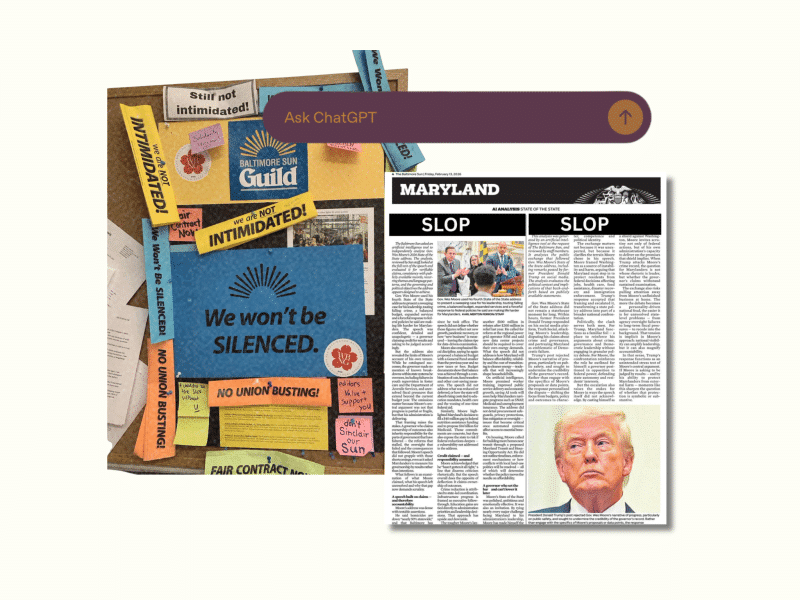
When The Baltimore Sun can’t get journalists to lower their standards, it turns to generative AI
The Baltimore Sun ”once again disparaged … human reporters and their work” by publishing two AI-generated political analyses, the newspaper’s union said.
Q&A: ‘We’re winning when media reparations is common-sense’: Media 2070’s new chapter
In the midst of attacks on Black press and journalists, Media 2070 charts a tangible future for Black narrative power and media reparations.