
Q&A: Alan Chazaro of KQED’s ¡Hella Hungry!
Poet, educator and ¡Hella Hungry! creator Alan Chazaro reflects on coming to food writing as someone from outside the institution of traditional journalism, telling human stories through food and more.
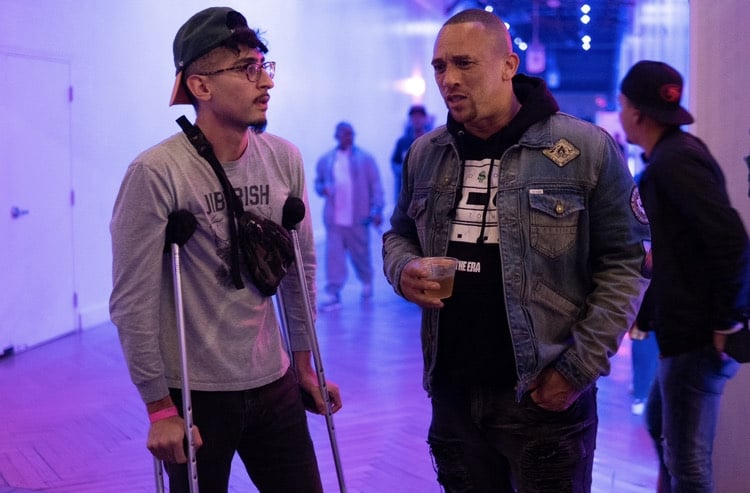
When poet, educator and KQED food reporter Alan Chazaro is hungry, he said he invokes the name of the series he created at the Bay Area public media station: “Damn, I’m ¡hella hungry!”
“Hella” is a Bay Area word through and through, and the name’s Spanish punctuation, he said, is a nod to “not just my background, but the multi-dimensionality of the Bay Area.”
Those dimensions, against a backdrop of columnists wringing their hands about what they say is a “crime-riddled Bay Area” while long-time residents are pushed out of their homes, are what Chazaro seeks to capture in the series. For him, the food is a conduit to capturing the stories of the people that are in the kitchen and the world that shapes them.
Chazaro has been making art in the Bay Area since he was a teenager, which has put him on the other side of the microphone, and credits his current KQED colleague, Pendarvis Harshaw, who also grew up in the Bay Area — to his approach to journalism and interviewing.
“I could tell he valued many aspects of my experience that other journalists maybe overlooked or didn’t have the awareness to perceive,” he said. “Having been in that position as an interviewee taught me how I could approach my subjects in the way I felt Pen approached me: with humility, deep curiosity, humor, respect and realness.”
He isn’t necessarily drawn to what’s novel or flashy, or married to the idea that writing about a place and its people once means you can never return unless something major happens — his work covering places that distinctly reflect the Bay Area is the product of observation, patience, and a willingness to see what he learns when looking at an familiar place in a different light.
After coming back to the Bay Area due to the start of the COVID-19 pandemic, he hit the ground running with journalism and launched ¡Hella Hungry! at KQED in May of last year. Chazaro said he strives to tell stories that draw on his identity and unique set of experiences, rather than clickbait.
“I wanted to be a Bay Area perspective that I don’t see a lot in mainstream media, as somebody that was raised locally with immigrant parents, particularly as a Latino man,” he said. “I just read a lot of stuff that can kind of be clickbaity, especially when it comes to food … I hate that kind of journalism, personally.”
The Objective’s Janelle Salanga spoke with Chazaro on the phone about his approach to food writing, how organizations can support food writers telling multidimensional stories and more.
You grew up in the Bay Area, where you now work. Tell me a little bit about how you came to love food, the roles it’s played in your life and what it means to you to get to write about food in the place you were raised.
I always try to be straightforward with people that I don’t see myself as a food writer by trade. I see myself as a cultural observer, of which there are many lenses, one of which is food. As I’ve come into the role as a food writer … I started reflecting on it, looking back [to food] as a source of sustenance — not [just] literal sustenance, but metaphoric sustenance, and bringing people literally and metaphorically to the same table, sharing experiences, taking memories and recipes and family textures, and diasporic experiences, putting that on a plate, and then consuming that. So I very much try to view it from that more “poetic” perspective of something that goes beyond the ingredients or a new restaurant opening.
… That being said, you know, I grew up with a single-parent, Mexican immigrant home, so I ate a crap ton of tacos and tortas and bistec — many things to me that are like, “Oh, that’s normal, daily food.” Quesadillas was my sandwiches, right? … I think it’s important, and an essential thing, for journalists to cover the places we’re covering with authenticity and with a sense of deep connection to the people that are from there.
… I identify very personally with local creatives. In my own career as a Bay Area poet, I have been interviewed by journalists [like Pendarvis Harshaw] regarding my art and poetry. Those experiences — of being the subject of an article or podcast, rather than the reporter — gave me a unique insight into how others can perceive you and your work with care, empathy, and attention. It feels humanizing when you’re hustling to share your art and someone with a platform says “hey, this is dope, let’s talk about it.” … It was also important for me to see a local, relatable person in the role of reporter, rather than some abstract, intangible news institution without a face.
Because I know a lot of people that are obsessed with food, and they make food videos, and they’re always going to restaurants — I was never that way. And I would argue, even, that part of what I’m trying to communicate [in ¡Hella Hungry!] is, I’m drawn to people and their stories. So when I think of a restaurant, I’m not necessarily thinking of, “Will this get me clicks? Is this something trendy? Is this something new and buzzy?” I’m more thinking about, “Who are the people behind it? What is their background? What is their role and intention in this community? Who are they, and what is their story?”
What do you think gets lost when food writing tells stories fixated on the technicalities of dishes themselves instead of the stories of the people who make them?
I’m very sensitive to things like gentrification — or erasure, maybe, is a better word … Erasure is a … broader reality that many people experience, especially when you’re looking at immigrant people [and] working class communities. It’s easy to forget all of the contexts socially and economically and culturally that can go into something. When we only look at the food or the restaurant, it kind of just ignores the reality and the context of which these restaurants and places are — maybe they’re raising the rent in the area, maybe they’re changing the demographic or the vibe of a certain neighborhood that’s been a certain way for a while, and making it different for the people that have lived there without considering those ripple effects.
I’m somebody that went to school for sociology and Chicano studies and poetry … so when I enter a story, I’m looking for those sorts of implications. Even if I’m not writing about those things directly — I don’t necessarily want to be didactic in every piece, and be like, “Hey, gentrification sucks, and people are getting erased” … I can be very hyper-specific about the people I do choose to profile.
I can write about this restaurant that everybody’s writing about right now, because it’s just opened, and it’s super fancy, and it’s trendy, and it’s getting a lot of attention. Or I can write about this Latino kid that’s running a pop-up out of his garage and only sells tortillas at hip-hop shows and has like, 300 followers on Instagram, knowing that story probably won’t get as much attention, but I have the ability to cover that person and talk to them, and listen to them and validate their experience. … A lot of times, I typically lean towards [covering] those subsets of food makers, which are pop-ups or impermanent or somebody that has a full time job, you know, and they’re just doing this on the side for two nights a week.
Those are the people I want to write about, because they’re typically from the Bay Area, and they’re just hustling to survive, because “Oh, [it’s] damn expensive here.” And if my article brings in like 10 more people … it gives them a morale boost, but it also gives them an actual, practical business boost, I hope. It’s happened a few times: I’ve written about random spots in gas stations, and I wrote about a formerly incarcerated construction worker that sells sandwiches out of his apartment on weekends. And in both of those cases, the people have contacted me and been like, “Hey, my business is going hella crazy right now in a good way.” Or they’ve even gotten jobs based off of somebody reading the article … and reaching out to them.
… That’s more important to me than my stories … going viral or something like that. Am I making a real, or at least attempting, to make a [real] impact in people’s lives and sustaining community businesses that I know have roots here and are [run by] people that are hardworking? That’s what drives me, and I feel like that can get lost if you don’t pay attention to those realities [like erasure], or [don’t] have a sense of care for the community.
How do you curate the selection of folks that you reach out to?
A lot of it is honestly just word of mouth. … I’ve been here for a couple of decades — I went to high school here, elementary. I went to college here, I went to grad school here. I’ve worked jobs all around the Bay Area, in different industries. I’ve had students here, I have cousins here, I have siblings here, parents. I kind of leverage those networks as much as I can, and just sort of trust other people’s radars, especially people that I know. From there, it kind of becomes like this tree branch lineage of, “I met the chef who’s doing this taco pop-up on Tuesdays at a barbecue spot, and he knows his friend is doing fried chicken on Saturdays only at this club,” and then I go check that out.
… It does take a certain level of work and a certain level of care and trust. Some of these businesses, they’re not always permitted, or … the person [behind them] might be undocumented. There’s a lot of factors that can go into writing those stories, and it can require extra patience as a journalist, because … some of those communities and people don’t trust media, and they don’t trust institutions and outsiders to just see what’s going on or tell them anything. There’s been times where I’ve had to wait months … for them to trust in me, without me forcing it. And they’ll come back to me months later, and be like, “Hey, dude, can you actually write that story now?” For me, as a journalist, when that person is ready to tell their story, that’s when I’m ready to share it, rather than me … forcing a narrative.
Speaking of trust, traditional journalism can really emphasize distance from the people you’re working with to tell a story. And that’s not really present in the Instagram reels you put together where you’re sharing meals and swapping stories with these folks. Why do you think creating that kind of atmosphere where people can share a meal with you while you’re talking with them about their business, and their story, is important to the kind of food writing that you want to do?
I think this probably comes from my being, [for] over a decade, an educator and being in classrooms. A lot of the way classrooms worked for me was, you know, [based on] building trust, building community, communicating with people, being patient, and allowing an organic sort of bond to be built between human beings.
… I do like to be face-to-face with people — even when possible, be in their space, whether that’s a pop-up on the sidewalk or a restaurant that they’re just opening in their kitchen, or that doesn’t have a brick and mortar, and they are cooking out of their mom’s ovens. I’m just, like, sitting there in their living room. And watching basketball with their mom, while they’re baking and interviewing them, formally, but also like [sitting there] in this very informal context. That’s that person’s life and reality, so … I want to understand that. So I can write about their fullness and their dimensional experiences as accurately as possible and with as much empathy and understanding as possible. Getting all of those layers of somebody, to me, is very essential.
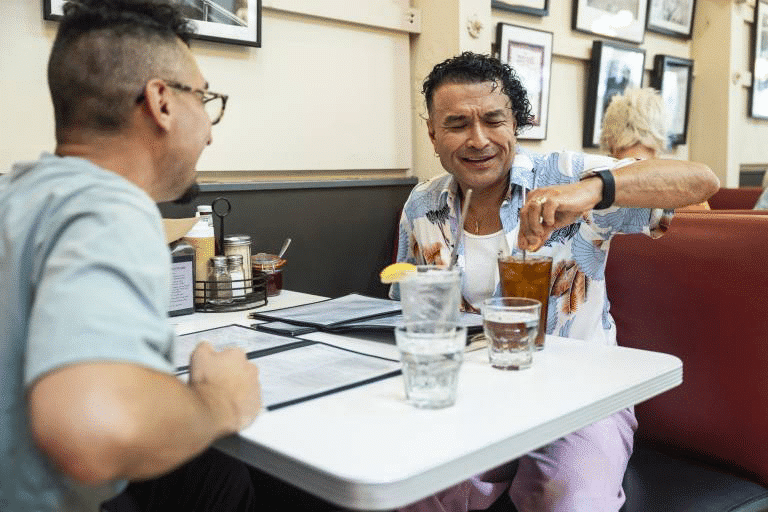
It does require hella work, and hella time and hella patience and a lot of scheduling and making sure everything lines up for those moments that happen. … But I just want to get to know them as, as a Bay Area person, basically trying to survive economically by being creative through food. That’s why I make the effort as much as I can to really meet people in like, their most organic contexts, as much as possible.
Of course, I can’t always do that. Nor can the subjects always do that. … But when it does line up, it’s a very beautiful form of nourishing the spirit, right? We’re both taking time for each other right now. I’m eating your food, I’m in your home. You’re giving me yourself too, right. And it’s this exchange of love and care for one another, that I think really stems, again, from my sense of being a teacher and my experience as a Bay Area person from a marginalized community and background, in terms of being the son of immigrants and things like that, and knowing what that’s like for me as a person, so that I can give that amount of tender attention to somebody that maybe doesn’t get it for their business.
It sounds like KQED has really supported your approach to covering food. How would you like to see other organizations supporting and encouraging food writing that goes beyond clickbait or the typical formula of what food writing could look like?
Giving opportunities to non-traditional voices, like myself, and like many other people that I know that could tell amazing stories about the places that we live in, but because they don’t have those credentials, or those pathways, they’re not a part of the conversation. Obviously, there’s the larger societal realities of people having pathways into journalism to begin with … and all of these complex sorts of infrastructures need to be in place for somebody to even be in a position to be like, “Hey, I want to be a journalist.”
… I started in community college, and I almost dropped out of high school, and I didn’t even know what journalism was for, like, most of my life. It takes a certain institution to be like, “Okay, this kid has no experience, really. But he’s from the place he’s writing about, and he represents a demographic that we have very little of in the newsroom, which is being Mexican American, in a region of California that has hella Mexican Americans, right?” You kind of have to give credit to the organizations like KQED that acknowledge all of those things as part of my package as a journalist and gave me the ball, saying, like, “Hey, you can play on this team.”
…There are definitely organizations that I felt like were way more skeptical of me, and maybe gave me freelance opportunities, but never really said, “Hey, here’s like a living salary to work off of.” That comfort and that trust in somebody that’s raising a family in the Bay Area to have an annual salary — if people don’t give us those opportunities, I might have not even been in journalism for more than two or three years, because I would have burned out on freelancing.
… An important piece here is that “the institution” that I work for really empowers me, as a [worker at a] public media outlet, to tell these stories, and to take my time and to really let the stories be written in a way that’s authentic to me and to the subject. I’ve freelanced for many publications, and there are often editors that are rushing something, or they don’t quite see what I’m trying to capture in a story, so they might be forcing something or trying to stir up some spice or drama that isn’t there in a way. I’m like, “Dude, this is just a story about somebody making muffins in their house, I don’t know what to tell you.”
I think that also has to be a part of the equation. It’s not just a writer, being from somewhere or caring deeply about a group of people, it’s also the writer having those intentions and then the organization also having those intentions and those two things aligning, which sadly in media is kind of rare, in my experience.
Some journalism can make the Bay Area — especially its big cities like San Francisco, San Jose and Oakland — out to be almost hyperbolically violent. How do you see your role as a journalist in that landscape, especially as someone who was born and raised in the Bay Area?
I see my role as a food and culture writer. Within that context, I’m very aware that when I open social media, there’s a lot of accounts that are posting … fear mongering content, and I’m kind of like, “Okay, hello, people are doing that. And that’s apparently getting a lot of clicks. So I’m gonna go talk to the kid that dropped out of high school and used to steal cars, because he grew up in a certain environment at a certain time, and now he works for Goodwill and helps to organize charity funds and gives away free food, with his pop-up.”
I want to talk to that person, and learn from them. “Amplifies” is the word that I use a lot, because I feel like as a journalist, you’re given this microphone for a region in some capacity. I view my role as trying to find these people that have come through communities that don’t always have all the resources but are still doing something super dope and are giving back and are very hardworking — these are like my neighbors, my cousins, my friends.
I see them as almost kin in a way: I grew up with kids like you and I know many people like you, so let’s just interact like that, and let me share some of what you’re doing, which I think is cool, within that bigger context of — in a different sort of person’s mind, they could only fixate on the negative aspects of what that neighborhood might be. Food very much can be an intersection for that positive, community-based experience, and it often is a place of joy and happiness and sharing, giving back, and an economic boost for a region.
Journalism, to me, is not so much [just] reporting the straight facts. It’s more an interrogation of a layered reality with many factors involved. Taking a moment to deeply consider one perspective of this huge swirl of things going on, and hoping through that, we can understand somebody’s experience, or a certain food or a certain dish, or even a neighborhood. A lot of things can happen through food writing, if we approach it with more of a sociological framework. That’s not to say that writing about an ube chocolate taco just for the hell of it shouldn’t happen, because it should. It’s just about trying to do that in a way that’s authentic and original.
Janelle Salanga is a reporter for Sacramento NPR affiliate CapRadio who moonlights as The Objective’s editorial director.
Edits and copy edits by Omar Rashad.
We depend on your donation. Yes, you...
With your small-dollar donation, we pay our writers, our fact checkers, our insurance broker, our web host, and a ton of other services we need to keep the lights on.
But we need your help. We can’t pay our writers what we believe their stories should be worth and we can’t afford to pay ourselves a full-time salary. Not because we don’t want to, but because we still need a lot more support to turn The Objective into a sustainable newsroom.
We don’t want to rely on advertising to make our stories happen — we want our work to be driven by readers like you validating the stories we publish are worth the effort we spend on them.
Consider supporting our work with a tax-deductable donation.

James Salanga,
Editorial Director
Related Articles
Q&A: Karen Attiah says her firing shows mainstream media still fails at talking about race
Karen Attiah, former long-time Washington Post opinion columnist and editor, sat down to talk about objectivity, “Democracy Dies in Darkness”, Black representation in news, and more.
Q&A: Autonomy News wants to cover bodily autonomy as a human right
Garnet Henderson and Susan Rinkunas, co-founders of the worker-owned reproductive justice outlet, on their new newsroom and what covering reproductive justice looks like in this particular moment.
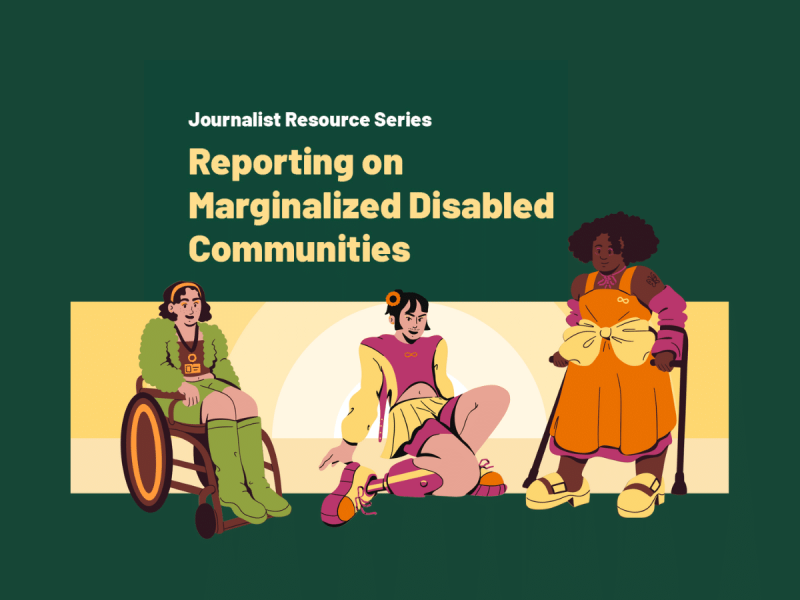
Q&A: Guide for Reporting on Disabled Communities
Ericka A. Dixon and Sebastian Margaret, senior national organizers with The Disability Project at Transgender Law Center, on crafting a guide for better reporting on disability focused on those most at the margins.