
The article ‘Times Union’ didn’t want readers to see
The editor-in-chief of the regional outlet interrupted travel plans to take down a story about the local impact of the ongoing Israeli genocide in Palestine — another echo of the journalistic malpractice currently rampant.
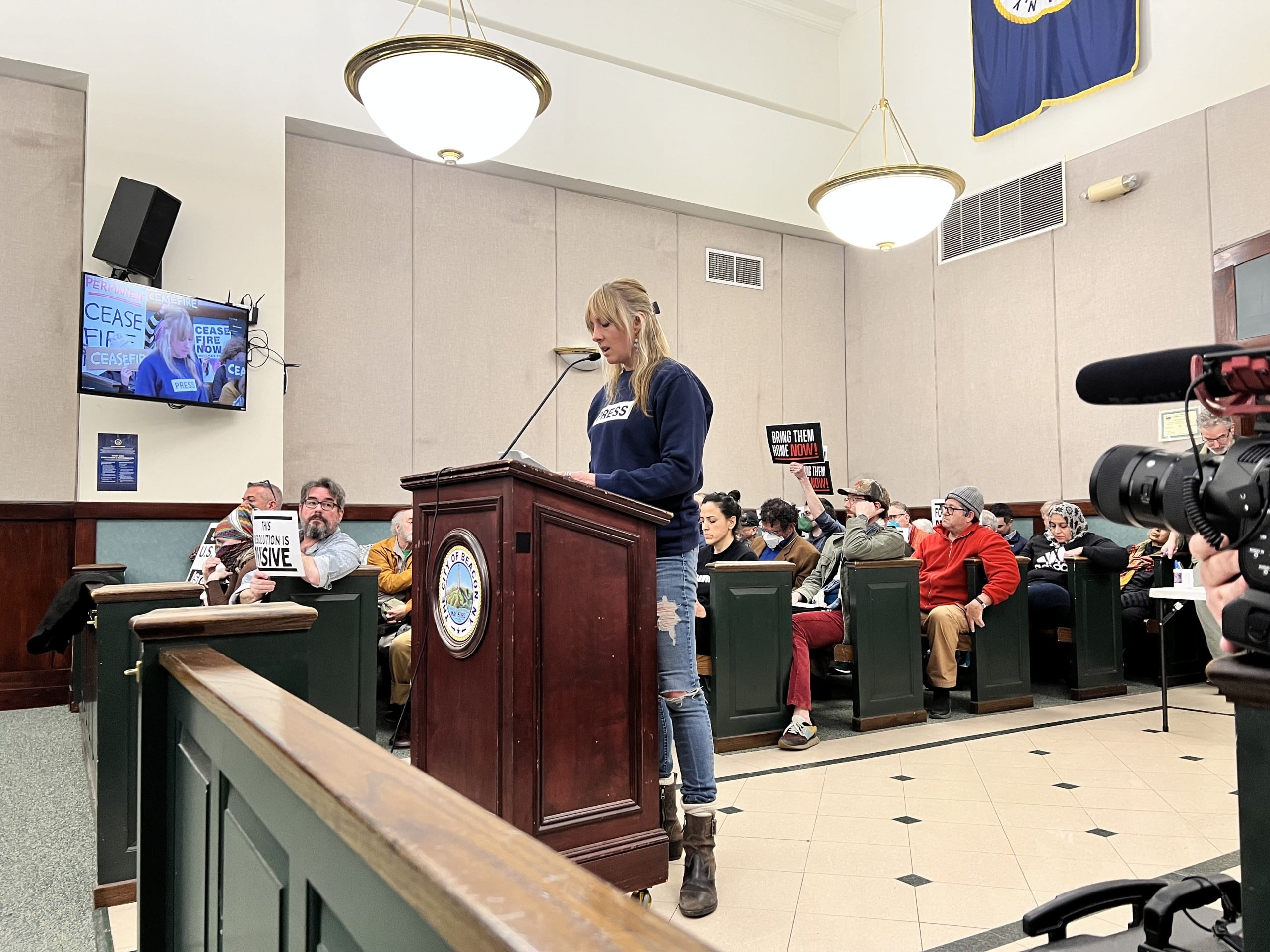
In April, I got a tip for a potential news story: Businesses in Beacon, a small town an hour north of New York City in the Hudson Valley, received anonymously posted letters harassing them for displaying signs supporting a ceasefire in the Gaza Strip, where the ongoing Israeli genocide has killed at least 40,000 Palestinians, including 16,500 children, according to Al Jazeera at the time of this writing.
A local story connected to international affairs, I thought it was a good fit for Times Union, the regional affiliate of Hearst Newspapers in Upstate New York, which I had previously contributed to as a freelance journalist. I sent a pitch to the Hudson Valley section editor, whom I had worked with in the past, and he commissioned it. The article, “Beacon Businesses Harassed for Supporting Ceasefire in Palestine,” was published online to both of our satisfaction on April 10.
The article was up for less than 24 hours before it was abruptly taken down by Times Union’s editor-in-chief, Casey Seiler, who pushed the newsroom to do so even while he was traveling out of office. Seiler couldn’t point to any factual errors in the article nor procedural errors in my reporting, instead accusing me of having an unspecified conflict of interest.
In a decade of being a full-time freelance journalist, I have personally never come up against the kind of editorial opposition I’ve experienced since covering the reverberations of the ongoing Israeli genocide in Gaza. The New York Times recently refused to issue a correction on an article I had contributed to, even after I provided police reports refuting allegations of an antisemitic crime reported by my co-author. Earlier, in December, an editor at The Smart Set, an arts and culture magazine that I contributed to for five years without issue, accepted a pitch of mine on decolonization — only to have a higher-up summarily reject the draft, without edits, notes or payment.
I am hardly alone in experiencing such pushback. The National Writers Union has compiled and verified at least 44 cases of retaliation by media company management against workers for either supporting Palestinians or criticizing the Israeli government since the start of the ongoing genocide. The cases of retaliation documented by NWU range from reassignment to stories unrelated to the genocide all the way up to termination of employment.
Related: U.S. journalists face retaliation, censorship for supporting Palestinian human rights
Seiler declined to comment for this article, deferring to my section editor’s explanation in April. At the time, I was told Seiler had ordered the article taken down due to my previous coverage of the Israeli genocide in Gaza and its reverberations, which I had written about for mainstream outlets like The New York Times and alternative ones like The Progressive Magazine. Journalists routinely returning to a subject is so common that it is referred to in industry jargon as a “beat,” and I had not faced any scrutiny for my other beats, such as labor unions, which I’ve covered since 2017, including in two previous articles for Times Union.
When I pressed for further details, including the written policies that I had supposedly violated, I was provided with excerpts from “General Standards and Practices for Hearst Newspapers” — which I had never previously been given, much less agreed to abide by, either in writing or otherwise. According to Seiler, I had violated two sections on conflicts of interest — but none of the conflicts enumerated, be they personal, financial or otherwise, applied to this situation. I was not, in fact or appearance, standing to gain from the article I had written for Times Union, outside of the payment offered by the publication itself.
When I once again pressed, the justifications came full circle: It was not that I had “a hard-and-fast conflict,” but “the appearance of partiality” due to my previous reporting.
What I was partial to and from whence that appearance arose was never specified, but Seiler claimed that no one who opposed a ceasefire in Gaza would agree to be interviewed by me — which was demonstrably untrue, as I had interviewed two such subjects, whose quotes failed to make it into the article due to time constraints, not due to any supposed antipathy toward me. I offered to add their quotes in a revision, but the conversation was over. The story would stay down. The best I could do was demand full payment. In the end, I suppose I should be thankful that at least I got paid the full amount I was due.
Despite Seiler’s accusations, it was actually Times Union that was ironically running afoul its own policies, as well as standard journalistic practice. According to the aforementioned standards and practices, Times Union should not “remove published material from our websites unless there is a clear public safety issue that can be substantiated by court documents or police records.” Standard journalistic practice would also necessitate an acknowledgement, if not justification, of Seiler’s decision to take down the article, which Times Union failed to issue.
As I recently wrote in an article for Drop Site, such journalistic malpractice has become troublingly common when it comes to coverage of Israel and Palestine. The reading public’s response to articles such as that one — and very likely this one too — often vacillates between self-righteous (“This is why I support alternative media!”) and blase (“Who even trusts the media anymore?”). Even sources are remarkably unsurprised when their perspectives are ignored or suppressed. The business owners whom I interviewed for Times Union, for example, were glad not to be demonized further, even if that meant they weren’t heard at all.
Of course, the current decline of news media as an industry is due primarily to economic factors, with tech companies cannibalizing traditional advertising revenue and venture capitalists picking the bones. But the loss of trust engendered through such journalistic malpractice explains why so few people are shedding tears while the news is slowly dying.
Correction (Sept. 13, 2024): This story has been updated to remove a mention of Times Union’s 25% kill fee, as the paper offered the full payment without pushback. The Objective regrets the error.
Arvind Dilawar is an independent journalist. His articles, interviews and essays have appeared in The New York Times, Time Magazine, The Daily Beast and elsewhere. Find him online at: adilawar.com.
We depend on your donation. Yes, you...
With your small-dollar donation, we pay our writers, our fact checkers, our insurance broker, our web host, and a ton of other services we need to keep the lights on.
But we need your help. We can’t pay our writers what we believe their stories should be worth and we can’t afford to pay ourselves a full-time salary. Not because we don’t want to, but because we still need a lot more support to turn The Objective into a sustainable newsroom.
We don’t want to rely on advertising to make our stories happen — we want our work to be driven by readers like you validating the stories we publish are worth the effort we spend on them.
Consider supporting our work with a tax-deductable donation.

James Salanga,
Editorial Director
Related Articles

Journalists aren’t the only ones sharing the news, and that’s a good thing
A new framework from Journalism + Design Lab invites newsrooms to build on the abundance, diversity, and momentum already in our communities to strengthen local news.
The Black press has always faced an inequitable funding landscape. Its future can’t be the same
Looking to historical models can provide some clarity and inspiration in an environment once again hostile to funding Black journalists and the Black press.
It’s healthy for student journalists to raise concerns about AI
Generative AI isn’t a real solution to the issues facing newsrooms. Students are right to point that out.