
As Trump orders public health data purge, journalists scramble to save info on gender diversity
The erasure of data on trans and gender-diverse people reflects the Trump administration’s anti-trans party line. And while the data may be restored, their current loss and any likely revision impacts journalists and more importantly, the communities they serve, across their beats.
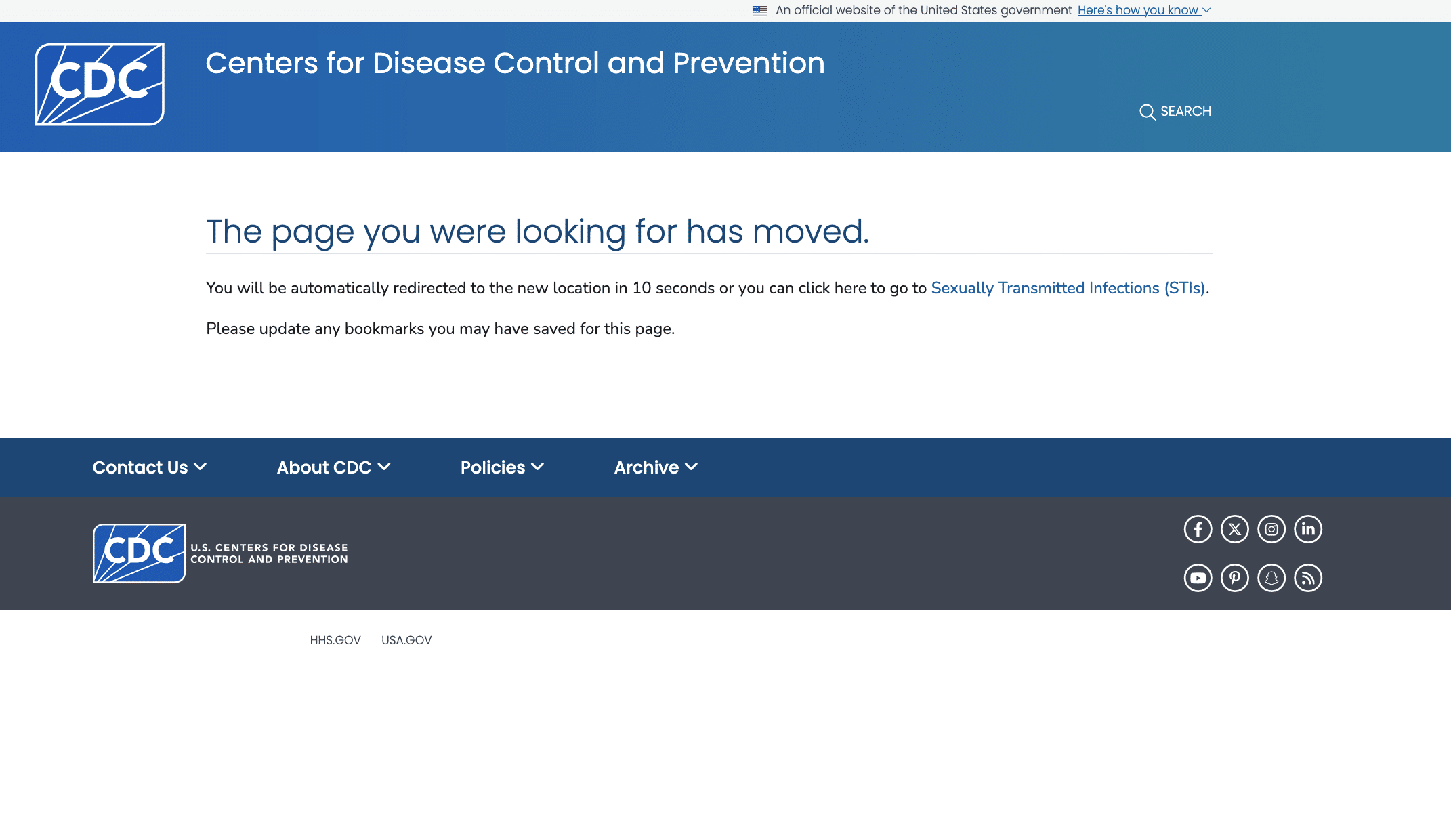
Journalists, researchers, and public health workers scrambled to save datasets from the Centers for Disease Control (CDC) on Friday as they disappeared from government websites. President Donald Trump’s administration ordered the agency to remove all references to “gender ideology,” a transphobic phrase asserting gender identity is forced upon people.
CDC staff were told the entire website would be shut down if that mandate wasn’t accomplished by 5 p.m. Eastern time on Jan. 31. Among the pages currently down are the CDC’s Social Vulnerability Index and another CDC page on “Efforts to Address Racism as a Fundamental Driver of Health Disparities,” last publicly archived on Tuesday. The page about transgender and gender-diverse persons was also taken down and now redirects to the Sexually Transmitted Infections page. HIV content was also temporarily removed.
“This data belongs to all of us,” said Nsikan Akpan, the managing editor for Think Global Health. “We’ve already paid for this data, so taking it away, in some way, is robbing people of the information that they pay for in order to be informed and also to live.”
The erasure of data on trans and gender-diverse people reflects the Trump administration’s anti-trans party line. And while the data may be restored, their current loss and any likely revision impacts journalists, and more importantly, the communities they serve, across their beats.
“All these things could be back up online next week,” Akpan said. “But … a lot of them are being scrubbed of essential information and essential details. The people that are associated with these labels that they’re scrubbing still exist.”
President Trump already signed two executive orders looking to further push trans and gender-diverse people to society’s margins: Last week, he declared the U.S. will only recognize “male” and “female”, and he signed another order Tuesday defunding gender-affirming care for youth. The erasure of trans and gender-diverse people is epitomized in the burgeoning removal of the “TQIA+” on state department websites.
Related: Legacy media helped create this anti-trans moment. Now they’re reporting on it.
Beyond this targeting, though, there’s a “whole ecosystem of academic work, data work, policy work enabled by this data,” said Kae Petrin, the volunteer interim executive director at the Trans Journalists Association. “That can have implications in a lot more series and on a lot more beats than initially realized.”
Deborah Blum, director of the Knight Science Journalism program at the Massachusetts Institute of Technology, said journalism now needs to be “looking at where the weight of the evidence lies,” she said. “And in this case, the weight of the evidence is telling us that we’re in big trouble.”
One likely change to data that returns to the CDC site may be survey labels switching solely to XY sex categories. That means results premised on gender diversity will no longer make sense, she added, so double-checking and recontextualizing data will become even more imperative to further public health reporting.
“It [the data] could come back up, but it could be meaningless,” Blum said. “It’s important for researchers and also in my case, science journalists, to be aware of that … We need to act from the beginning as if what the government is telling us is not necessarily valid.”
The U.S. Census Bureau website was temporarily down and has since been restored, but data on sexual orientation and gender identity was removed.
The data loss is also occurring during a federal health communications pause (slated to end on Feb. 1), meaning some data on the CDC about respiratory virus and COVID-19 levels in the U.S. — including bird flu — have not been updated.
“By shutting down public health communications and purging the CDC of helpful data, the Trump administration is putting people across the United States at great risk,” said Timothy Karr, a spokesperson with media advocacy group Free Press, via email.
“Trump … seems more concerned about safeguarding himself from the sort of accountability and fact-checking that often results when you provide reporters access to the reams of essential medical data kept by this important agency.”
Blum suggested journalists continue to archive and reference archives of trusted pages, which will be “historic information.”
“In a few years, that’s gonna be out-of-date information,” she said. “But at least we’ll have some kind of baseline so that if reality reinvades federal information, we’ll be able to check it against what we knew before.”
During the first Trump administration, collection of civil rights data was sharply rolled back. So archiving can be crucial, because data loss reverberates throughout society.
Petrin underscored these datasets have been used to make decisions about who gets funding for programs, which areas are under-resourced, and more.
“One of the ways that journalists can check, ‘Is the government making evidence-based policy decisions?’ is to go look at the same data the government’s purporting to use for those decisions,” they said. “A bunch of your sources might be losing their ability to do certain types of research. Then you also have the barrier to the information and the … decreasing quality of the information.”
There have already been efforts from researchers to preserve the pre-Trump data baseline. Researchers at the Harvard T.H. Chan School of Public Health spent Friday in a data preservation marathon seeking to catalogue as much CDC data on health equity as possible, which they soon hope to make accessible publicly through repositories like the Harvard Dataverse.
Longtime science journalist Maggie Koerth created a Google form to connect journalists, scientists, and anyone who has downloaded CDC datasets with folks looking for them. You can share a dataset here.
The Journalist’s Resource also compiled a list of ways to begin archiving datasets:
- Save the websites to the Wayback Machine. The Wayback Machine has an extension for internet browsers and is available as a mobile app for both iPhone and Android. You can install those via the left-hand panel of the website’s homepage.
- To find missing websites, type in their URL into the Wayback Machine search bar.
- You can preemptively suggest federal websites and content that end in .gov, .mil and .com to the End of Term Web Archive.
- You can suggest federal climate and environmental databases to the Environmental Data and Governance Initiative.
- You can suggest databases to The Data Liberation Project, which is run by MuckRock and Big Local News.
The move to strip trans and gender-diverse people from the nation’s public health and science data — along with minimizing other marginalized groups — also relies on exclusionary and harmful legacy media coverage. In the past, coverage from legacy media like the New York Times has been similarly used to justify anti-trans legislation, which has been growing year over year.
“The trans community is part of who we are,” Blum said. “This administration is tending to pick off what they see as the most vulnerable, least powerful groups, so you start there [with data revision], but that doesn’t mean you stop there … You can sit around and say, ‘Well, that’s not my problem, but it is your problem.’”
Petrin added that the data overhaul opens up questions about accountability journalism looking at data privacy, given the administration’s explicit anti-trans stance: “We collected a lot of information, and how is it now going to be used?”
And now more than ever, Petrin said, it’s crucial for cis journalists to invest time and energy into learning how to report on trans communities accurately.
“Often, if there is a trans reporter in a traditional newsroom, they’re the only person on their beat in that newsroom, if not the only person who is openly trans, you know, in, in that entire workplace,” they said. “And so a lot gets put on them, especially in times like this where everything that we are reporting on is so personally upsetting.”
Proper reporting can look like figuring out whether the response to executive orders is grounded in preemptive compliance, an existing dataset, or some new metric, Petrin added. It also looks like not deferring to jargon without context and taking the time to research language in anti-trans bills before recirculating it in stories.
Journalists write for the communities they serve, and that includes everyone impacted by public policy, especially those at the margins. To report accurately and fairly, journalists must be clear about rhetoric, policies, and actions that seek to erase trans people from public life.
James Salanga is the co-director of The Objective and the podcast producer for The Sick Times.
This piece was edited by Gabe Schneider. Copy edits by Omar Rashad.
We depend on your donation. Yes, you...
With your small-dollar donation, we pay our writers, our fact checkers, our insurance broker, our web host, and a ton of other services we need to keep the lights on.
But we need your help. We can’t pay our writers what we believe their stories should be worth and we can’t afford to pay ourselves a full-time salary. Not because we don’t want to, but because we still need a lot more support to turn The Objective into a sustainable newsroom.
We don’t want to rely on advertising to make our stories happen — we want our work to be driven by readers like you validating the stories we publish are worth the effort we spend on them.
Consider supporting our work with a tax-deductable donation.

James Salanga,
Editorial Director
Related Articles
U.S. investment in international reporting is shrinking, taking international journalists’ opportunities with it
As Donald Trump wins more attention from news media, one loser has often been international reporting — despite the growing imperative for American readers to have a more expansive view of their place in an increasingly interconnected world.

Hundreds of journalists demand USA Today Co. end Palantir partnership
Nearly 800 journalists at USA Today Co. papers signed a statement calling for the company to end its newly-announced partnership with software company Palantir, whose products have been used by the U.S. government to support immigration raids.
Despite COVID-19, disabled reporters say disability is still inconsistently prioritized in news
The onset of the COVID-19 pandemic saw remote and hybrid work arrangements grow and a greater interest in disability reporting. But six years later, disabled reporters say there wasn’t a full-scale reckoning with disability in newsroom coverage and culture.