
Semafor’s forum on media trust forum doesn’t substantively address racial disparities
Semafor’s recent media summit had many ideas about how to restore trust – but not much discussion about how they track back to racial inequities.
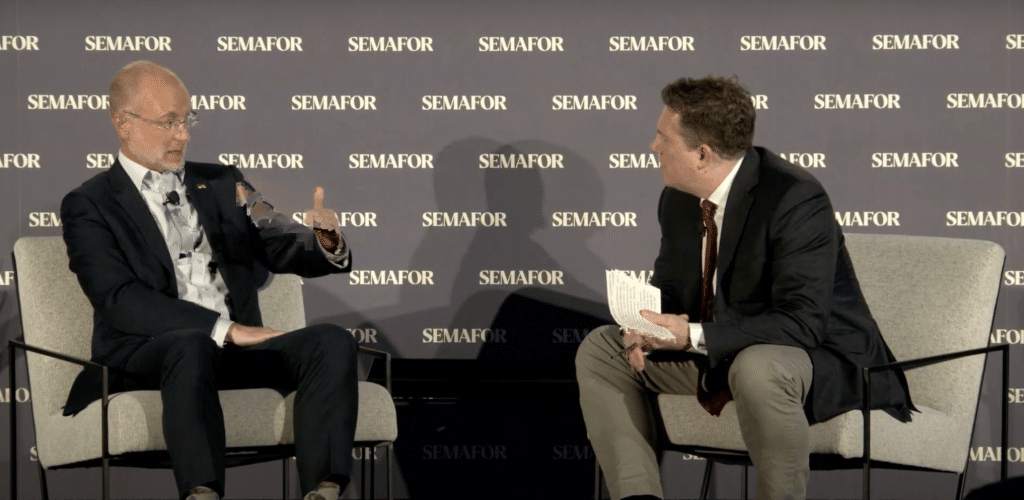
Late last month, Semafor hosted an event that, per the description, brought together “the brightest minds in publishing, journalism, media, and investing.” The “Innovating to Restore Trust in News” summit invited 11 journalists, journalism executives, and leaders from media-adjacent organizations.
The interviews, primarily hosted by Semafor editor-in-chief Ben Smith and Semafor’s media editor Max Tani, were brief and centered on how American’s trust in national media has plummeted and how Republican trust in mass media has plummeted.
The idea for the summit was, as Semafor co-founder Justin Smith noted, a response to Jeff Bezos is radically changing the opinion section at The Washington Post, which he found puzzling as “Jeff Bezos is probably one of the greatest living entrepreneurs in the world.”
And so, he said, Semafor decided to bring together “a broad and high level array of leaders from across the ideological spectrum” to tackle some
At the summit, there were as many white British media types as people of color. And notably missing were questions and answers that offered any analysis of how the media ecosystem in this country was built on racial exclusion — and how that may impact trust in media from Republicans, Democrats, and Americans at large.
The absence of that discussion is topical: Just days before the event, MSNBC canceled the weekend and primetime slots for their non-white hosts.
The questions missing from the summit are also not new. In 1968, The Kerner Commission, established by President Lyndon B. Johnson, released a report on the discrepancies between what black audiences see and what’s written about. Or as they put it: “a significant imbalance between what actually happened in our cities and what the newspaper, radio, and television coverage of the riots told us happened.” According to the Pew Research Center in 2023, more than 50 years later, this still holds: About two-thirds of black adults say news about black people is more negative than about other groups.
The only “significant” discussion on race came when Ben Smith interviewed Brendan Carr, the chairman of the Federal Communications Commission, which has broad authority over media policy in the U.S. Even then, Smith didn’t challenge Carr’s perspective about President Trump’s desire to dismantle diversity, equity, and inclusion programs.
“Your position is a private company is engaged in discrimination based on race, the federal government should have nothing to say about it?” Carr asked Smith.
“Of course not,” Smith replied.
Carr’s statement, as Smith did not point out, is a misrepresentation of the facts. President Trump’s attacks on diversity, equity, and inclusion are built on tearing down programs first established by President John F. Kennedy aiming to make our government more representative and less disproportionately white. To be specific, one of Trump’s recent executive orders terminates Executive Order No. 11246 from 1965, which establishes that the policy of the federal government is “to prohibit discrimination in employment because of race, creed, color, or national origin.” Trump has extended the desire to dismantle similar programs within private companies as well.
In the 1960’s, these policies were opposed prominently by at least one group: segregationists. Now it’s being opposed and dismantled by Trump and his allies.
Instead of refocusing on the harm of Trump’s policies and false media narratives, the conversations relied on broader generalizations about trust, divorced from discussion about race and power and dancing around issues that have haunted the American press since newspapers sold fugitive slave advertisements.
Not even two months in, the second Trump administration has already dismantled much of the employment infrastructure meant to desegregate the government, removed access to critical datasets related to trans healthcare and Long COVID, and eliminated funding to USAID programs that provide emergency food supplies globally in regions facing starvation.
When asked whether Washington is “freaking out too much about Trump,” Emma Tucker, editor of the Wall Street Journal, agreed.
She added: “A little bit. Perhaps a little bit too much … it’s too early to say whether the meltdown is justified.”
We depend on your donation. Yes, you...
With your small-dollar donation, we pay our writers, our fact checkers, our insurance broker, our web host, and a ton of other services we need to keep the lights on.
But we need your help. We can’t pay our writers what we believe their stories should be worth and we can’t afford to pay ourselves a full-time salary. Not because we don’t want to, but because we still need a lot more support to turn The Objective into a sustainable newsroom.
We don’t want to rely on advertising to make our stories happen — we want our work to be driven by readers like you validating the stories we publish are worth the effort we spend on them.
Consider supporting our work with a tax-deductable donation.

James Salanga,
Editorial Director
Related Articles

McClatchy layoffs cause ‘end of an era’ for some Spanish-language papers
The latest round of layoffs from McClatchy eliminated editorial staff at two Spanish-language papers, Vida en el Valle and El Nuevo Herald, along with the Spanish-speaking reporter at Tri-City Herald.
Trans News Network calls New York Times boycott for accurate trans coverage, following boycott from WAWOG
For years, reporters, media workers, and media accountability organizations have said the New York Times’ reporting and commentary is spreading harmful misinformation about trans people.
Governor Newsom adds to California’s legacy of stifling prison media access
Governor Gavin Newsom is the latest California governor to consistently veto bills seeking to expand media access and press freedom in prisons, following a precedent set by prior state governors.