
Journalism school faculty grapple with covering Palestine and genocide
U.S. journalism professors have taken a variety of approaches to teaching about covering Palestine, including not doing so at all.
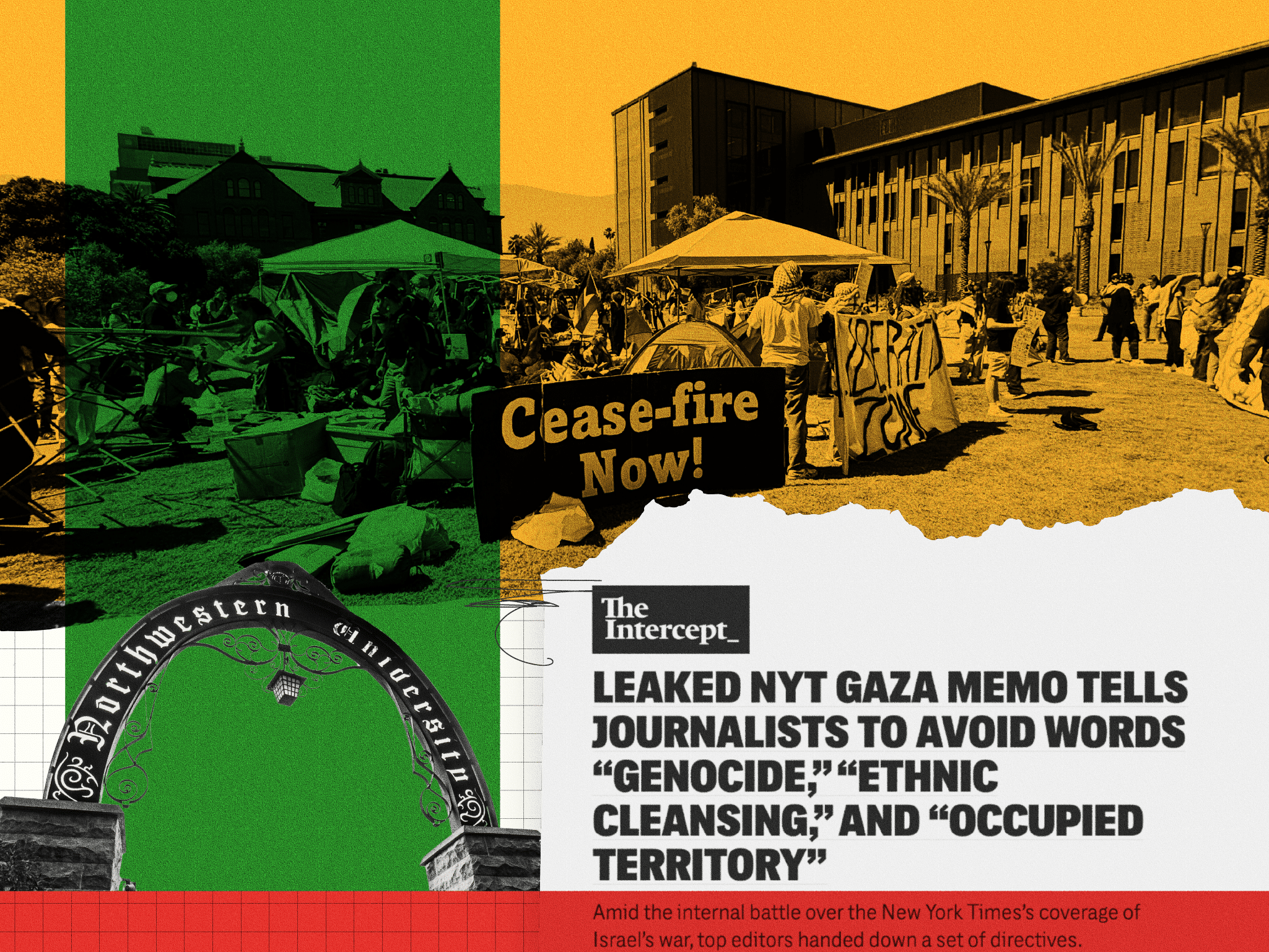
Around the U.S., professors have faced sharp backlash after supporting Palestinian human rights — including at journalism schools.
Dr. Steven Thrasher at Medill School of Journalism was among Northwestern University faculty who faced later-dropped charges for “obstructing a police officer” at an on-campus Palestine solidarity encampment in April 2024.
Yet the school’s inaugural Daniel H. Renberg Chair of Social Justice in Reporting said he was suspended from teaching in late June 2024, despite a faculty committee finding no grounds for the suspension. He was also denied tenure and had his employment set for termination later this year.
A Northwestern University spokesperson confirmed Thrasher’s bid for tenure was denied over email but did not share more details about why. The university also did not respond to additional request for clarification on the suspension timeline by time of publication.
Thrasher detailed his experience in a Literary Hub essay, calling it a “political hit job over my support for Palestine.”
Given this landscape, The Objective reached out to over 80 deans, directors, and professors at journalism schools around the U.S.
Those who shared spoke about their approaches to covering Palestine and Israel in class, word choice in news coverage, and the future of teaching Palestine coverage at U.S. journalism schools. Of the 58 journalism school deans or directors contacted, just one replied.
Over two years after Oct. 7, 2023, Israel has killed over 70,000 Palestinians. The death toll includes more than 249 journalists and media workers in Gaza, according to the Committee to Protect Journalists. The organization, a nonprofit that promotes worldwide press freedom, said “Israel has systematically destroyed media infrastructure in Gaza.”
Palestinians, human rights organizations, a United Nation commission and the International Association of Genocide Scholars have said Israel is committing genocide in Gaza. Human rights organizations like Amnesty International have also called out decades of Israeli apartheid in Palestine.
Schisms in teaching about Palestine at U.S. universities and journalism schools are reflected in news reporting. The New York Times, BBC, and CNN have faced internal and external backlash over reported pro-Israel coverage.
Teaching Palestine coverage in class
Thrasher knew he planned to cover “whatever happened after October 7” in his long-time course Sex and the American Empire, because “as a journalist and professor … I use elements from the news to talk to the theories that we’re discussing.”
In January 2025, he was cleared in an university investigation into his social media use and views of objectivity.
But in Thrasher’s absence, “Medill professors fear for their jobs when discussing Palestine, even in class,” former Daily Northwestern staffer Simon Carr wrote in a letter signed by Medill student journalists and alums protesting the university’s decisions.
“The University takes the tenure process very seriously and has adhered to the rules that govern that process,” a Northwestern University spokesperson said. “The University has full confidence in the recommendation and decision-making process of our Medill faculty and dean, respectively.”
The fear Carr expressed in the Daily Northwestern letter may have been reflected in the lack of accepted interviews with The Objective from U.S. journalism program deans and directors contacted through email.
Related: U.S. journalists face retaliation, censorship for supporting Palestinian human rights
Only one, Dr. Robin Johnson of the University of Idaho, accepted an interview.
Johnson prefaced the conversation by saying he was not giving any official statements from the University of Idaho and that his comments were from his own personal perspective.
In his media ethics class, Johnson said he has used “the war in Gaza” as an example of media coverage and what news organizations should or should not do.
“To me, you need to present that to students as a moral issue,” he said. “There are ways in which you can systematically go through and make a determination as to what you’re going to do as a journalist or as a news organization and be able to explain it and be transparent about it.”
Another approach is what Gregory Khalil called “empathetic objectivity” over email.
Khalil, a former adjunct associate professor at the Columbia Journalism School and a Palestinian-American, has publicly shared his journalism education approach on the topic with a former co-professor, Ari Goldman.
“The idea is to create a foundation for reporting by deeply understanding two elements: One, the perspectives of all parties involved, on their own terms. And two, the actual unvarnished facts,” Khalil said.
Khalil’s colleague Goldman also responded to The Objective via email.
“I am an American Jew and a Zionist,” he said. “Over the past seven years, I’ve taught with a Palestinian-American who is an anti-Zionist. … In class, we have worked to state our perspective while respecting the point-of-view of the other.”
“We’re not using accurate words to describe what’s happening”
For Nausheen Husain, an assistant professor at Syracuse University’s Newhouse School of Public Communications, there is one thing that is clear about journalism right now: “We’re not using accurate words to describe what’s happening, and that’s against every premise of journalism I’ve learned.”
To her students, she has talked about passive voice and word choice in framing.
“That we are calling it a war in journalism almost seems like wishful thinking, like, ‘If it’s a war, we can kind of stomach it more,’” she said. “There are not two equal sides … There’s so many reasons why it feels a little bit bizarre to call it a war.”
When asked if there are inequities in U.S. news coverage of Palestine and Israel, Khalil’s colleague Goldman said “of course,” later adding, “Some days we get it wrong, but I think we mostly get it right.”
Media analyses and investigations have found some mainstream U.S. media outlets have largely not platformed Palestinian voices, or in the case of the New York Times, restricted words including “genocide,” “Palestine”, and “occupied territory” in coverage.
Related: Q&A: Yousef Munayyer on Western media’s complicity in Israel’s occupation of Palestine
Johnson, at the University of Idaho, said news organizations “lose a little bit of credibility” if they don’t say “why they’re not using a term like genocide … when other organizations are, or a report has come out that said that it is.”
He added that he could understand why the term genocide “for a group of people would be one in which they hesitate to use, especially in this context of Israel.”
“But,” Johnson added, “there’s also the literal definition of genocide, and if one were to look at the actions of the Israeli government and what they’re doing in Gaza and it meets that definition, and if it meets that definition by your own criteria, then you should call it genocide. Are there other terms that could be used? Of course.”
On the topic of why media outlets at times use different terms to describe the reality in Gaza, Khalil said, “‘Genocide’ is the new climate change.”
“The only people denying its application to Gaza are ignorant, triggered, or complicit,” he said. “Ironically, the failing to name what is now obvious to so many speaks to the fact of genocide: The first step towards genocide is denying the humanity of the targeted group.”
What is the future of journalism school curriculum?
University of Missouri School of Journalism associate professor Cristina Mislán said listening to Palestinians is foremost.
“To not listen to the stories of people who have lost their lives, whether they’re journalists or not … to do that is to be complicit in the genocide,” Mislán said.
For journalism schools to counteract inequities in news coverage around Israel and Palestine, she suggested “it would help if there wasn’t only one or two faculty who are willing to have these conversations in class.”
Khalil, the former Columbia adjunct professor, spoke similarly: “It should be taught,” he said via email. “How can we expect our media or our government to successfully broach fraught issues like Israel/Palestine if we can’t explore them in our educational settings?”
He also said facts, international law, and Palestinian perspectives are “often minimized or mischaracterized.”
Mislán emphasized the importance of journalism education including a grounding in the humanities, especially when it has a professional focus.
“It’s just a lack of really prioritizing critical thinking skills, learning history,” she said.
Thrasher pointed to the utility of learning journalism through other avenues outside of universities, citing author Lewis Raven Wallace’s work, City Bureau, and former long-time Washington Post columnist Karen Attiah’s work.
“It’s important and it takes a lifetime of skill to work at, but it’s not that complicated to begin somebody on the journey of journalism,” Thrasher said. “One of the most important parts of it, though, is grounding yourself, and the schools are not grounded in values … they’re grounded in PR. They’re grounded in being quiet about things that are deemed to be too controversial, and that doesn’t work for journalism.”
Update, Jan. 27: This story was updated to clarify the title used by Gregory Khalil.
Aaron Stigile is a journalist and storyteller whose work has appeared in Carnegie-Knight News21, Migrant Insider, the Times of San Diego, Stocktonia, Idaho Education News and more.
This story was edited by James Salanga. Copy edits by Jen Ramos Eisen.
We depend on your donation. Yes, you...
With your small-dollar donation, we pay our writers, our fact checkers, our insurance broker, our web host, and a ton of other services we need to keep the lights on.
But we need your help. We can’t pay our writers what we believe their stories should be worth and we can’t afford to pay ourselves a full-time salary. Not because we don’t want to, but because we still need a lot more support to turn The Objective into a sustainable newsroom.
We don’t want to rely on advertising to make our stories happen — we want our work to be driven by readers like you validating the stories we publish are worth the effort we spend on them.
Consider supporting our work with a tax-deductable donation.

James Salanga,
Editorial Director
Related Articles
Fort Worth Report becomes Texas’s sixth unionized newsroom
The Fort Worth Reporters Guild voted 11-1 to unionize, and will begin working with management on collective bargaining for a contract.
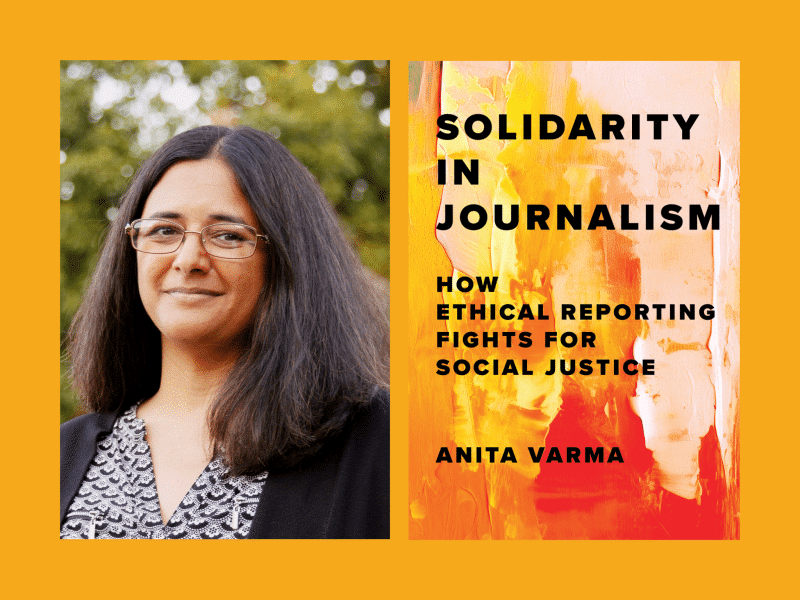
Q&A: ‘All journalism advocates’: Anita Varma on solidarity journalism
Journalism professor Anita Varma on her forthcoming book, Solidarity in Journalism: How Ethical Reporting Fights for Social Justice, the limits of the advocacy vs. journalism conversation, and more.
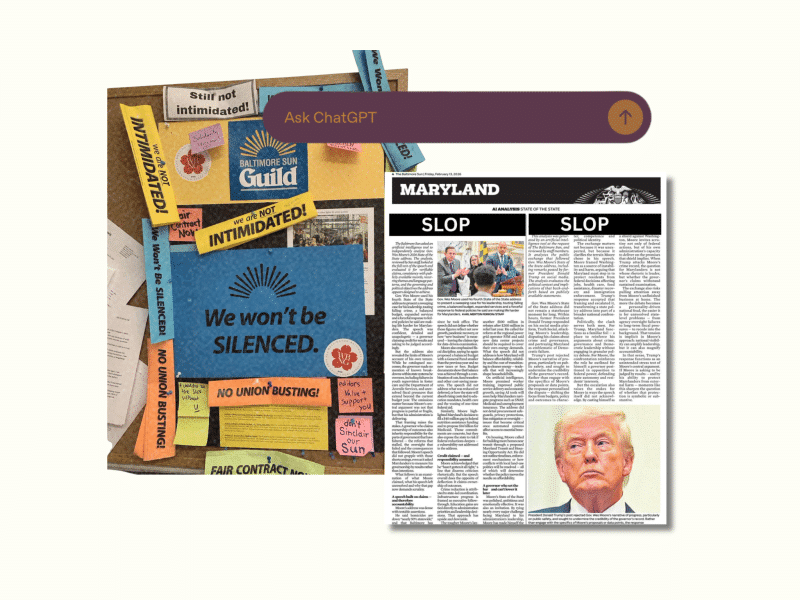
When The Baltimore Sun can’t get journalists to lower their standards, it turns to generative AI
The Baltimore Sun ”once again disparaged … human reporters and their work” by publishing two AI-generated political analyses, the newspaper’s union said.