
Reporting on ICE killings follows a long history of normalizing state violence
Mainstream coverage of Renee Good, Alex Pretti, and Keith Porter’s killings shows how anti-Black news standards desensitize communities to state violence.
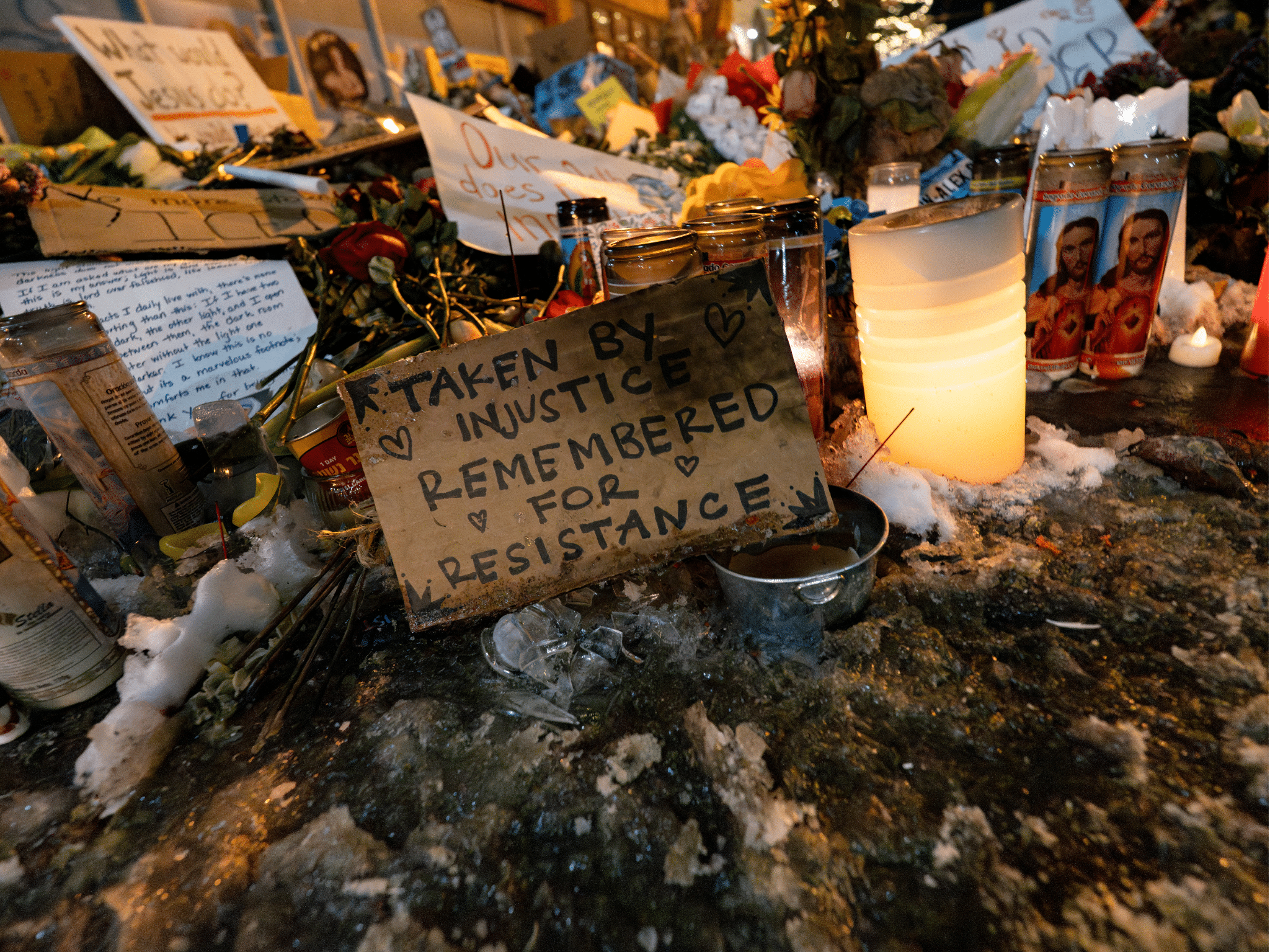
In January, federal agents in Minneapolis publicly executed Renee Good and Alex Pretti, inciting growing U.S. and global anxiety around escalating fascism and authoritarianism in the U.S. government. Firearms trainer and Immigrations and Customs Enforcement agent Jonathan Ross shot and killed 37-year-old lesbian poet and mother Good on January 7 during “Operation Metro Surge” in Minneapolis. Less than three weeks later, U.S. Department of Veterans Affairs ICU nurse Pretti, also 37, was shot and killed by U.S. Custom and Border Patrol agents Jesus Ochoa and Raymundo Gutierrez. Ochoa has been employed by CBP since 2018, while Gutierrez joined in 2014.
It wasn’t until after the murders of Good and Pretti — both white citizens — that people across the country heard the name Keith Porter, Jr., a Black 43-year-old father of two who was shot and killed by off-duty ICE officer Brian Palacios on New Year’s Eve in Los Angeles. Palacios has been accused of making racist remarks about Black people and Latinos, according to court records. Further details of Palacios’ identity and employment for ICE are unknown.
Although the officers involved in these shootings have had years of experience working in immigration raids, some mainstream media outlets and public discourse have repeated the narrative that these killings are the result of “poorly trained” and “inexperienced” agents, a trend that Interrupting Criminalization journalism fellow and independent journalist Lewis Raven Wallace says U.S. newsrooms have long perpetuated around policing — one that removes responsibility from police and continues the cycle of state violence.
“Mainstream media does a lot of unspoken work in normalizing certain kinds of death and making other kinds of death exceptional and remarkable,” Wallace said. “Deaths caused by poverty, hunger, ICE detention … these have been normalized by mainstream media, while Alex Pretti and Renee Good in particular have been treated by the media as exceptional deaths.”
So while Wallace acknowledges there are some ways in which Good and Pretti’s deaths are exceptional, he says the way they’ve largely been reported on “obscures the way ICE has been operating as a death machine in communities already.” Journalists, researchers, and media justice organizers say this approach is rooted in journalism norms linked to the anti-Black foundation of U.S. migration and media systems, and say more funding and interest in journalism that rejects those norms is needed.
Related: Reckoning with the Federal Communications Commission’s history of structural racism
Harmful norms around reporting on ICE killings are intertwined with violent history of U.S. migration
The U.S. government has forcibly removed around 8.5 million immigrants through deportation orders issued from 1895 to now, Diné cartographer Mariah Tso and historian Dr. Kelly Lytle Hernández found in their project Mapping Deportations. The two mapped the history of immigration patrol and deportations across the U.S. since 1970, and while ICE is not explicitly mentioned in their timeline, deportation orders have clearly increased since the department’s founding in 2003.
In an October 2025 interview on Red Nation, both Tso and Lytle Hernández said their research unmasks the foundational setup and continuity of white supremacy and how it shows up in immigration control today.
“The migration story is predicated upon native elimination and chattel slavery,” Lytle Hernández said. “That’s what we describe as the foundations of immigration patrol.”
Several organizations have also articulated how these throughlines are echoed in the development of U.S. journalism and media systems. Among them is Media 2070, launched in 2020, which advocates for media reparations to address journalism’s historical and ongoing harm to Black communities, and its team has argued that the industry doesn’t financially benefit from an end to ICE, human trafficking, or U.S. policing.
“Racism’s been good for business for too many big media companies for far too long,” the Media 2070 authors wrote in their launch essay. “Large media companies have little incentive to advance or achieve racial equity in their operations since it would force them to dismantle the white-racial hierarchy that exists in their own newsrooms … This is why media reparations are crucial.”
Related: Q&A: Media reparations with Collette Watson
In 2016, then-CBS chairman and CEO Les Moonves openly rooted for Trump’s racist presidential campaign, saying, “It may not be good for America, but it’s damn good for CBS. The money’s rolling in … This is going to be a very good year for us. It’s a terrible thing to say, but bring it, Donald. Go ahead. Keep going.” (Moonves later departed CBS in 2018 after being accused of sexual misconduct.)
While Pretti and Good received global news attention, that same investigative and critical news focus has not been afforded to non-white people, particularly Black people, killed by police throughout history — which media scholars like Joseph Torres, part of the Media 2070 team, say is linked to the “foundational” anti-Blackness in the development of the U.S. and its media systems.
“The United States is a settler-colonial nation,” Torres said. “When it comes to the enslavement of Black folks and the westward expansion of the genocide of indigenous people in this country, these hierarchies were necessary for the political project of America. So, like anything, you need a narrative … and when you dehumanize people, it results in policies.”
Before the Thirteenth Amendment, media companies profited and participated in slavery, running advertisements for slave owners, and even acted as brokers for transactions. Printers and newspapers acted as the public space for human trafficking transactions, with advertisements often instructing people to “inquire at the printer.”
Major media institutions have also demanded “objectivity” from their workers — an industry norm that journalists and media scholars have critiqued as a construct upholding systemic racism and white supremacy, from Ida B. Wells, to the Kerner Commission in the 1960s, to the media sociologists of the 1990s, and into today.
“Black journalists have long been accused of bias and the inability to ‘objectively’ cover their own communities,” the Media 2070 team wrote. “White news-media companies have sought to protect a white-racial hierarchy by demanding objectivity that by default centers whiteness.”
Mainstream and corporatized media’s anti-Blackness extends to the systemic oppression of other marginalized groups, particularly non-white immigrants and migrants who have historically been depicted as “aliens” and violent criminals, while anyone who opposes this repression is painted as “domestic terrorists.”
Both Good and Pretti were labeled as domestic terrorists by the Trump administration, a tactic also employed in the Stop Cop City movement in Atlanta, when dozens of protesters were arrested and charged with racketeering and domestic terrorism charges. Police and the Georgia attorney general claimed twenty-six-year-old queer climate activist Tortuguita, killed by Georgia State Patrol officers in an Atlanta park in January 2023, was a violent police protester with little to no challenge from mainstream and legacy media.
What’s needed to shift norms around reporting on ICE killings?
As immigration raids, escalating attacks on trans people’s rights, and targeting of press freedom continue throughout the U.S. Wallace has been among the journalists who have also questioned the practice of showing both sides of an issue as the only path to fair, objective reporting, or “both-sides-ism.”
They authored their first book, The View from Somewhere, after being fired from American Public Media for, as they put it, “publicly talking about the problems of objectivity amidst rising authoritarianism.”
“The mythology of ‘both sides’ becomes this excuse to uphold what is clearly a very toxic status quo,” they said. “Because now we’re ensconced in some kind of national debate about whether or not people should be getting dragged off our streets by masked federal agents. That shouldn’t be a discussion, if we want to continue to live in a democracy.”
Author and organizer Alicia Bell said there’s also a double standard around how local and national newsrooms are perceived.
“I’ve heard from several independent small newsrooms about the ways in which they have been categorized as advocates or activists when they report on community resistance or report on ICE happenings,” Bell said. “That assumption of advocacy or activism is placed on larger newsrooms and is certainly not placed on national or international newsrooms when they’re reporting on these same topics.”
In 2024, Borealis Philanthropy released a report looking at the steps to a thriving journalism ecosystem for Black, brown, and Indigenous communities and found that between 2009 and 2015, just 6% of the grants invested in the U.S. news and information ecosystem went to efforts serving non-white racial and ethnic groups.
Related: New Borealis report: Prioritize funding BIPOC media, not AI
There have been additional local efforts to invest in newsrooms serving those communities: New York City policy passed in 2020 directs city agencies to invest at least 50% of their advertising budgets into community and ethnic media, and since the legislation’s inception, at least $72 billion has gone to those outlets.
Still, Bell, who also leads the Racial Equity in Journalism Fund at Borealis Philanthropy, said movement journalism and community reporting are currently under-resourced and underfunded — despite the fact that they often pose an alternative to other normalized industry habits like parachute journalism.
The practice, in which journalists, often with little prior local knowledge, are dispatched into an unfamiliar area to cover breaking news, disasters, or conflicts before quickly leaving after initial reporting, has been largely adopted across national newsrooms. But Bell says this lends more to an extraction model and, oftentimes, a context collapse in the resulting coverage, with important details a local reporter might be familiar with are left out of the piece due to the dispatch reporter’s lack of knowledge.
“There’s this perception from larger newsrooms that they can … helicopter in and cover something better than some local organizations,” Bell said. “Instead of creating agreements that would be economically beneficial for local organizations, they use their resources to deploy someone or a team to a place. That continues to exacerbate the economic harm and also impacts how deep the reporting is. That’s something that both funders and large-scale newsrooms are accountable for.”
Editor’s note: The Objective receives philanthropic funding from Borealis Philanthropy. Lewis Raven Wallace is an advisory board member of The Objective. Neither Wallace nor a member of Borealis reviewed this story prior to publication.
Aja Arnold is a journalist and author based in Atlanta with over nine years of experience in investigative journalism, feature writing, cultural analysis, music critique, and more. She is the founder and publisher of Atlanta-based outlet Mainline.
This piece was edited by James Salanga. Copy edits by Marlee Baldridge.
We depend on your donation. Yes, you...
With your small-dollar donation, we pay our writers, our fact checkers, our insurance broker, our web host, and a ton of other services we need to keep the lights on.
But we need your help. We can’t pay our writers what we believe their stories should be worth and we can’t afford to pay ourselves a full-time salary. Not because we don’t want to, but because we still need a lot more support to turn The Objective into a sustainable newsroom.
We don’t want to rely on advertising to make our stories happen — we want our work to be driven by readers like you validating the stories we publish are worth the effort we spend on them.
Consider supporting our work with a tax-deductable donation.

James Salanga,
Editorial Director
Related Articles

Self Magazine shuttering means one less publication taking disability seriously
The almost 50-year-old publication was a lifeline for chronically ill readers.

Equalpride lays off staff at Them after purchasing the publication from Condé Nast
National resources to cover queer and trans news are shrinking as the number of anti-trans bills being considered across the U.S. in 2026 outpaces last year.

Ravenous is the newest publication in a growing menu of food journalism co-ops
As corporate media instability and “pivot to video” shift the landscape of culture reporting, new worker-run food publications like Ravenous feed cravings for long-form writing.