High school students of various ethnicities sit around a table, discussing. A blue filter is placed over the photo excepting the people, who are highlighted with iconography outlined in light blue and orange including lightbulbs, houses, and checkmarks.

Students plugging local news gaps isn’t sustainable for students, communities, or journalism

Carla Murphy on how expecting college students to “fill the gap” in local news without addressing institutional power may reify inequities. 

A collage of five images placed atop a faded, yellowed newspaper background. A scattered image of a turned-off iPhone sits center and is surrounded by four images: a block of hashtags stating #MeToo, with the central #MeToo bolded for emphasis; a photo of graffiti at Black Lives Matter Plaza that states “not enough!”; a sticker that reads Trans Rights Are Human Rights; and a negative of a sticker on a stop sign that reads Defund The Police #BlackLivesMatter.
Movement journalism can transform narratives

When we accept that we are powerless, we foreclose our own radical potential. Stories can change that.

Native and non-Native media practitioners sit in a circle discussing the roots of American democracy in Indigenous tradition. The image is stylized with a blue filter applied over all but the people, and iconography in light blue and orange outlines depicts a boat on a body of water, along with thought bubbles rising out of people's heads.
Looking to earth and ecology to revive local news

Jennifer Brandel on the civic potential of journalism that reorients toward the land.

A map of the so-called United States filled in with blue and split around the Mason-Dixon line with a news clipping. The Southern states are rendered with a glitching computer-style effect.
The national media has ignored the South. Now the South’s problems are the nation’s

Oral histories from Southern journalists and authors about the news industry’s geographical bias.

A Black person holds a newspaper emblazoned with the Movement Media Alliance logo.
Journalism appropriately covering this political moment needs funding

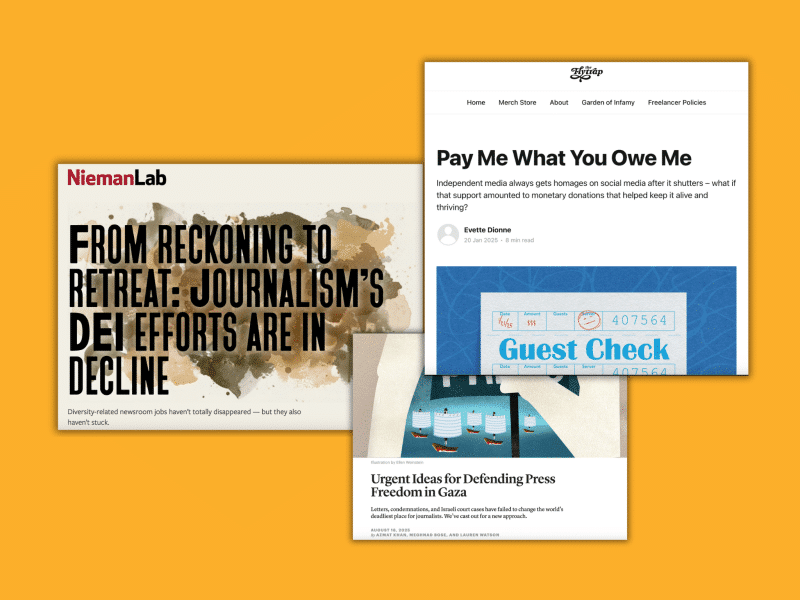
As efforts to increase newsroom diversity grind to a halt or are reversed, marginalized journalists face new obstacles amid industry cutbacks and right-wing pressure.

On graph paper background, three headshots styled as stickers and accompanied by scribbled stars surround the words "goodbye, Teen Vogue." From left to right: Aiyana Ishmael, a Black woman with wavy hair over one shoulder wearing a green dress with her hands on her hips. Rainesford Stauffer, a white woman smiling slightly at the camera with a black turtleneck. Alma Avalle, a white woman with bangs and glasses wearing a blazer over a shirt.
Teen Vogue’s loss is an irreplaceable void in teen media

Between fandoms and youth activists, people don’t take teenage girls seriously — but Teen Vogue did.

Signage in West Baltimore directing to the Penn North metro station, the area where all the mass overdoses happened. Accompanying signage notes that the area is under video surveillance.
Baltimore media outlets may be exacerbating an already unprecedented overdose crisis

Experts say stigmatizing language and hasty coverage in Baltimore has spread misinformation and steered a city struggling with the overdose crisis away from public health response and toward fear-driven police crackdowns.

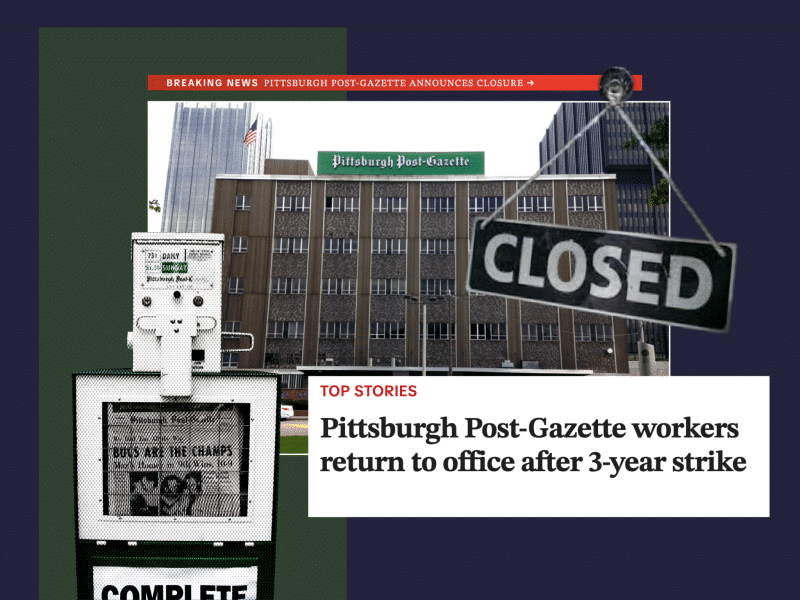
The sign outside the Pittsburgh Post-Gazette office building.
NewsGuild’s longest strike ends after historic court decision

The U.S. 3rd Circuit Court of Appeals found the Pittsburgh Post-Gazette violated the National Labor Relations Act on several counts. The Pittsburgh Post-Gazette newsroom worker strike is the longest continuing work stoppage in the U.S.

The Teen Vogue logo on a black and white gradient, with the word Politics in the site's header font written under and crossed out.
Vogue guts Teen Vogue Politics team

Vogue.com is merging with Teen Vogue, eliminating the youth-focused publication’s politics section. Four Condé Union officers have also been fired after questioning the layoffs.

A bustling scene of a city, with people moving up and down various rooms and buildings. One person carries a sign that says free speech; at the bottom of the page is a newsstand that reads "Democracy Dies in Darkness."
A letter from the Civic Media Magazine editors

Introducing the digital version of the Civic Media Magazine: The stories here show what’s possible when we reimagine local news not just as something to consume, but as a tool for community action.